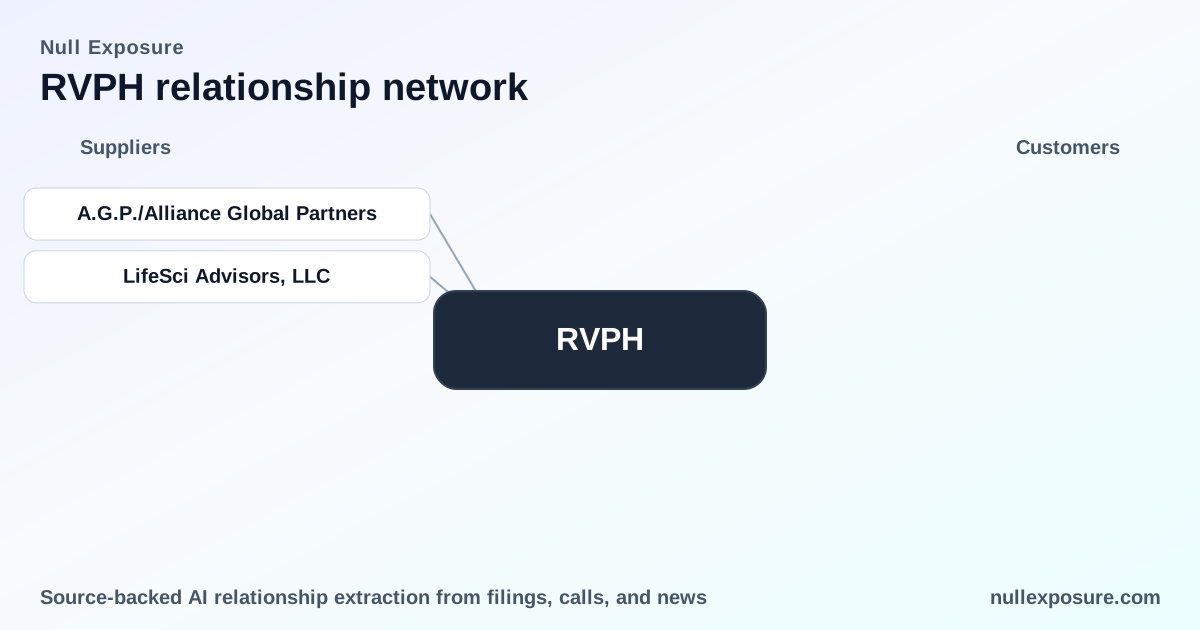
Reviva Pharmaceuticals (RVPH): Supplier relationships and what they reveal about the company's operating posture
Reviva Pharmaceuticals is a clinical-stage biotech that monetizes by advancing proprietary CNS drug candidates—most prominently brilaroxazine (RP5063)—through clinical development and financing events until partnering or commercialization. Revenue is currently non-existent; value creation is driven by clinical milestones, intellectual property, and periodic capital raises that fund trials and regulatory filings. For investors and operations partners, the supplier and advisory network around Reviva is a direct indicator of funding strategy, trial execution risk, and manufacturing dependency.
Explore deeper supplier intelligence on NullExposure: https://nullexposure.com/
The short list of counterparties everyone should know
This section covers every relationship in the supplied results. Each entry is concise and source-linked.
A.G.P. / Alliance Global Partners — placement agent for equity offerings
A.G.P./Alliance Global Partners has served repeatedly as sole placement agent for Reviva's equity financings, including public offerings announced in June 2025 and September 2025 and a registered direct offering in 2022. These engagements indicate Reviva uses boutique-capacity investment banks to access financing windows rather than large, long-term syndicates. (See GlobeNewswire press releases: June 26, 2025; September 18–19, 2025; September 6, 2022.)
LifeSci Advisors, LLC — investor relations and communications partner
LifeSci Advisors functions as Reviva’s investor relations and PR contact across multiple corporate disclosures and event announcements in 2025–2026, including financial results, regulatory updates, and presentation logistics. Their consistent presence in Reviva press materials signals an outsourced IR model that centralizes external messaging with a specialized healthcare communications firm. (See GlobeNewswire releases and related coverage in 2025–2026 and a Yahoo Finance note on patent news.)
What these relationships reveal about Reviva’s operating model
The composition and behavior of Reviva’s counterparties produce a clear operating blueprint: capital-intensive, externally executed, and globally scoped.
-
Contracting posture — short-term and transaction-driven. The company relies on placement agents for discrete equity raises rather than long-dated financing syndicates, consistent with the disclosed short-term financing arrangements and termination flexibility in contracts. This indicates a deliberate preference for modular capital raises tied to clinical milestones rather than rolling credit facilities.
-
Service orientation with limited internal scale. Reviva employs CROs, consultants, and IR firms for core functions, reflecting a lean internal headcount and a vendor-heavy model for R&D, regulatory filings, and communications. Outsourced investor relations through LifeSci and repeat placement work with A.G.P. underline this posture.
-
Manufacturing and supply criticality. The company does not own manufacturing facilities and depends on third-party contract manufacturers for GMP API production and drug substance. This creates single-source and process-risk exposure that is operationally material given the drug-development timetable.
-
Global clinical footprint. Clinical programs, including a global Phase 3 RECOVER-1 trial, span North America, EMEA and APAC, requiring multi-jurisdictional CRO coordination and counterparty reach in several regions.
-
Spend and scale profile. External R&D expense runs into the tens of millions annually, consistent with a spend band in the $10M–$100M range for clinical development. This scale requires recurring capital raises and disciplined working-capital management.
These are company-level signals; they do not tie any single constraint to a named counterparty unless documented explicitly.
Operational and investment implications
-
Capital dependency is the principal short-term risk. Reviva’s market capitalization and cash runway dynamics force recurring reliance on placement agents and public offerings for operating funding. The repeated use of A.G.P. for equity raises shows a repeatable channel but also concentration risk in financing execution.
-
Execution risk is concentrated in outsourced manufacturers and CROs. Regulatory review of third-party manufacturing practices and the potential for single-source disruption are critical operational risks that could delay NDA readiness or clinical timelines.
-
Communications consistency supports investor access but not financial insulation. Outsourced IR through LifeSci provides professional market-facing messaging and event coordination, which helps visibility during raises and regulatory milestones yet does not alter underlying cash burn or clinical risk.
-
Global trials increase complexity and cost. A Phase 3 global trial requires synchronized site performance across regions; the firm’s limited internal operating footprint heightens dependence on CRO competence and contract terms.
How to think about partner risk versus opportunity
-
Partners as leverage points: Repeat engagements with A.G.P. suggest an efficient route to market for capital, which is positive for execution speed when market windows are favorable. LifeSci’s role amplifies message discipline, an asset during fundraising and regulatory communications.
-
Upstream fragility: The lack of in-house manufacturing and the stated reliance on a limited number of suppliers create high-impact single points of failure for product availability. Investors should treat third-party manufacturing capability and contractual breadth as leading indicators of timeline risk.
-
Spend visibility matters: External R&D expenditures in the tens of millions per year imply further capital needs; the company’s ability to access equity markets through known placement agents will determine near-term dilution and trial continuity.
If you want a structured supplier risk brief or transaction map for Reviva, visit NullExposure: https://nullexposure.com/
Bottom line and recommended attention points for investors and operators
Reviva operates a classic clinical-stage biotech model: no product revenue, high burn for global Phase 3 development, outsourced execution, and serial equity financing. The company’s relationships with A.G.P. and LifeSci are not operational counterweights; they are execution enablers that reduce time-to-market but increase dependence on external counterparties for capital and communications. The most consequential risks for valuation are manufacturing concentration, trial execution across jurisdictions, and the firm’s recurring need to access public markets.
For actionable next steps: validate the company's manufacturing contracts and backup suppliers, review CRO performance metrics for RECOVER-1, and monitor upcoming financing announcements where A.G.P. is engaged. For a supplier-by-supplier risk scorecard or to map counterparties to contractual terms, return to NullExposure and request a tailored brief: https://nullexposure.com/
Explore our platform for more supplier intelligence and contract-level signals: https://nullexposure.com/