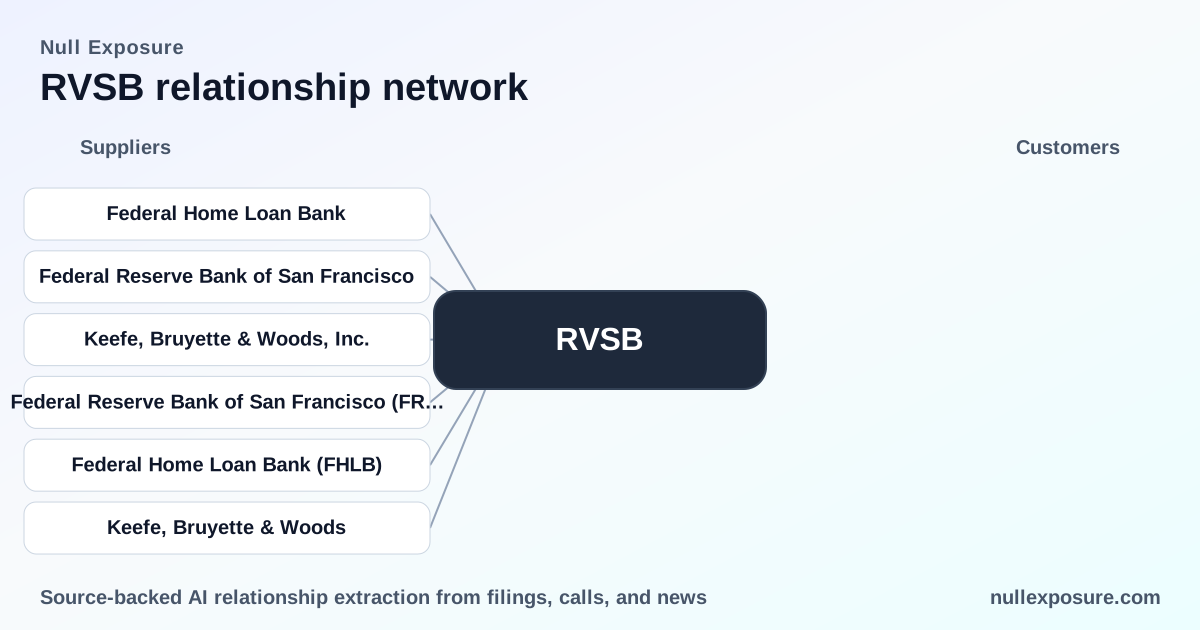
Riverview Bancorp (RVSB) — Supplier relationships that shape liquidity and capital actions
Riverview Bancorp operates as the holding company for Riverview Community Bank, generating net interest income and fee revenue by servicing small and medium-sized businesses and local consumers in the Pacific Northwest. The company monetizes through traditional regional banking activities—commercial lending, deposit taking, and targeted loan purchases—and it supplements balance-sheet liquidity through borrowings from central bank facilities and advances from the Federal Home Loan Bank, while outsourcing select execution tasks such as share repurchases to specialist broker-dealers. This structure leaves liquidity access and execution partners as material suppliers to the franchise economics.
Learn more about supplier risk and counterparty mapping at https://nullexposure.com/.
Operational and capital partners discussed below are not peripheral: they are the plumbing that sustains lendable funds, supports deposit stability, and enables shareholder return programs. Below I map the relationships that matter to investors and operators, summarize their roles in plain English, and cite the public disclosures that document them.
How Riverview funds growth and covers withdrawals
Riverview balances deposit funding with wholesale borrowings and secured advances. The bank leverages formal access to the Federal Home Loan Bank system and short-term borrowing capacity from the Federal Reserve Bank of San Francisco as primary liquidity conduits, enabling the bank to originate loans beyond core deposit growth and to meet episodic withdrawal needs. According to the FY2025 Form 10‑K, Riverview “relies upon advances from the FHLB and borrowings from the Federal Reserve Bank of San Francisco…to supplement its supply of lendable funds and to meet deposit withdrawal requirements.” This relationship is central to the bank’s liquidity playbook. (FY2025 10‑K)
Every supplier relationship that matters (concise, sourced)
-
Federal Home Loan Bank (FHLB): Riverview uses FHLB advances as a core source of wholesale funding and had $60.5 million in outstanding FHLB borrowings as of December 31, 2025. The FHLB functions as a credit source for member banks to support lending and liquidity. (Riverview FY2025 Form 10‑K; GlobeNewswire Jan 27, 2026)
-
Federal Reserve Bank of San Francisco (FRB): Riverview maintains a borrowing line with the FRB that contributes materially to available liquidity—$288.3 million of FRB capacity reported at December 31, 2025, and the FRB is explicitly cited as a backstop for withdrawal coverage and supplementary lendable funds. (Riverview FY2025 Form 10‑K; GlobeNewswire Jan 27, 2026)
-
Keefe, Bruyette & Woods, Inc. (KBW): Riverview engaged KBW to execute a Rule 10b5‑1 stock repurchase trading plan, granting KBW authority to repurchase shares on behalf of the company under the plan’s terms. The board approved a $4.0 million repurchase program and used KBW to facilitate structured execution. (Press coverage March 2026; The Globe and Mail/TradingView/Manila Times press releases)
What those relationships imply for investors
Riverview’s use of FHLB and FRB facilities is a deliberate liquidity architecture choice: it reduces funding concentration on volatile uninsured deposits and gives the bank optionality to expand lending when core deposits lag. The outstanding FHLB balance ($60.5 million) and combined borrowing capacity (approximately $515.5 million available liquidity at 12/31/2025, including both FHLB and FRB lines) show the bank maintains a meaningful cushion to support operations and loan originations. (GlobeNewswire Jan 27, 2026)
Using a broker‑dealer under a Rule 10b5‑1 plan to repurchase shares signals a disciplined, pre‑planned approach to capital return that is operationally outsourced. This reduces execution risk and allows repurchases during certain blackout periods, but it also creates counterparty exposure to the dealer’s execution quality and contract performance. (KBW press releases March 2026)
Operating model constraints and what they reveal about the business
The company’s public disclosures identify two company‑level operating constraints:
-
The business acts as a buyer of third‑party commercial loans to diversify and supplement originations—purchased loans totaled $35.3 million at March 31, 2025. This underwriting extension increases portfolio sourcing complexity and creates dependency on external originators for asset yield and credit selection.
-
Riverview outsources data processing and other operational functions to third‑party providers, indicating an operational posture that intentionally levers external service providers for non-core processing and back‑office tasks.
These constraints describe a bank with a hybrid posture: core banking delivered in‑house, strategically augmented through purchased loans and outsourced processing. For investors, that implies moderate operational complexity: concentration risk is in a few critical corridors (liquidity access and data/processing providers), and maturity of relationships is typical for a regional bank rather than a start‑up vendor network.
Risk implications and concentration considerations
-
Liquidity concentration: Dependence on FHLB and FRB facilities is normal for a community/regional bank, but the magnitude of available capacity relative to the balance sheet is material—investors should track utilization and covenant terms that could constrain flexibility under stress. (FY2025 10‑K; GlobeNewswire Jan 27, 2026)
-
Execution counterparty risk for buybacks: Outsourcing repurchase execution to KBW mitigates internal operational burden but creates execution and reputational exposure if the broker underperforms or if market conditions force program suspension. (Press releases March 2026)
-
Third‑party origination quality: Purchased loans expand origination channels but concentrate credit risk in outside originators’ underwriting standards; monitoring purchased loan performance is essential given $35.3 million of such assets at March 31, 2025. (FY2025 10‑K)
If you want a deeper counterparty scorecard or a prioritized supplier risk map for Riverview, explore tailored analyses at https://nullexposure.com/.
Practical watchlist for investors and operators
- Monitor FHLB/FRB borrowings and available capacity disclosures each quarter; sudden increases in utilization will be an early signal of deposit stress or aggressive lending.
- Track purchased loan performance and aging metrics to assess whether external originations are sustaining net interest margins without increasing credit losses.
- Watch repurchase program activity reports and any changes to broker arrangements; alterations to execution partners or program suspensions indicate capital management shifts.
Bottom line — what matters next
Riverview’s supplier relationships are compact but consequential: central bank facilities (FHLB and FRB) underpin liquidity and lending optionality, while KBW provides structured execution for share repurchases. These partners reduce certain operational burdens but concentrate risk in a few critical corridors. For investors allocating to RVSB, the combination of limited market cap, modest profitability metrics, and outsized reliance on wholesale liquidity argues for active monitoring of quarterly funding metrics and purchased‑loan performance. To begin mapping these dependencies into an investment or operational risk framework, visit https://nullexposure.com/.
Bold, focused monitoring of liquidity lines, execution counterparties, and purchased asset performance will drive your next decisions on exposure size and engagement with management.