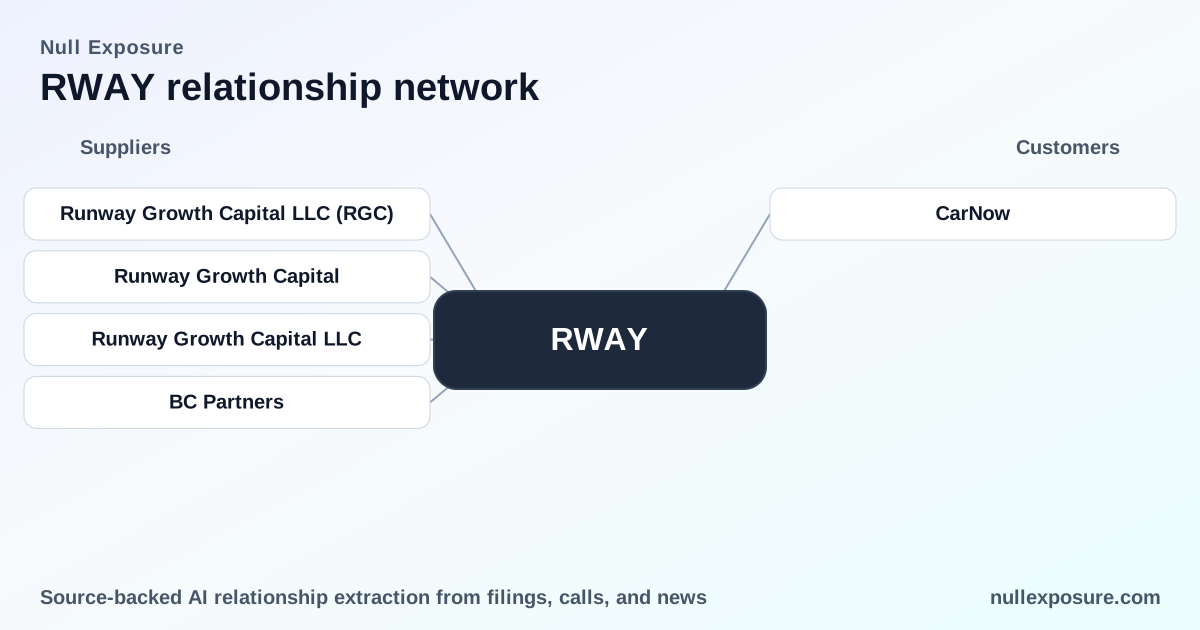
Runway Growth Finance (RWAY): How supplier relationships shape the BDC thesis
Runway Growth Finance is a publicly traded business development company that monetizes by providing growth capital to venture-backed technology and life sciences firms while outsourcing day‑to‑day investment and administrative operations to specialist managers. Investors gain exposure to RWAY through its interest income, realized and unrealized gains on portfolio positions, and a fee arrangement with its external manager; the operating model concentrates decision-making and back‑office execution in a small set of supplier relationships that drive both performance and operational risk. For a focused supplier-risk view, see the NullExposure company profile: https://nullexposure.com/.
Executive summary
- Runway Growth Capital LLC (RGC) functions as RWAY’s external investment adviser and operator, with a wholly owned admin vehicle handling day‑to‑day administration. (Marketscreener; PR Newswire)
- BC Partners is now integrated into the credit origination ecosystem, expanding distribution channels and altering recent portfolio composition. (247WallStreet; Intellectia)
- The company runs with material borrowings and a defined credit facility timetable, indicating long‑dated financing relationships with large banks and a reliance on external capital. (SEC filing excerpts)
Read on for a supplier‑level map, the constraints that drive contracting posture, and the investment implications of RWAY’s service relationships.
Why supplier relationships are the deciding factor for RWAY’s operating leverage
Runway operates as an externally managed BDC. That structure creates concentrated operational and revenue exposure: the adviser collects management fees and controls sourcing, underwriting and portfolio construction, while the BDC retains economic exposure to asset performance. For the year ended December 31, 2024, Runway Growth Capital earned base management fees at a 1.50% rate totaling $15.7 million, demonstrating that advisory economics are a meaningful revenue line and a vector for alignment or conflict. (Runway 2024 disclosures)
The company also maintains material third‑party borrowings and a bank credit facility with a defined availability and maturity schedule; the facility’s availability period expires April 20, 2025 and the stated maturity is April 20, 2026 unless extended, which frames refinancing and liquidity planning for the portfolio. These financing arrangements are with large, regulated lenders and administrative banks, underscoring the importance of bank relationships to capital structure. (SEC filing excerpts)
For a deeper supplier‑risk dashboard and ongoing updates, visit NullExposure: https://nullexposure.com/.
Key supplier and advisor relationships — what every analyst should note
Runway Growth Capital LLC (RGC)
Runway Growth Capital LLC is the external investment adviser that manages RWAY’s investment activities and oversees daily operations; its wholly owned Runway Administrator Services LLC provides the administrative services necessary for the company to operate. According to a Marketscreener dividend notice and company filings, RGC is the contract counterparty responsible for advisory and administrative delivery. (Marketscreener, March 10, 2026; PR Newswire, 2022 — https://www.prnewswire.com/news-releases/runway-growth-capital-llc-adds-brannon-morisoli-to-its-life-sciences-team-301605951.html)
Runway Growth Capital (transaction context)
Runway’s role as investment adviser was preserved through a credit‑business transaction that retained the existing management team, including CEO David Spreng, ensuring continuity of the adviser relationship even as ownership and strategic partnerships evolved. This was reported in coverage of BC Partners’ acquisition of the credit business. (AlternativesWatch, November 1, 2024 — https://www.alternativeswatch.com/2024/11/01/bc-partners-credit-acquisition-runway-growth-partnership-piper-sandler-lending/)
BC Partners
BC Partners has been integrated into the credit origination ecosystem supporting Runway, broadening sourcing channels and influencing deal flow; public reporting notes that integration within the BC Partners Credit ecosystem is already contributing to new origination channels while the portfolio contracted during the integration period (portfolio fair value declined from $1.02 billion to $946 million). This reflects both strategic reorientation and short‑term portfolio rebalancing. (247WallStreet, March 9, 2026; Intellectia/press coverage, March 2026)
Note on coverage: multiple press items and corporate filings across 2024–2026 reiterate RGC’s role and BC Partners’ involvement; treat the adviser and the BC Partners affiliation as the primary supplier/partner vectors for operational and sourcing risk. (Bitget coverage and Intellectia articles, March 2026)
Operational constraints that shape the business model
Contracting posture — long‑term finance with defined maturity windows
The company’s credit facility includes an availability period expiring April 20, 2025 and a stated maturity date of April 20, 2026 unless extended, followed by an amortization period. That calendar imposes discrete refinancing and covenant windows that affect liquidity management and deal pacing. This is a company‑level signal drawn from the credit facility language in filings.
Counterparty concentration — large banks and institutional lenders
Runway’s credit agreements list major banks (KeyBank National Association, CIBC Bank USA, U.S. Bank National Association) as administrative, documentation and paying agents, signaling a lender base composed of large enterprises that control administrative mechanics and have leverage in covenant and liquidity negotiations.
Service provider centrality — externalized investment and admin functions
RGC is the primary service provider and controls investment decisions under an advisory agreement; Runway Administrator Services LLC, a wholly owned RGC subsidiary, provides administration. This creates a single‑point dependency: the adviser not only sources and manages assets but also supplies core back‑office services. The constraint data explicitly links RGC to the adviser and administrator roles.
Spend scale and maturity signals — multi‑band spend with concentrated line items
Filing excerpts show large balance‑sheet borrowing lines and fee lines that span multiple spend bands: a borrowings line (reported as 558,250 in filings) supports a 100m+ classification, while base management fees of $15.7 million in 2024 put adviser fees squarely in the $10m–$100m band; administrative expenses of roughly $2.0 million fall in the $1m–$10m band. These figures are signals of material economic relationships with the adviser and the capital markets.
Investment implications and risk checklist
- Operational risk is concentrated: RGC’s role as adviser and owner of the administrator makes the company dependent on one organizational suite for sourcing, execution and administration — a positive for consistency but a single‑vendor risk if performance or governance issues arise.
- Refinancing cadence is consequential: the April 2025–2026 credit timeline creates a discrete set of refinancing or extension decisions that will influence portfolio deployment and NAV dynamics over the next 12–18 months.
- Affiliation with BC Partners changes origination economics: integration into BC Partners’ credit ecosystem broadens deal flow but coincided with a short‑term portfolio contraction; monitoring subsequent deployment and yield characteristics is essential.
For ongoing monitoring of supplier exposures and counterparty concentration, consult NullExposure’s supplier intelligence hub: https://nullexposure.com/.
Final read: what to watch next
Track three items closely: adviser fee trajectory and any incentive fee adjustments; the outcome of the credit‑facility availability and maturity window in 2025–26; and post‑integration origination volume through the BC Partners channel. Together they will determine whether RWAY’s externalized operating model drives scalable returns or concentrates event risk.
Bold takeaway: RWAY’s economics and operational continuity are tightly bound to Runway Growth Capital (and affiliates) plus a set of large bank counterparties — that configuration creates concentrated upside if the adviser delivers, and concentrated downside if refinancing or adviser performance falters. For a supplier‑centric update the moment filings or press releases change, visit NullExposure: https://nullexposure.com/.