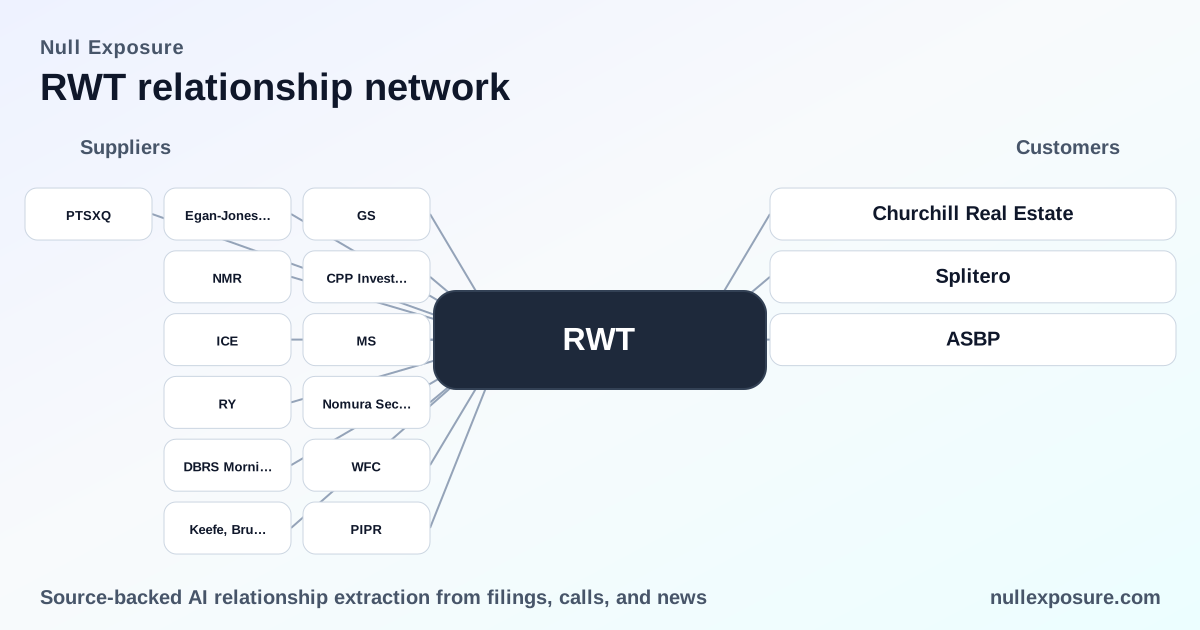
Redwood Trust (RWT): Who they work with, how they fund the business, and what that means for investors
Redwood Trust operates as a specialized mortgage REIT that originates, acquires and securitizes residential mortgage exposures and earns through spread income, servicing-related fees, and returns on retained investments. The company monetizes by acquiring prime jumbo and investor loans, packaging them into private-label securitizations and whole‑loan sales, and by using a mix of short-dated warehouse facilities and longer-term securitizations to fund the portfolio. Capital markets intermediaries, structured finance partners, ratings agencies and strategic lenders are core to the model. Explore more company-level signals at https://nullexposure.com/.
Capital markets and bank syndicate: who underwrote Redwood’s debt
Redwood executed a debt offering that relied on major investment banks as book‑running managers, demonstrating the company’s access to primary markets and the intermediation role banks play in its funding stack.
- Goldman Sachs acted as one of the book‑running managers on Redwood Trust’s $85 million debt offering announced in 2024, underscoring the company’s engagement with bulge‑bracket distribution channels (HousingWire, FY2024).
- Morgan Stanley served alongside other banks as a book‑running manager on the same offering, providing distribution and underwriting capabilities for Redwood’s public debt placement (HousingWire, FY2024).
- Wells Fargo Securities participated as a book‑running manager on the offering, reflecting the use of large bank syndicates to place Redwood debt (HousingWire, FY2024).
- RBC Capital Markets was also part of the book‑running group that distributed the $85 million notes, expanding Redwood’s distribution reach into the Canadian‑and‑U.S. hybrid capital markets (HousingWire, FY2024).
- Piper Sandler took a book‑running role on the offering as well, indicating Redwood’s mix of large and mid‑tier banks for placement and taxable note execution (HousingWire, FY2024).
- Keefe, Bruyette & Woods joined the syndicate, bringing specialty fixed‑income and mortgage distribution expertise to the transaction (HousingWire, FY2024).
Each of these engagements confirms Redwood’s reliance on institutional distributors to access debt capital markets and to translate securitization economics into investible securities for fixed‑income investors.
Strategic institutional backer: expanded secured borrowing with CPP Investments
- CPP Investments increased its secured borrowing facility with Redwood to $400 million from $250 million, expanding a strategic financing relationship that supplies committed balance sheet capacity for loan acquisition and holding (InsiderMonkey, FY2026).
This expanded facility is a prominent signal of institutional confidence and direct balance‑sheet support from a major pension investor, improving Redwood’s liquidity profile for near‑term loan originations and hold-to-securitization strategies.
Structuring and securitization partners that move assets to market
Redwood sources structuring and rating expertise to convert originated exposures into bond issuance or private placements.
- Nomura Securities International acted as the sole structuring agent for a $139 million bond secured by 1,577 home equity investment contracts issued with fintech partner Point, showing Nomura’s role in securitizing alternative residential credit (HousingWire, FY2023).
- Nomura was also sole structuring agent and sole bookrunner for a separate $146 million HEI securitization with Point, dating to earlier activity that established the Point‑Redwood conduit relationship (PR Newswire / National Mortgage Professional, FY2021).
- DBRS Morningstar provided the initial rating coverage for Point’s first rated bond issuance when Redwood co‑sponsored a Point securitization, introducing external credit assessment into these structures (HousingWire, FY2023).
- Egan‑Jones Ratings provided a BBB investment‑grade opinion on Redwood’s notes that were expected to list on the NYSE, which supports Redwood’s ability to access fixed‑income investors seeking investment‑grade paper (HousingWire, FY2024).
- The New York Stock Exchange was the expected listing venue for those notes, indicating Redwood’s preference for broad exchange liquidity and regulatory transparency on certain debt instruments (HousingWire, FY2024).
These relationships show Redwood’s use of specialist structurers and ratings agencies to convert loan pools into investor‑grade securities and to access exchange liquidity when appropriate.
Originator and servicing partner: Point
- Point co‑sponsored a home equity investment securitization with a Redwood subsidiary and originated the HEI contracts; Point continues to service those assets under the agreement, demonstrating a partnership where Redwood provides securitization capacity while Point supplies originations and servicing (PR Newswire / National Mortgage Professional, FY2021).
Point’s role demonstrates Redwood’s reliance on external originators and servicers to scale product sourcing, and to create asset types (like HEIs) that sit outside traditional mortgage product sets.
(If you want a consolidated supplier map and vendor exposure analysis, visit https://nullexposure.com/.)
What the constraints tell investors about Redwood’s operating posture
Redwood’s documented constraints and contract descriptions reveal an operating model that balances short‑dated funding with pockets of long‑term operational commitments:
- Contracting posture — mixed term structure: Redwood uses both long‑term office leases and short‑term, annually renewed warehouse and advance facilities to finance acquisitions, signaling operational flexibility but exposure to rolling refinancing risk. Evidence: lease schedules and descriptions of one‑year‑initial warehouse facilities (Company filings, FY2024).
- Counterparty concentration but with institutional reach: The company transacts with large financial institutions and more than 200 loan sellers, over half of which are banks, indicating both diversification across many sellers and a reliance on large counterparties for warehouse and repo financing (Company filings, FY2024).
- Critical funding through securitization: Securitization issuance has historically been a material funding source for residential lending activities; disruptions to the securitization market would directly affect Redwood’s funding cost and capacity (Company filings, FY2024).
- Role diversity — buyer, seller and service consumer: Redwood acts as buyer (loan acquisitions), seller (whole‑loan distributions and securitizations), and a consumer of service providers (third‑party servicers, IT, and custodial agents), creating multi‑vector dependency on execution across markets and vendors (Company filings, FY2024).
These constraints outline a business that is capital markets dependent, operationally leveraged to securitization flows, and exposed to refinancing windows — facts investors should price into credit and equity assumptions.
What this means for investors and operators
- For investors: monitor the renewal cadence of short‑term facilities and the stability of securitization windows; the CPP Investments facility expansion is a positive liquidity signal, but dependence on annual warehouse extensions increases refinancing risk.
- For operators and partners: maintain robust servicing and third‑party controls because Redwood outsources servicing execution and relies on external IT and operations to preserve cash flows tied to retained securities.
If you’re evaluating counterparty exposure or structuring opportunities with Redwood, get the supplier mapping and historical transaction detail at https://nullexposure.com/.
Bottom line
Redwood Trust is a mortgage REIT that leverages distribution banks, structured‑finance specialists, ratings agencies and strategic institutional lenders to source, fund and monetize residential loans. The company’s funding model mixes short‑term warehouse facilities with periodic securitizations and targeted long‑term facilities, producing high operational leverage to capital markets conditions. For investors and counterparties, the focus should be on facility renewal risk, securitization market access, and the stability of originator/servicer relationships.
Deep dive supplier and capital markets profiles, plus a downloadable supplier map for RWT, are available at https://nullexposure.com/.