Redwood Trust (RWT-P-A): Strategic partnerships power securitization and capital access
Redwood Trust operates as a mortgage-focused REIT that monetizes through origination, securitization and portfolio management of residential and commercial mortgage loans and mortgage-backed securities, extracting spread income and structured fees while rotating capital via joint ventures and borrowing facilities. Recent disclosures and press coverage show Redwood combining institutional capital relationships with fintech product partnerships to accelerate securitizations and preserve liquidity — a dual strategy that supports yield generation and balance-sheet flexibility. For a full supplier and counterparty view, visit https://nullexposure.com/.
What the recent relationship signals tell investors
Redwood’s pattern of counterparty selection reflects a clear operating playbook: leverage strategic equity stakes and joint ventures to access proprietary deal flow and share execution economics, while maintaining secured credit lines for balance-sheet optionality. That posture increases the firm’s ability to scale securitizations quickly and to participate in upside through equity-style economics, rather than relying solely on one-off trading gains.
- Contracting posture: Redwood structures both minority equity stakes (strategic fintech investments) and formal joint ventures with institutional allocators, combining fee-for-service and profit-participation economics.
- Concentration and criticality: Relationships with large capital partners underpin funding capacity; fintech alliances provide structuring and execution capabilities that are critical to certain innovative RMBS transactions.
- Maturity: The mix includes both established institutional partnerships and earlier-stage fintech relationships, which diversifies execution pathways but introduces varying operational risk profiles.
For more context on counterparties and risk mapping, check the supplier lens at https://nullexposure.com/.
How each disclosed relationship contributes to Redwood’s model
Below I cover every relationship mentioned in the available reporting, with a plain-English summary and the reporting source.
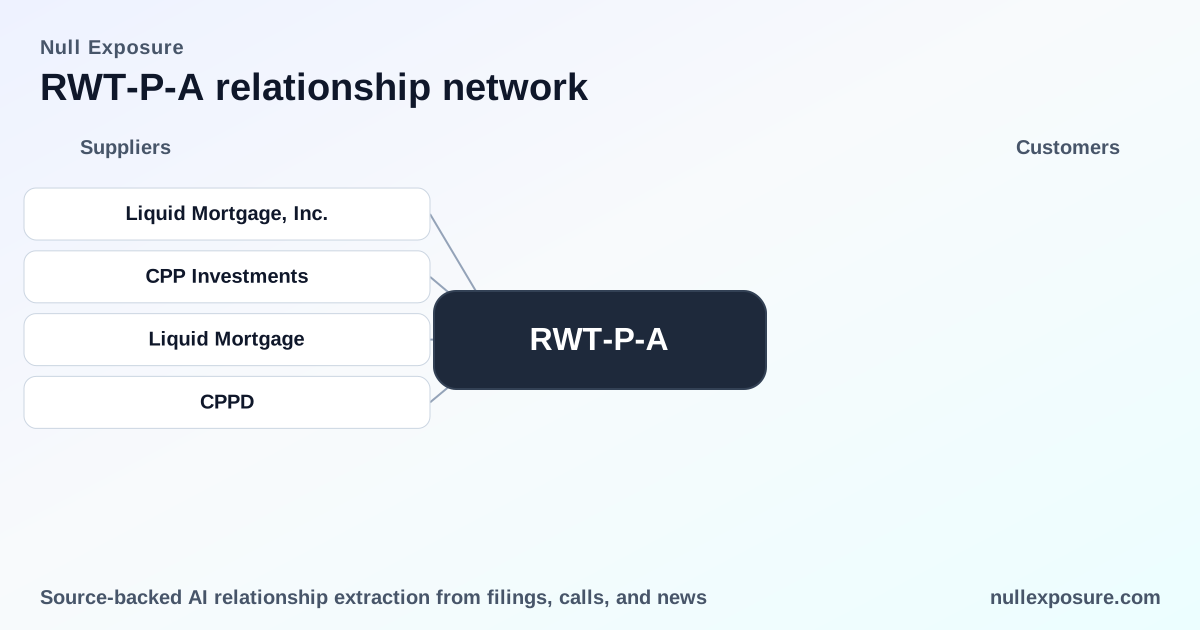
Liquid Mortgage, Inc. — blockchain-enabled securitization partner
Redwood leveraged its minority investment in Liquid Mortgage to appoint the company as distributed ledger agent (DLA) on what it described as the market’s first non-agency RMBS leveraging blockchain-based technology, using Liquid Mortgage’s patented digital asset and data platform to support securitization execution. According to a PR Newswire release covering the transaction (FY2021), Redwood engaged Liquid Mortgage directly in the role of DLA for the deal.
Source: PR Newswire, transaction announcement (FY2021).
HousingWire also reported that Redwood had earlier that year acquired a minority stake in Liquid Mortgage and used the fintech to assist with the securitization, highlighting the strategic rationale of combining ownership with execution capability. HousingWire’s coverage framed the stake as a deliberate move to accelerate fintech-enabled product execution.
Source: HousingWire, coverage of Redwood’s fintech partnership (FY2021).
CPP Investments / CPP — large capital partner and JV counterparty
Redwood expanded its secured borrowing facility with CPP Investments, raising the committed facility to $400 million from $250 million, which directly enlarges Redwood’s secured liquidity runway for purchasing and warehousing loans. Finviz summarized the facility increase in its market coverage (FY2026), underscoring the practical funding lift.
Source: Finviz news note on credit facility expansion (FY2026).
Management also described the joint-venture economics with CPP on its earnings call: Redwood takes a 20% stake in the JV, earning defined economics on loans placed into the JV while retaining participation in upside outcomes as a minority equity stakeholder — a structure designed to accelerate capital turnover while preserving attractive margins. The earnings call transcript (Q4 2025) provides the management commentary on JV mechanics and the rationale for the partnership.
Source: InsiderMonkey / Q4 2025 earnings call transcript.
Constraints and what they imply about Redwood’s operating model
There are no explicit constraint excerpts supplied in the relationship data payload; however, the available relationship activity itself functions as a practical constraint signal at the company level. From the partnerships and facility activity we can derive these operational characteristics:
- Strategic diversification of contracting types: Redwood mixes minority equity positions (fintech) with traditional secured credit lines and joint ventures (institutional), indicating a preference for hybrid contracting to balance upside participation with capital discipline.
- Moderate counterparty concentration at the institutional level: The expanded CPP facility and JV position imply meaningful dependency on large institutional counterparties for funding scale, which is efficient but concentrates counterparty and funding risk.
- Operational criticality of fintech integrations: Using Liquid Mortgage as DLA for a blockchain-enabled RMBS creates execution dependency on third-party platform reliability and governance, shifting some operational risk outside Redwood’s core processes.
- Maturity spread across relationships: The CPP JV represents a more mature, capital-intensive relationship, whereas the fintech minority stake is an earlier-stage strategic investment designed to incubate new product capabilities.
These company-level signals should inform diligence on funding resilience, counterparty agreements, operational controls around fintech integrations, and the legal structure of JV and secured facility arrangements.
Investment implications and next steps for operators and research teams
Redwood demonstrates a deliberate strategy to marry traditional mortgage finance economics with selectively chosen technology partners and institutional capital. That combination improves securitization execution and capital turnover but requires rigorous oversight of counterparty credit, operational resiliency (especially where distributed ledger roles are outsourced), and the terms governing JV economics.
Key actions for investors and counterparties:
- Validate the legal and operational scopes of the DLA role Liquid Mortgage plays in securitizations, including custody, transfer, and audit controls (blockchain integrations change operational failure modes).
- Review the credit and covenant structure on the CPP secured borrowing facility and JV governance to assess funding durability and dilution/priority risk in stress scenarios.
- Monitor execution cadence: successful scaling of fintech-enabled RMBS product lines will be an early indicator that the minority stake translates into sustainable fee and spread enhancement.
Explore supplier and counterparty profiles for additional diligence at https://nullexposure.com/ — the supplier view surfaces relationship history and public reporting that matter in underwriting and counterparty risk assessments.
Final take
Redwood’s current supplier map underscores a dual-axis growth strategy: secure institutional capital to finance scale while investing in or partnering with technology providers to improve product economics and execution speed. That strategy produces higher capital efficiency when relationships perform as structured, but it concentrates reliance on a small number of counterparties for funding and on emerging technology partners for certain securitization mechanics.
Investors and operators should prioritize contract-level review and operational testing around these suppliers to confirm that revenue amplification from JV economics and fintech-enabled securitizations is backed by robust legal, credit, and operational protections. For a tailored counterparty risk snapshot and ongoing monitoring, visit https://nullexposure.com/.