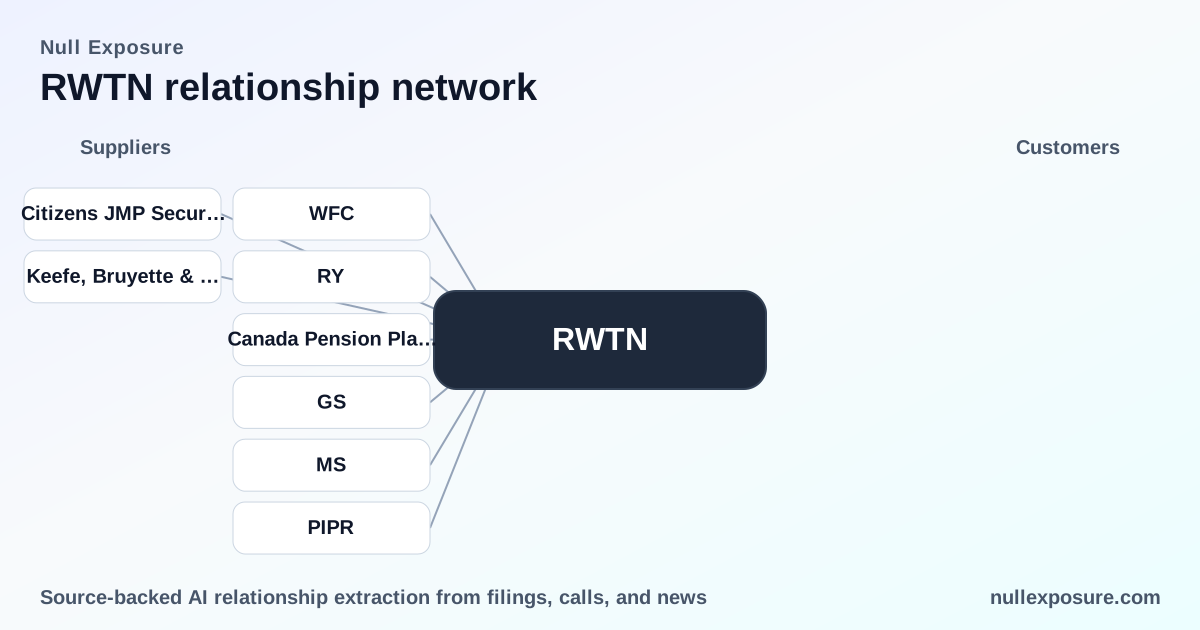
Redwood Trust (RWTN) — who is financing the balance sheet and what it means for investors
Redwood Trust operates as a mortgage REIT that earns spread income by originating, acquiring and securitizing residential loans and mortgage-backed securities, funding those positions with a mix of short-term warehouse and repo facilities and longer-dated public debt. The company monetizes through yield on loans and retained securities, servicing fees on retained MSRs, and cyclical capital markets activity—illustrated by a pair of high-coupon senior unsecured offerings in 2026 designed to refinance legacy convertible and exchangeable notes and preserve liquidity. For yield-focused investors, Redwood offers a high cash yield (reported dividend yield ~7.79%) but a capital-structure profile that is heavily dependent on capital markets and counterparty financing. Learn more about the supplier relationships that move the capital here: https://nullexposure.com/
Why the recent $85M offering matters to counterparties and investors
Redwood priced $85 million of senior unsecured notes due 2029 at 9%, with an underwriter over-allotment option and a stated use of proceeds for mortgage lending, MBS purchases, long-term portfolio investments and repayment of earlier convertible/exchangeable debt. According to National Mortgage News (March 2026), the deal lists a large syndicate of joint book-runners and a co-manager, reflecting a market-driven refinancing strategy rather than balance-sheet deleveraging.
This transaction demonstrates several company-level operating characteristics that affect supplier relationships and counterparty risk:
- Mixed tenor of funding: Redwood maintains both long-term and short-term facilities; the company explicitly discloses long-term facilities while also relying on short-term, often uncommitted warehousing and repo lines that are renewed annually.
- Capital-market dependence: Frequent debt placements show the business is structured to access public and investment-banking distribution channels rather than internal cash generation.
- Counterparty concentration risk: Redwood cites that significant servicing concentration with a single sub-servicer could be material—this is a company-level signal on operational criticality, not tied to a named counterparty in the excerpts.
- Role diversity: Redwood acts as buyer, seller and service consumer—it purchases loans and HEI, sells/securitizes assets, and relies on third-party sub-servicers to perform loan servicing tasks.
- Spend and cash flow scale: Repurchases and paydowns in 2024 totaled tens of millions, consistent with a $10M–$100M spend band on financing and restructuring activity.
If you are tracking capital providers or counterparty exposure, review these relationship signals and the underwriting syndicate for concentration and pricing dynamics. For a consolidated view of Redwood counterparties and exposures visit https://nullexposure.com/
Who’s on the syndicate and what each relationship is doing
Each of the following counterparties is named in the underwriting and financing announcement published by National Mortgage News (March 2026): https://www.nationalmortgagenews.com/news/redwood-trust-offering-85-million-of-debt
Morgan Stanley & Co.
Morgan Stanley is a joint book-running manager on the $85 million senior unsecured note offering, participating in distribution and placement of the new notes. According to National Mortgage News (March 2026), Morgan Stanley sits with the rest of the large bank syndicate managing the deal.
Goldman Sachs & Co.
Goldman Sachs acted as a joint book-running manager on the offering and is part of the syndicate underwriting the notes sold to the market. The role confirms Goldman’s distribution responsibility for Redwood’s 2029 notes (National Mortgage News, March 2026).
RBC Capital Markets
RBC Capital Markets is listed as a joint book-running manager for the offering and participates in underwriting and distribution of the new senior unsecured paper (National Mortgage News, March 2026).
Wells Fargo Securities
Wells Fargo Securities served as a joint book-running manager for the deal, helping place the 9% notes and covering potential over-allotments (National Mortgage News, March 2026).
Keefe, Bruyette & Woods
Keefe, Bruyette & Woods is part of the joint book-running group that underwrote the offering, providing distribution reach into fixed-income and mortgage-focused investor channels (National Mortgage News, March 2026).
Piper Sandler & Co.
Piper Sandler is named among the book-runners for the transaction, participating in the syndicate that priced and distributed the 2029 notes (National Mortgage News, March 2026).
Citizens JMP Securities
Citizens JMP Securities acted as the co-manager on the offering, a role that typically supports placement and marketing to institutional accounts outside the lead banks (National Mortgage News, March 2026).
Canada Pension Plan Investment Board (CPP)
CPP provided a $250 million corporate secured revolving financing facility to Redwood and helped create a $500 million joint venture to invest in residential investor bridge and term loans, strengthening Redwood’s secured funding and investment capacity (National Mortgage News, March 2026).
What these relationships mean for operational and credit risk
The underwriting syndicate composition and CPP’s secured facility show a two-track funding model: public unsecured notes at high coupons for term funding, and secured institutional facilities and joint-venture capital for asset-level deployment. That structure produces clear implications:
- Refinancing and liquidity risk: reliance on repeat debt offerings keeps Redwood exposed to market appetite for high-coupon mortgage REIT paper. The 9% coupon is an expensive but available source of term funding.
- Short-term funding dependency: the company’s routine use of uncommitted loan warehouses and repo lines creates rollover risk that can force asset sales in stressed markets.
- Operational concentration: the stated concentration risk around sub-servicers is an operational vulnerability that elevates counterparty criticality, even when not tied to a specific named vendor in the public excerpts.
- Counterparty diversification: the breadth of underwriters (global banks plus regional specialists) reduces distribution concentration but does not eliminate funding cost or market-access risk.
Practical next steps for investors and counterparties
- Review exposure to Redwood’s unsecured and secured liabilities in counterparty portfolios and stress-test scenarios for repo/warehouse withdrawal.
- Prioritize monitoring of servicer concentration metrics and CPP JV asset performance as early indicators of credit stress.
- For relationship diligence and comparative supplier mapping, consult the NullExposure platform: https://nullexposure.com/
For investors evaluating Redwood Trust, the trade-off is clear: attractive current yield supported by active capital markets access, offset by sensitivity to refinancing conditions, short-term facility renewals and servicing concentration. For a consolidated supplier-risk view and ongoing monitoring of Redwood’s counterparty network, visit https://nullexposure.com/ — the platform centralizes the counterparties, financing vehicles and constraint signals that underlie counterpart exposure and operational risk.