Redwood Trust (RWTP): A short-term finance engine with concentrated operational levers
Thesis: Redwood Trust operates as a specialty mortgage finance firm that acquires, warehouses, securitizes and services mainly prime jumbo and investor residential loans, then monetizes through loan sales, securitization spread capture and retained servicing economics; the firm leverages short-term secured financing and periodic joint-venture warehouse facilities to rotate assets, which creates both attractive yield capture and concentration and funding liquidity sensitivities for counterparties and investors.
If you evaluate supplier and counterparty relationships for RWTP, the key questions are: who funds the warehouses and joint ventures, which servicers and sub‑servicers carry operational risk, and how reliant is the business on short-term credit lines. For more deep-dive supplier profiles and relationship mapping, visit https://nullexposure.com/.
How Redwood makes money (concise) Redwood acquires residential loans and mortgage servicing rights (MSRs) on a flow or platform basis, finances those assets with short-term repo and warehouse facilities, then realizes cash by (1) selling whole loans into the market, (2) issuing securitizations and retaining interest or servicing strips, and (3) harvesting servicing income and advance yields. Profitability depends on spread capture between asset yields and short-term funding costs, and on execution of securitizations. Company filings and recent commentary confirm this operating posture and its reliance on short-duration financing.
A recent investor action: joint-venture expansion with CPP Investments
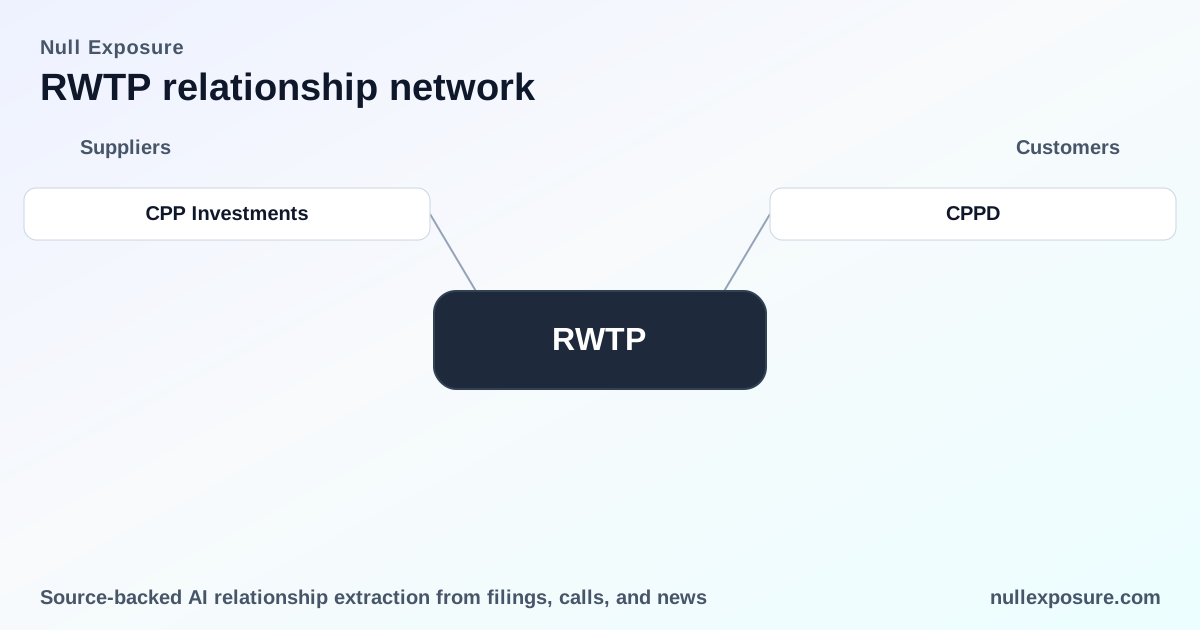
- CPP Investments increased the joint-venture facility cap for Redwood’s Sequoia platform to $400 million in Q3 2025, expanding the JV funding runway and underwriting capacity for acquiring loans on that platform, according to a Motley Fool earnings transcript republished by The Globe and Mail on March 10, 2026. This is a capital-markets affirmation of Redwood’s model to combine third‑party capital with its acquisition and securitization capability.
Read more on partner arrangements at https://nullexposure.com/.
What the relationships tell you — the single supplier-level result CPP Investments
- Redwood’s expanded partnership with CPP Investments raised the Sequoia joint venture facility limit to $400 million in Q3 2025, which directly increases the platform’s capacity to acquire and warehouse loans pending securitization or sale. A Motley Fool earnings transcript reported via The Globe and Mail on March 10, 2026 documents the expansion and its intent to accelerate growth on the Sequoia platform.
Operating constraints and what they mean for suppliers and counterparties Redwood’s public disclosures and recent commentary make clear that its operating model is characterized by a set of binding constraints — these are firm-level signals about counterparty risk, contracting posture, concentration and maturity.
- Short-term contracting posture: Redwood uses repurchase (repo) facilities and loan warehouse lines that are typically financed for fixed periods generally not exceeding 90 days, and many loan warehouse and servicer advance financings are established with initial one‑year terms and routinely amended annually. This creates continuous roll-over risk: counterparties supplying funding or liquidity operate under short recommitment horizons, and the company’s asset rotation depends on recurrent access to short-term credit.
- Funding is partly uncommitted: Several short-term borrowing facilities used to finance acquisitions are explicitly uncommitted and limited in term. For counterparties, that elevates funding optionality and off-ramps during stress — a supplier should price and structure exposure accordingly.
- Operational concentration around sub‑servicers is material: Redwood discloses that if a single sub‑servicer handles a large percentage of loans or HEI where Redwood owns servicing rights, failures or funding pressure at that sub‑servicer could have a material adverse effect on results. This is a direct operational-risk signal for operations and vendor-due-diligence teams.
- Role diversity across the value chain: Redwood acts as seller (acquiring loans from origins and selling/ securitizing), buyer (owns originator platforms such as CoreVest and others it consolidated), and service provider (retains servicing rights while contracting third-party sub‑servicers to perform the servicing). For counterparties this means Redwood plays multiple roles and can be both counterparty and client depending on the transaction.
- Active seller network and scale dynamics: As of year-end December 31, 2024, Redwood had re‑established 95 bank seller relationships after the 2023 regional banking stresses and operated a total network of 210 loan sellers, over half of which were banks. This breadth supports continuous flow acquisition but creates exposure to banking-sector accession and regional credit cycles.
- Spend and capital move signals: In 2024 Redwood repurchased and repaid $72 million of outstanding debt securities, indicating active balance‑sheet management in the $10m–$100m spend band and active liability reshaping.
Why those constraints matter to suppliers and investors
- Liquidity counterparties need explicit covenants and pricing that reflect the heavy use of short-term, occasionally uncommitted facilities; lending tenor and attachment points will determine exposure to warehouse rolls and repo re-pricing.
- Operational vendors and servicers should size contingency capacity given the materiality risk if a single sub‑servicer handles a concentrated share of advances or MSR volumes.
- Strategic capital partners (like CPP Investments) that provide JV or warehouse capacity support Redwood’s growth without forcing the firm to hold long-term capital, but such structures transfer liquidity and execution risk between the JV and Redwood — a successful relationship reduces funding volatility; a stressed partner reduces available capacity quickly.
Implications for portfolio construction
- Credit and liquidity risk are paired. Redwood’s core economics—buy, finance short, securitize or sell—produces volatile funding needs; investors should treat exposure as funding-sensitive credit risk rather than a pure asset-yield story.
- Counterparty selection and legal terms matter more than headline JV sizes. The CPP Investments facility expansion is a positive signal of capacity; what matters operationally are commitment clauses, recall rights, and who underwrites warehouse breaks.
- Operational concentration is a near-term governance risk. Underwriting counterparty resilience and sub‑servicer contingency plans should be part of ongoing monitoring.
What to watch next
- Track amendments to warehouse and servicer advance facilities for changes in tenor or commitment status during 2026; any shift toward longer committed facilities materially reduces rollover risk.
- Monitor Redwood’s servicing counterparty roster and metrics on advances concentrated with single sub‑servicers; a rising concentration metric would be a red flag.
- Watch subsequent JV capital moves (additions or contractions) with partners like CPP Investments as a read on marketplace appetite for funding prime jumbo and investor loan warehouses.
For readers mapping counterparties and supplier contracts, our platform provides structured relationship intelligence and constraint summaries tailored to due diligence workflows — start at https://nullexposure.com/ to request the supplier dossier.
Bottom line: Redwood’s business model captures spread through active asset rotation and JV funding, but short-term funding dynamics and sub‑servicer concentration are the company’s defining risk levers; monitor JV commitments and warehouse tenor closely. For supplier-focused diligence and contract-level coverage, explore more at https://nullexposure.com/.