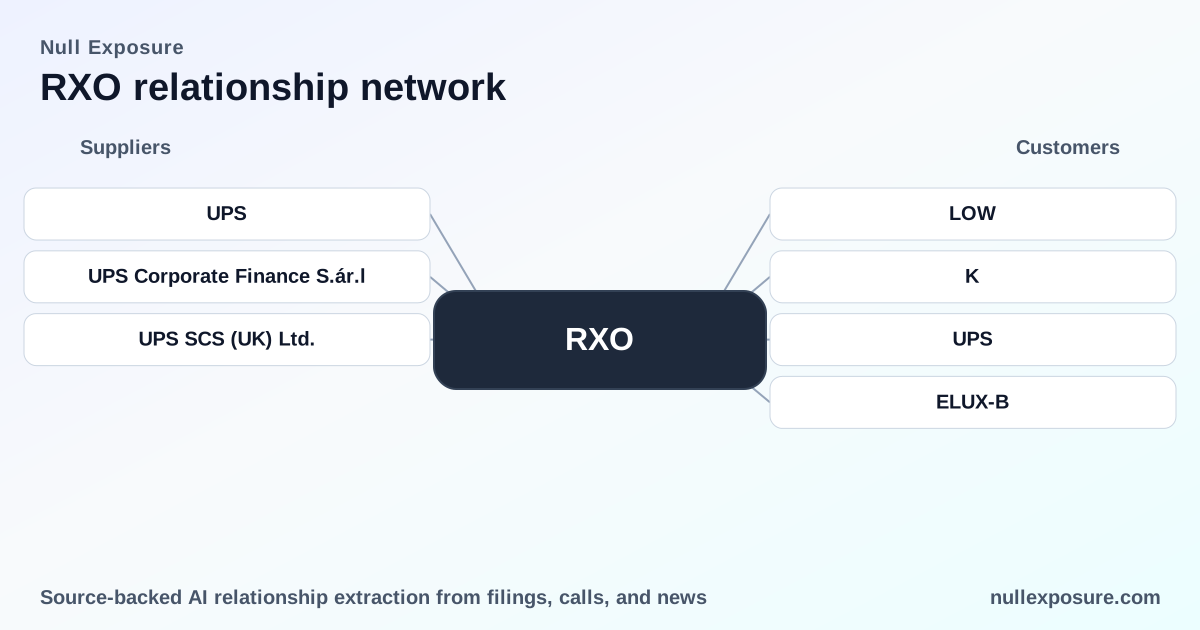
RXO Inc.: Supplier relationships reshaped by the Coyote acquisition
RXO operates as an asset-light freight transportation and logistics platform that monetizes by matching shippers with carriers and managing freight execution, supplemented by technology-enabled services and selectively owned assets. The company generates revenue from brokerage spreads, managed transportation fees, and segment services while relying on independent motor carriers and contractual commitments to scale capacity. For investors and operators, the strategic acquisition of Coyote Logistics from UPS materially alters RXO’s supplier map and elevates integration and contracting risks—monitor integration progress and carrier economics closely. For more on supplier analytics and relationship intelligence, visit https://nullexposure.com/.
How RXO actually makes money and why suppliers matter
RXO is a technology-driven freight connector: it earns fees and spreads by arranging transport for customers and optimizing routes and rates, while keeping capital intensity low through an independent-carrier model. The company reported $5.74 billion in revenue (TTM) against thin profitability (negative EPS and low operating margin), underscoring that scale and gross profit conversion drive valuation upside more than current margin expansion. The business is dependent on two structural supplier realities: an asset-light fleet of independent carriers under short-term agreements, and longer-term lease commitments supporting owned or leased terminals and technology hubs. These dual contracting postures create a hybrid supplier risk profile—flexible capacity via short contracts, but fixed-cost exposure via long leases.
Material supplier relationships identified in public reporting
Below I cover every relationship surfaced in the public results set. Each entry is a concise, plain-English takeaway followed by the original reporting source.
United Parcel Service, Inc. (UPS)
RXO entered into a definitive agreement with United Parcel Service, Inc. to acquire Coyote Logistics for $1 billion, a transaction that significantly expands RXO’s brokerage scale and customer footprint. According to a Simply Wall St news item referencing FY2026, RXO announced the agreement on June 25 (https://simplywall.st/stocks/us/transportation/nyse-rxo/rxo/future).
United Parcel Service of America, Inc. (UPS)
RXO completed the acquisition of Coyote Logistics from United Parcel Service of America, Inc., consolidating Coyote’s contracts and carrier relationships under the RXO platform and transferring operational control. A Simply Wall St report noted completion of the transaction on September 16 (FY2026) (https://simplywall.st/stocks/us/transportation/nyse-rxo/rxo/future).
UPS Corporate Finance S.ár.l
As a seller affiliate in the Coyote transaction, UPS Corporate Finance S.ár.l was listed among the UPS entities from which RXO acquired Coyote, indicating a multi-entity disposition of Coyote within the UPS corporate family. The transaction and parties were reported by Simply Wall St in FY2026 (https://simplywall.st/stocks/us/transportation/nyse-rxo/rxo/future).
UPS SCS (UK) Ltd.
UPS SCS (UK) Ltd. was also named among the UPS-related sellers involved in the Coyote Logistics sale, reflecting cross-border disposition of Coyote assets and contracts that RXO absorbed as part of the deal. Simply Wall St captured this completion notice in its FY2026 reporting (https://simplywall.st/stocks/us/transportation/nyse-rxo/rxo/future).
Key takeaway: all four relationship entries describe the same strategic transaction—RXO’s acquisition of Coyote Logistics from multiple UPS corporate entities—creating immediate supplier and customer network effects that require active integration management.
For deeper supplier profiling and ongoing monitoring of post-acquisition counterparty risk, see https://nullexposure.com/.
Contracting posture, concentration and maturity — company-level constraints that matter
Public excerpts and filings provide clear company-level signals about RXO’s supplier posture:
- Short-term carrier contracts dominate operational flexibility. Management states RXO “typically sign[s] a non-exclusive, one-year, renewable agreement with carriers,” which creates rapid capacity elasticity but also exposes RXO to pricing volatility and churn among independent motor carriers.
- Material long-term lease commitments exist alongside short carrier contracts. As of December 31, 2025, RXO disclosed $52 million of future undiscounted operating lease payments commencing in 2026 with initial terms of 7–11 years; this indicates fixed-cost maturity that reduces operating leverage in periods of volume weakness.
- Service-provider dependency is central to the business model. The asset-light structure explicitly relies on independent carriers to execute freight, making supplier performance and availability a critical operational risk rather than a peripheral procurement issue.
These constraints together create a mixed maturity profile: operational capacity is short contract and high-turnover, while infrastructure and facility commitments are long-term and fixed. That combination compresses managerial margins during integration or demand shocks.
What the UPS/Coyote deal changes for investors and operators
The Coyote acquisition is an inflection point for RXO’s supplier universe.
- Scale and reach increase: Absorbing Coyote expands freight lanes, existing customer contracts, and carrier relationships—potentially lowering unit cost if integration captures synergies.
- Integration risk is elevated: Consolidating carrier pools and contractual terms requires reconciling rates, technology platforms, and compliance standards; execution failure would pressure gross margins.
- Concentration and counterparty exposure shift: RXO now assumes contractual relationships and obligations previously managed by UPS entities, changing counterparty risk from a seller to an operator across a broader geographic footprint.
Financially, RXO’s EV/EBITDA of ~72.7 and negative EPS indicate market expectations are priced for future margin improvement and growth; the Coyote deal must materially contribute to that path to justify valuation. Monitor quarter-to-quarter revenue growth (-11.9% YoY recently) and earnings volatility as leading indicators of integration success.
Mid-article action: for operational due diligence or custom supplier heatmaps tied to RXO’s post-acquisition footprint, visit https://nullexposure.com/.
Investor checklist and next moves
For portfolio managers and procurement leads evaluating RXO supplier risk, prioritize the following:
- Track quarterly metrics tied to Coyote integration (revenue contribution, carrier retention, technology migration).
- Review lease maturity schedules and expected synergies to understand the timeline for fixed-cost leverage.
- Assess carrier contract churn and rate pass-through mechanisms given reliance on one-year renewable agreements.
- Monitor reported service issues or customer attrition following the integration, as those are leading signals of execution risk.
Final recommendation: the UPS-to-RXO transaction materially changes RXO’s supplier profile and elevates both opportunity and integration risk. Investors should demand focused disclosure on carrier retention and lease amortization schedules, while operators should prioritize standardizing contracts and compliance across the enlarged carrier network. For continuous monitoring of these supplier relationships and bespoke exposure analysis, visit https://nullexposure.com/.
Summary: RXO’s asset-light model combined with long-term leases and a major M&A step transforms supplier dynamics—scale improves potential margins, but the company’s short carrier contracts and newly-acquired contract inventory create a window of elevated execution risk that investors and operators must track closely.