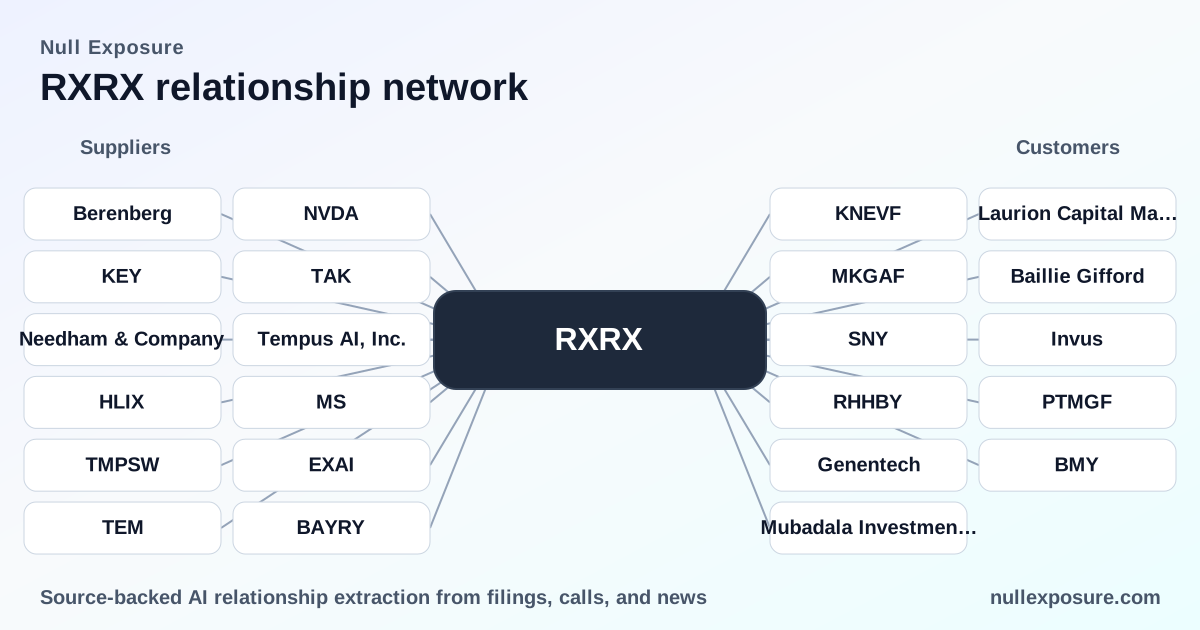
Recursion Pharmaceuticals (RXRX): the supplier landscape that underwrites an AI-first drug company
Recursion Pharmaceuticals operates as an AI-driven drug discovery and development company that monetizes through a combination of in‑house clinical programs, partnered R&D, licensing and milestone payments, and capital markets transactions. The company industrializes discovery by combining automated wet labs, a proprietary Recursion OS, and third‑party data and compute partners; revenue and optional consideration flow from partnering deals, asset in‑licenses, and capital raises that lengthen runway. For investors and procurement leaders, supplier relationships are both the operational backbone and a material financial lever for Recursion’s platform strategy. Learn more about supplier risk and opportunity at https://nullexposure.com/.
The business model that makes suppliers strategic, not incidental
Recursion’s operating model deliberately externalizes several inputs that determine speed and scale: patient-level clinical records, chemical design and synthesis capabilities, AI compute infrastructure, and capital markets services. That means suppliers are contractually critical, often under multi‑year commitments, and directly affect R&D throughput and cash consumption. Company disclosures show a mix of concentrated, long‑duration purchases (notably Tempus) and smaller licensing arrangements (Helix), which creates a two‑tier supply posture: high-dollar, strategic data/compute partners driving discovery velocity; and service/placement partners underwriting financing and execution.
Constraints from filings and public releases reinforce this view:
- Long‑term licensing and record‑purchase agreements exist with Tempus and Helix, signaling multi‑year commitment and vendor lock‑in where data access is central to program development.
- Geographic reach now includes North America and EMEA due to acquisitions and international supplier/clinical relationships, increasing regulatory and operational complexity.
- Spend concentration is significant: Tempus relationships sit in the upper spend band (up to $160 million aggregate), while Helix is a modest multi‑year license (~$9 million total), showing both high and low spend tiers.
These are company‑level operational signals that shape procurement posture, contingency planning, and cash modeling. If you manage counterparty risk, factor in the mix of critical high‑value contracts and multiple smaller licenses.
Visit https://nullexposure.com/ to compare supplier risk across biopharma portfolios.
Supplier map: the relationships investors and operators must know
Below I walk through every supplier relationship surfaced in the public results and explain why each matters to Recursion’s operating and financial profile.
Nvidia — compute and AI infrastructure partner
Recursion has partnered with Nvidia to develop BioHive‑2, described as the fastest supercomputer wholly owned and operated by any pharmaceutical company, and the collaboration underpins Recursion OS performance and speed. According to GenengNews and Sahm Capital coverage (FY2024–FY2026), Nvidia technology is central to Recursion’s on‑premise compute strategy and investor commentary on AI upside.
Tempus / Tempus AI, Inc. — strategic data supplier and payment counterparty
Recursion maintains a multi‑year agreement with Tempus to purchase oncology multimodal records and rights; in 2025 Recursion issued shares to Tempus in lieu of a $32 million cash license fee and recorded substantial record‑purchase spend and related current assets. Company filings and news reports (TradingView, GlobeNewswire, and financial commentary in FY2024–FY2026) show Tempus is a high‑value, active supplier with contract terms up to $160 million aggregate, making it a material cash‑flow driver and counterparty risk.
Helix — patient data license for therapeutic discovery
Recursion entered a three‑year licensing arrangement with Helix for patient data and development rights, with annual payments of $3.0 million recorded as an intangible asset ($9.0 million total). The Helix relationship is a mid‑tier, long‑term purchase that supplies clinical and genomic inputs to the Recursion OS, according to company disclosures (FY2024).
Exscientia — chemical design and synthesis complement
Recursion combined with Exscientia to strengthen small‑molecule design and synthesis capabilities; the merger brings chemical design methods that complement Recursion’s image‑driven biology and expands platform functionality, per the GlobeNewswire announcement and GenEngNews coverage (FY2024). Exscientia’s capabilities are positioned as a platform enhancement rather than a purely transactional supplier.
Bayer — co‑development / collaboration program counterparty
A collaboration with Bayer produced an Epsilon program in fibrosis, where Recursion has since in‑licensed the lead candidate from the joint work; GenEngNews (FY2024) reports Bayer as a strategic pharma partner providing therapeutic targets and development options that Recursion converted into internal rights.
Takeda — originator of in‑licensed compound REC‑4881
Recursion in‑licensed REC‑4881 from Takeda and redirected it into a focal program for FAP after identifying the mechanism through Recursion OS screening; multiple news reports (TS2 Tech and Finviz, FY2025) place Takeda as the original developer of that compound and therefore a source of assets that Recursion can repurpose using its platform.
Morgan Stanley — placement agent for capital raises
Morgan Stanley acted as lead placement agent on a $150 million private placement led by Kinnevik in FY2022, providing capital markets execution and access to investor demand that supported Recursion’s balance sheet. The PR Newswire release (FY2022) names Morgan Stanley as lead.
Berenberg, KeyBanc Capital Markets, Needham & Company — co‑placement agents
Berenberg, KeyBanc, and Needham served as co‑placement agents alongside Morgan Stanley for the FY2022 private placement, supplying distribution, syndication and placement services to execute the raise (PR Newswire, FY2022).
What this supplier mix implies for investors and operators
Recursion’s sourcing profile is strategically concentrated: a small number of high‑value, multi‑year suppliers (Tempus, Nvidia, Helix) supply inputs that determine R&D throughput, while a broader set of partners (Exscientia, Bayer, Takeda) supply capabilities and assets that expand the platform. This creates four investment‑relevant dynamics:
- Operational criticality: loss or deterioration of Tempus or Nvidia relationships would materially slow discovery velocity and could force costly re‑engineering of workflows. Evidence in filings shows Tempus spend and active contractual accounting that underscores criticality.
- Convertible spend to equity: Recursion has used equity in lieu of cash (Tempus share issuance for fees), which preserves cash but creates complexity around dilution and resale risk (TradingView/press coverage, FY2025).
- Diverse monetization levers: partner co‑development and in‑licensing (Takeda, Bayer, Exscientia) feed internal pipelines and optionality without proportional upfront capital, supporting long‑term upside if platform leads translate into clinical value.
- Geographic and regulatory complexity: expanded operations in Canada, England and Scotland increase supplier management overhead and regulatory touchpoints, which investors must price into risk premiums.
If you manage supplier due diligence or credit exposure, prioritize verification of long‑term agreements, termination clauses, and alternative sourcing for the Tempus and Nvidia modalities.
Explore comparative supplier intelligence and contract risk scoring at https://nullexposure.com/ to benchmark Recursion against peers.
Bottom line and next steps
Recursion has architected a supplier ecosystem that is both its greatest operational advantage and its principal dependency: AI compute, proprietary and licensed patient records, and partner chemistry/synthesis capabilities are mission‑critical. For investors, that translates into a binary return profile where platform acceleration delivers asymmetric upside while counterparty or execution failures create meaningful development and cash risks.
If your firm evaluates vendor exposure, prioritize Tempus and Nvidia counterparty health, review equity‑for‑services precedents, and model sensitivity to long‑term data licensing costs. For a side‑by‑side supplier risk comparison and access to primary source citations, visit https://nullexposure.com/.