Rackspace Technology (RXT): Supplier relationships that define a hybrid-cloud services play
Rackspace monetizes by operating as a managed multi-cloud and private-cloud services vendor that designs, hosts and runs infrastructure and software for enterprise customers while taking recurring management and usage fees; the company captures margin through managed services and value-added integrations atop public cloud and its own sovereign/private data centers. The strategic value lies in being the operational layer between hyperscalers and regulated customers—selling managed outcomes rather than raw compute—and generating a mix of fixed contracts and usage-linked revenue. Learn more about our supplier risk and relationship coverage at https://nullexposure.com/.
Why relationships matter for Rackspace’s revenue engine
Rackspace’s product is operational trust: customers buy guaranteed environments, data residency and runbooked AI/analytics platforms instead of buying cloud instances directly. That business model drives three consequences: contracts that combine fixed management fees with variable usage charges; dependence on hyperscaler software and platform partners for product breadth; and capital and operating exposure to data center and power suppliers. Those dynamics shape both upside (cross-sell of managed AI) and downside (supplier concentration or price volatility).
Partner map: the suppliers and platform partners in public reporting
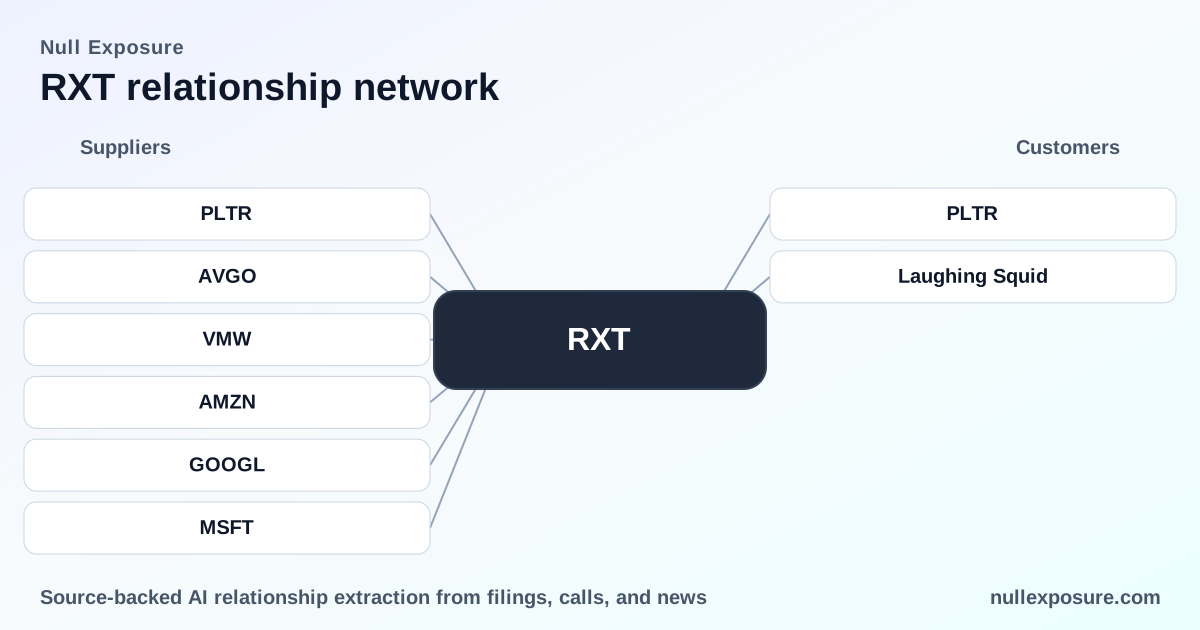
Below are the supplier and platform relationships surfaced in recent reporting and press — each relationship summarized in plain English with a concise source note.
Palantir Technologies (PLTR)
Rackspace and Palantir launched a strategic partnership to run Palantir Foundry and AIP in production on Rackspace-managed infrastructure, including hosting in Rackspace Private Cloud and UK Sovereign data centers to satisfy regulated data residency requirements; the collaboration positions Rackspace as the operational partner for Palantir deployments. Source: Rackspace–Palantir press release distributed via GlobeNewswire (Feb 18, 2026) and coverage in FinancialContent (Feb 20, 2026).
Broadcom (AVGO)
Rackspace is implementing VMware Cloud Foundation on Broadcom’s platform as part of its cloud stack modernization, signaling continued alignment with Broadcom’s enterprise virtualization and infrastructure portfolio. Source: TradersUnion article referencing the VMware Cloud Foundation implementation on the Broadcom platform (reported FY2026).
VMware (VMW)
Rackspace is advancing offerings around VMware Cloud Foundation to deliver on-premise and hosted VMware environments for enterprise customers, reflecting reliance on VMware technology to serve legacy and hybrid workloads. Source: TradersUnion coverage of Rackspace’s VMware Cloud Foundation deployment (FY2026).
Amazon Web Services (AWS / AMZN)
Rackspace designs and operates customer applications across AWS as one of its public-cloud execution platforms, which contributes to usage-based infrastructure charges that Rackspace passes through or manages on behalf of clients. Source: MarketBeat analyst alert summarizing Rackspace’s multi-cloud support including AWS (Feb 3, 2026).
Google Cloud (GOOGL)
Rackspace supports Google Cloud as part of its multi-cloud service set, enabling customers to run applications on Google’s platform while Rackspace provides operational services atop Google infrastructure. Source: MarketBeat analyst alert listing Google Cloud among Rackspace-supported platforms (Feb 3, 2026).
Microsoft Azure (MSFT)
Rackspace operates and designs customer workloads on Microsoft Azure as a core public-cloud partner in its managed services portfolio, allowing customers to choose Azure while Rackspace handles deployment and operations. Source: MarketBeat analyst alert including Microsoft Azure in Rackspace’s platform footprint (Feb 3, 2026).
What the constraints tell investors about Rackspace’s operating posture
The reporting includes several company-level signals about how Rackspace contracts and spends that are material to supplier risk and margin structure:
-
Usage-based contract exposure: Rackspace records usage charges from public cloud infrastructure providers, indicating a portion of its cost base is variable and tied to customer consumption. This structure creates revenue-aligned cost behavior but raises gross margin sensitivity when utilization patterns shift (constraint: usage_based, confidence 0.80).
-
Buyer posture for utilities and facilities: Rackspace is a large consumer of power and maintains utility contracts across major data-center regions; in 2024 it expensed roughly $40 million for utilities, which is an example of essential operating cost that sits outside software supplier relationships. This makes energy procurement a meaningful operational risk and negotiating vector (constraint: buyer, confidence 0.80).
-
Active supplier engagements: The relationships reported are active business arrangements rather than exploratory discussions, supporting current revenue and product roadmaps (constraint: active, confidence 0.90).
-
Spend concentration in mid-range bands: Utility spend (~$40M in 2024) fits a $10M–$100M spend band, showing that Rackspace’s supplier commitments include mid-sized, contractually significant obligations that influence cash flow and capital planning (constraint: spend_band 10m_100m, confidence 0.90).
Together these constraints reveal a company that contracts for a mix of fixed operational services and variable usage, operates critical data-center assets with tangible power exposure, and runs active partnerships that are integral—rather than experimental—to its service delivery.
Strategic implications for investors and operators
-
Revenue leverage to AI and managed software integration is real. The Palantir tie is a high-value win because it packages Palantir software into Rackspace-managed, sovereign-ready operations — a product that commands higher per-customer ARPU than commoditized hosting.
-
Margins remain exposed to usage and energy cost swings. Usage-linked public cloud charges and mid‑tens-of-millions utility bills reduce margin predictability and require disciplined pass-through pricing or hedging in contracts.
-
Dependence on platform partners is double-edged. Partnerships with VMware/Broadcom and the hyperscalers expand addressable market but create concentration and technical dependency that require favorable commercial terms and tight operational integration.
Consider tracking partner announcements and Rackspace filings for contract timing and revenue recognition details; for vendor negotiation benchmarking and supplier risk modeling, see our supplier scoring and risk signals at https://nullexposure.com/.
Bottom line and action steps
Rackspace is positioning itself as the operational bridge between hyperscalers, AI software vendors and regulated enterprises—a business model that earns recurring management fees while inheriting variable infrastructure costs. For investors, the Palantir partnership validates a higher-margin managed-AI revenue path, but utility and usage-based supplier costs require active monitoring to preserve gross margin expansion. Operators should prioritize contractual clarity on pass-throughs, capacity commitments and data-sovereignty SLAs.
For ongoing supplier analysis, methodology and alerts on RXT and comparable suppliers, visit https://nullexposure.com/. If you want a tailored supplier-risk briefing for Rackspace or a comparative scorecard across cloud integrators, request an engagement through our homepage at https://nullexposure.com/.