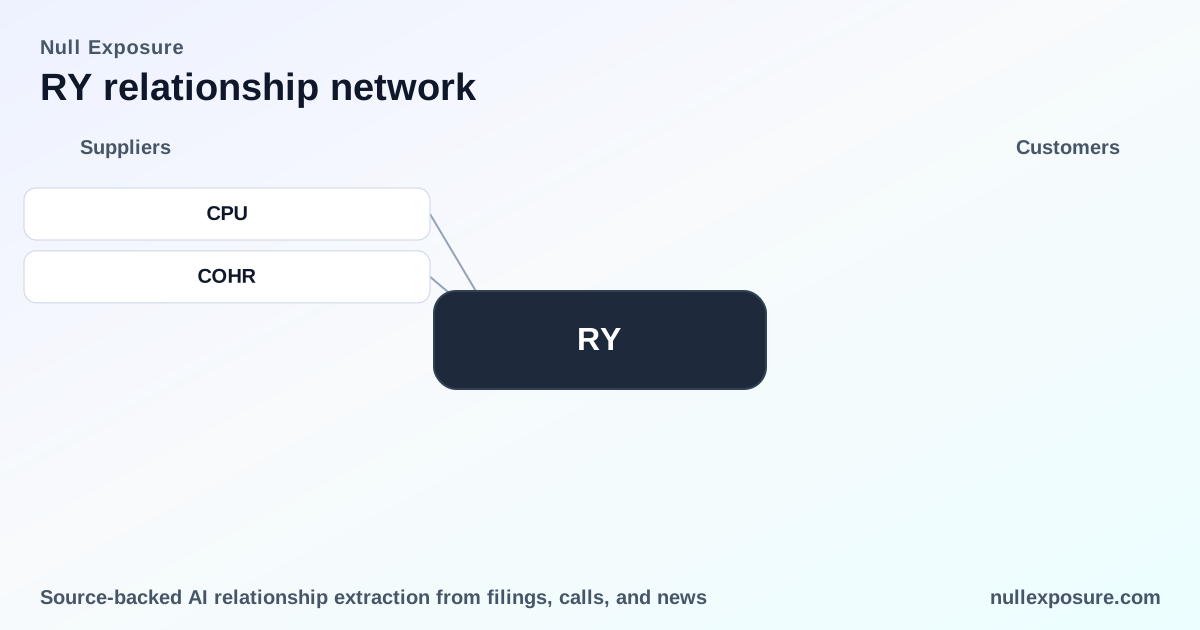
Royal Bank of Canada (RY): supplier relationships that matter for investors
Royal Bank of Canada is a globally diversified financial services franchise that monetizes through net interest income, fee-based wealth and capital markets businesses, and insurance underwriting. The bank’s operating leverage depends on a mix of client deposits, lending spreads, and recurring service fees, while its strategic investments in technology and partnerships support digital distribution and operational efficiency. Investors should view supplier relationships as operational levers that influence growth, cost structure, and resilience. For deeper intelligence on supplier links and concentration, visit https://nullexposure.com/.
Why supplier ties matter to a bank's valuation and risk profile
Banks are service platforms: third-party suppliers are not just vendors but nodes in the delivery chain for custody, shareholder services, and increasingly, AI-enabled customer experiences. Supplier choices affect regulatory compliance posture, data governance, and product time-to-market. Critical suppliers reduce operating risk if stable and well-governed; strategic tech partners can accelerate revenue capture but also raise concentration and vendor-risk exposure.
Company-level signals from the available supplier data:
- Contracting posture: RBC shows a strategic posture—public references point to partnership-style agreements for co-development (technology) rather than purely transactional procurement.
- Concentration: The supplier footprint inferred is diversified across payments/transfer agents and AI/technology vendors; no single third-party supplier is shown as dominating operations in the available records.
- Criticality: Transfer-agent relationships (shareholder recordkeeping) and core technology partnerships are operationally critical for investor communications and front-office product delivery.
- Maturity: Public communications indicate established, formalized relationships consistent with a large, regulated bank; partnerships are presented as enterprise-grade and security-focused.
No explicit supplier constraints (contract expiries, legal encumbrances, or marked concentration limits) were extracted in the available source set, so the above are company-level signals rather than relationship-specific restrictions.
Relationship-by-relationship: what investors need to know
Computershare Trust Company of Canada
- Royal Bank references Computershare as the transfer agent used for distribution of annual meeting materials and shareholder communications, indicating reliance on a market-standard registrar/custody vendor for investor recordkeeping. According to a WebWire press release linked to the bank’s annual meeting materials (FY2026), RBC points investors to Computershare’s site for access to documents. (WebWire, March 2026: https://www.webwire.com/ViewPressRel.asp?aId=351596)
- Why it matters: Transfer-agent arrangements are operationally critical for compliance and shareholder servicing; continuity and accuracy here directly affect investor relations and regulatory filings.
Cohere
- RBC has entered into a co-development partnership with Cohere to build and deploy “North for Banking,” an enterprise generative AI solution tailored to financial services, positioning Cohere as a strategic AI technology partner. This collaboration was reported in a FinTech news piece dated February 19, 2026 and reiterated in a WebWire item during FY2026. (FinTech.ca, Feb 19, 2026: https://www.fintech.ca/2026/02/19/royal-bank-investment-ai-tech-launch-team/; WebWire, Mar 2026: https://www.webwire.com/ViewPressRel.asp?aId=350805)
- Why it matters: Partnering on generative AI is material to RBC’s digital strategy—this type of relationship drives potential customer-facing product enhancements and back-office automation but also increases vendor governance requirements around data privacy and model risk.
What these suppliers tell you about RBC’s operating model
RBC’s supplier mentions highlight a dual strategy: rely on established financial-services infrastructure providers for regulatory-critical functions (Computershare) while engaging specialized technology firms (Cohere) to accelerate digital innovation. This mix signals a balanced approach—preserve operational stability where regulation is tight, and pursue agile, high-impact partnerships where differentiation is possible.
Key investor takeaways:
- Operational continuity is prioritized for core investor services via incumbent vendor relationships.
- Technology partnerships are being elevated to strategic co-development roles, indicating management is investing in revenue-adjacent capabilities rather than one-off vendor integrations.
- Vendor governance will be a rising focus on earnings calls and in filings as AI and data partnerships scale; expect questions on data segregation, IP ownership, and model validation.
Explore how supplier risk factors integrate into broader counterparty analysis at https://nullexposure.com/.
Risk, upside, and what to monitor next
Upside: Successful deployment of enterprise AI could lower cost-to-serve and create product differentiation in wealth and retail channels, supporting margin expansion. Technology co-development also shortens time-to-market for new features that translate into fee income.
Risk: Increasing reliance on third-party AI vendors elevates concentration and model-risk exposure; regulator scrutiny of data handling and AI governance will intensify. Transfer-agent continuity is low-risk operationally today, but any service disruption would have outsized reputational effects.
What to monitor in the next 12 months:
- Explicit contracting terms disclosed in filings or shareholder materials that reveal duration, exclusivity, and data rights with AI partners.
- Any expanded references to vendor concentration in management commentary or risk disclosures.
- Operational KPIs tied to technology rollouts (adoption rates, cost savings, time-to-market metrics) that quantify partnership ROI.
Conclusion — practical next steps for investors
Royal Bank of Canada is executing a pragmatic supplier strategy: stable incumbents for compliance-critical services and strategic tech partnerships for digital transformation. Investors should watch management commentary for the scale and governance of AI initiatives and any disclosures tying vendor performance to financial metrics.
For a consolidated view of supplier links and how they intersect with credit and operational risk, review our platform: https://nullexposure.com/. If you want targeted supplier exposure analysis for RY or comparable banks, start with our homepage at https://nullexposure.com/ and request a supplier risk brief tailored to your research needs.
Bottom line: Suppliers like Computershare validate RBC’s operational backbone; partners like Cohere signal an active push into AI-enabled revenue streams. Both kinds of relationships are material to valuation and risk — follow the contractual disclosures and operational KPIs to track whether these supplier relationships transform into sustained financial upside.