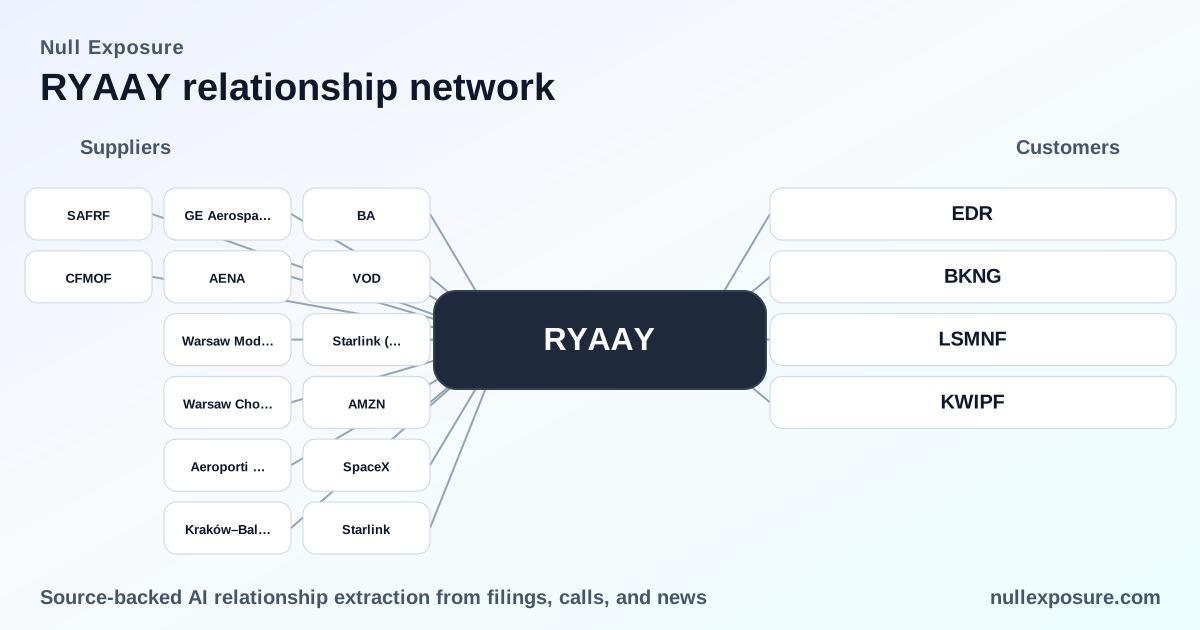
Ryanair (RYAAY) supplier map: fleet, engines, connectivity and the airports that matter
Ryanair is Europe’s largest low‑cost carrier by passengers and monetizes through a simplified single‑fleet operating model and heavy ancillary revenue—low base fares, rapid aircraft turnarounds, and paid extras. The company’s unit economics are directly tied to its aircraft suppliers, engine and MRO partners, in‑flight connectivity options, and airport commercial terms; those supplier relationships therefore translate into tangible revenue and cost levers for investors. For sourcing and continuous monitoring of counterparty exposure, see https://nullexposure.com/.
Why supplier relationships are a capital‑markets lever for Ryanair
Ryanair’s business model concentrates operational risk into a compact supplier set. That concentration is a structural advantage for cost control and negotiating power, but it creates direct execution risk if deliveries, engine support, or airport access diverge from plan. Consider these company‑level signals that define Ryanair’s contracting posture, concentration, criticality and maturity:
- Contracting posture — long‑dated fleet and service agreements. Ryanair secures capacity and predictability through multi‑year purchase and service contracts rather than spot arrangements, locking in unit cost advantages.
- Concentration — single‑type Boeing 737 fleet. A single‑type strategy reduces training, parts, and MRO complexity but concentrates vendor exposure with Boeing and engine suppliers.
- Criticality — deliveries and spare parts are operationally material. On‑time aircraft and engine support directly influence capacity, unit costs, and the company’s traffic outlook.
- Maturity — established relationships with global OEMs and airports. Multi‑decade partnerships (engines, MRO, airport bases) reduce supplier onboarding risk and preserve scale leverage.
For signal monitoring and counterparty visibility, visit https://nullexposure.com/ to map exposures and filings.
Supplier relationships you need to know
The Boeing Company (BA)
Boeing is Ryanair’s primary aircraft supplier; Ryanair operates a single‑fleet model based on the Boeing 737 family and has contracted new MAX‑10 deliveries. Earlier-than-expected Boeing deliveries are already being cited as a driver of the company’s FY2026 traffic upgrade to ~208 million passengers, and Ryanair expects the first 15 MAX‑10s in Spring 2027 with roughly 300 due by March 2034. (See Ryanair corporate report and related press coverage, March 2026: https://corporate.ryanair.com/novetats/ryanair-reports-q3-pat-of-e115m-pre-exceptional/ and related press notices in The Globe and Mail and TradingView.)
CFM (CFMOF)
CFM has a multi‑year spare‑parts agreement with Ryanair to support fleet growth to roughly 800 Boeing aircraft and some 2,000 CFM engines; this contract centralizes engine spare‑parts purchasing and materially reduces Ryanair’s engine‑support fragmentation. (Research‑Tree coverage, March 2026: https://www.research-tree.com/newsfeed/article/ryanair-holdings-plc-ryanair-cfm-agree-multi-billion-engine-contract-3168555)
GE Aerospace
GE Aerospace is referenced as a strategic partner for capacity and turnaround solutions, with GE’s leadership describing Ryanair as “one of our largest customers.” GE’s role underlines Ryanair’s focus on throughput and quick turnaround engineering solutions that sustain low unit costs. (Research‑Tree article, March 2026: https://www.research-tree.com/newsfeed/article/ryanair-holdings-plc-ryanair-cfm-agree-multi-billion-engine-contract-3168555)
Safran (SAFRF)
Safran is cited for an expanded MRO services relationship supporting Ryanair’s growth; Safran’s CEO framed the engagement as a long‑term strategic tie to sustain expansion and serviceability. A comprehensive MRO partnership with Safran improves fleet reliability and supports the single‑fleet strategy. (Research‑Tree article, March 2026: https://www.research-tree.com/newsfeed/article/ryanair-holdings-plc-ryanair-cfm-agree-multi-billion-engine-contract-3168555)
Vodafone Group PLC (VOD)
Vodafone is one of the connectivity vendors Ryanair has discussed for in‑flight Wi‑Fi trials or rollouts. Ryanair has held talks with Vodafone alongside other providers, though management projects low paid take‑rates for short flights which constrains the revenue upside of a paid Wi‑Fi model. (Sahm Capital coverage, January 2026: https://www.sahmcapital.com/news/content/ryanair-ceo-michael-oleary-thinks-airlines-will-offer-free-onboard-wi-fi-to-customers-after-feud-with-elon-musk-2026-01-28)
Starlink / SpaceX
Starlink (SpaceX) is a public part of the connectivity debate; Ryanair’s CEO publicly dismissed broad Starlink installation citing added fuel costs from antenna weight and drag and estimating a significant annual operating cost if adopted. The Starlink option represents a binary tradeoff between potential passenger experience upside and clear fuel/cost penalties for Ryanair’s ultra‑low‑cost model. (Finviz and The Edge Malaysia coverage, January–February 2026: https://finviz.com/news/279539/ and https://theedgemalaysia.com/node/789903)
Amazon (AMZN - Project “Leo”)
Amazon’s LEO constellation effort has been discussed alongside other providers as a potential in‑flight Wi‑Fi supplier. Ryanair engaged in exploratory talks with Amazon’s satellite team but projects limited paid adoption by passengers on short sectors. (Sahm Capital coverage, January 2026: https://www.sahmcapital.com/news/content/ryanair-ceo-michael-oleary-thinks-airlines-will-offer-free-onboard-wi-fi-to-customers-after-feud-with-elon-musk-2026-01-28)
Aena (AENA)
Aena is a major airport operator whose proposed tariff schedule includes a +21% charge increase over five years that directly affects Ryanair’s Spanish network economics. Rising airport charges at scale weaken Ryanair’s cost advantage on certain routes and could shift capacity allocation decisions. (Ryanair corporate news, March 2026: https://corporate.ryanair.com/news/?market=de)
Warsaw Modlin
Ryanair’s planned S26 base at Warsaw Modlin will host 7 aircraft and 49 routes, including seven new routes, reflecting a $700m investment tied to regional capacity expansion. This operational commitment signals Ryanair’s ongoing willingness to invest in localized bases. (Ryanair corporate news, March 2026: https://corporate.ryanair.com/news/?market=de)
Warsaw Chopin
Ryanair will operate 12 routes from Warsaw Chopin including new services to Leeds, Porto and Seville and expects to carry about 700,000 passengers per year. Chopin remains a strategic Polish hub for Ryanair’s network density play. (Ryanair corporate news, March 2026: https://corporate.ryanair.com/news/?market=de)
Aeroporti di Puglia
Ryanair’s Summer 2026 schedule strengthens connectivity into Puglia and consolidates a strategic partnership that local officials frame as critically important for regional tourism recovery. Local airport partnerships sustain Ryanair’s route density and ancillary income in tourist markets. (Ryanair corporate news, March 2026: https://corporate.ryanair.com/news/?market=de)
Kraków–Balice Airport
Ryanair announced further development of its base at Kraków–Balice, signalling ongoing network investment in Central Europe and reinforcing the carrier’s hub‑and‑spoke density in key growth markets. Expanded bases like Kraków support yield management and market share gains. (Ryanair corporate news, March 2026: https://corporate.ryanair.com/news/?market=de)
For a mapped view of these counterparties and their filing history, visit https://nullexposure.com/ and review supplier exposures.
What investors should take away: risks and operational levers
- Fleet delivery timing is a performance lever. Boeing delivery schedules directly scale Ryanair’s capacity guidance and traffic forecasts; early deliveries have already lifted FY2026 traffic outlooks. (See Boeing‑Ryanair delivery commentary in March 2026 press reports: https://www.theglobeandmail.com/investing/markets/stocks/BA/pressreleases/26692/ryanairs-traffic-numbers-for-january-2026-improve-year-over-year/)
- Engine and MRO contracts trade cash certainty for supplier concentration. The CFM spare‑parts agreement and expanded Safran/GE ties reduce unit downtime and bargaining friction but increase vendor dependence. (Research‑Tree coverage, March 2026: https://www.research-tree.com/newsfeed/article/ryanair-holdings-plc-ryanair-cfm-agree-multi-billion-engine-contract-3168555)
- Connectivity choices will not transform ancillary economics on short sectors. Management projects low paid takeup, so in‑flight Wi‑Fi is a passenger experience decision more than a near‑term profit center. (Sahm Capital, January 2026: https://www.sahmcapital.com/news/content/ryanair-ceo-michael-oleary-thinks-airlines-will-offer-free-onboard-wi-fi-to-customers-after-feud-with-elon-musk-2026-01-28)
- Airport charges are a local negotiating battlefield. Aena’s proposed tariff increases and local base investments in Warsaw, Puglia and Kraków will steer where Ryanair allocates capacity next season. (Ryanair corporate news, March 2026: https://corporate.ryanair.com/news/?market=de)
Bottom line and next steps
Ryanair’s supplier structure is a double‑edged sword: tight supplier relationships deliver cost leadership and predictable capacity, but they also concentrate execution risk in a handful of OEMs and airport partners. For active investors and operators, the most material variables to watch are Boeing delivery cadence, CFM/engine spare availability, airport tariff developments, and management decisions on connectivity capex. For a detailed counterparty exposure dashboard and continuous monitoring, start here: https://nullexposure.com/.
Assess supplier performance against Ryanair’s traffic, unit cost and ancillary trends before making allocation decisions. For direct access to supplier‑level filings and real‑time relationship mapping, visit https://nullexposure.com/.