Ryan Specialty Group Holdings (RYAN): supplier relationships and operational posture investors should price in
Ryan Specialty Group is a wholesale insurance and specialty underwriting platform that monetizes through brokerage fees, underwriting profit participation and fee-based risk management services delivered across a dispersed network of carriers and distribution partners. Revenue is driven by placement volume and underwriting margin, while capital structure and insurance purchasing are material drivers of cost and risk transfer. For investors evaluating supplier counterparty risk and capital markets access, the composition of Ryan’s banking, underwriting and advisory relationships is as important as top-line growth. For a deeper supplier risk scan, visit https://nullexposure.com/.
Business model and operating constraints that matter to investors
- Long-dated financing: Ryan carries a 7-year term loan facility with scheduled principal payments and a maturity in September 2031, priced off Adjusted Term SOFR (references show step-downs in spread over 2024–2025). This is a company-level financing posture that supports multi-year strategic initiatives and constrains refinancing and free-cash-flow dynamics through the late 2020s (company disclosures as of December 31, 2025).
- Large insurance spend and retained risk: Ryan maintains an E&O tower with a $150 million limit per occurrence and aggregate coverage, and a $5 million self-insured retention per claim as of December 31, 2025 — a clear signal of >$100m+ risk-transfer spend and significant retained exposure that influences claims volatility and the cost base.
- Concentration & contracting posture: Capital markets relationships are broad and transactional—multiple lead and co-managers are used for equity and debt offerings—while insurance counterparties represent operational criticality because coverage and retentions directly affect loss economics.
- Maturity & criticality: Long-term debt and material insurance programs indicate a mature contracting posture: the firm balances multi-year capital commitments with ongoing insurance purchases that are critical to operational continuity.
If you want an investor-focused supplier assessment tied to these constraints, see https://nullexposure.com/ for subscription access.
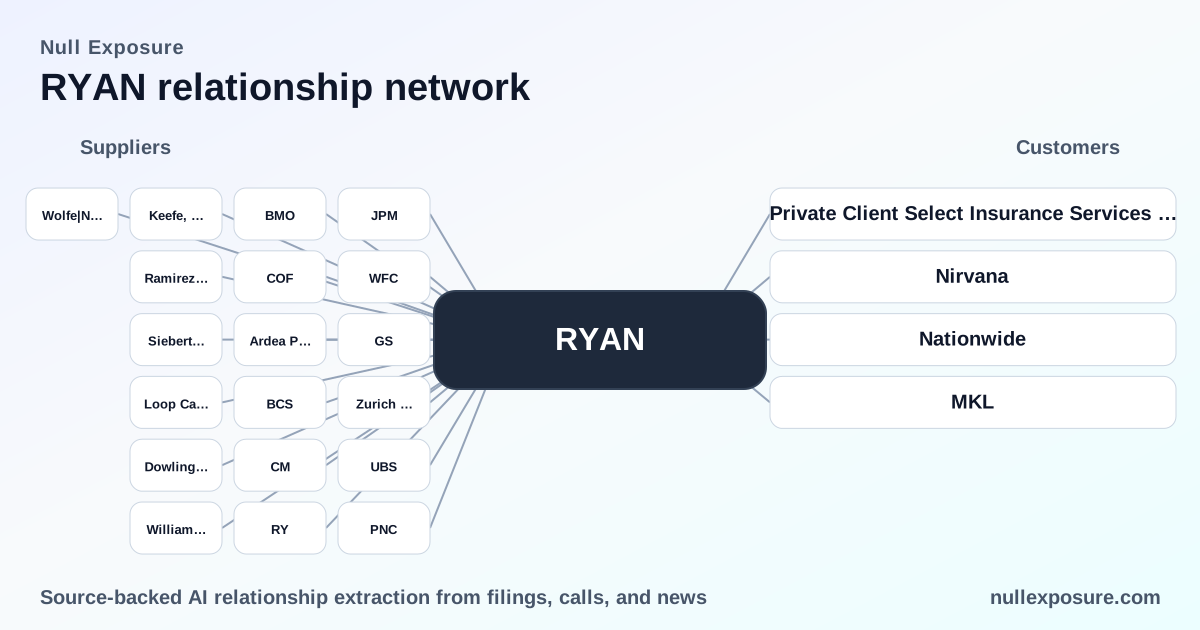
How Ryan’s counterparties lay out across capital markets and underwriting partners Below I cover every relationship surfaced in the supplied results with concise, investor-oriented notes and source pointers.
- J.P. Morgan — The bank acted as a lead book-running manager on Ryan’s public offering activity noted in July 2021, reflecting J.P. Morgan’s role in Ryan’s capital markets access and execution. (Insurance Journal, July 22, 2021)
- Wells Fargo Securities — Wells Fargo served alongside other lead book-runners on the offering, giving Ryan diversified distribution into institutional channels at that time. (Insurance Journal, July 22, 2021)
- Goldman Sachs & Co. — Goldman Sachs participated as a lead book-running manager for the same offering, reinforcing top-tier underwriting coverage for Ryan’s equity issuance. (Insurance Journal, July 22, 2021)
- Barclays — Barclays is listed as a lead book-runner on the 2021 offering, indicating multiple front-office banks were engaged to broaden investor reach. (Insurance Journal, July 22, 2021)
- UBS Investment Bank — UBS operated as a book-running manager on the offering, underscoring Ryan’s use of a mix of global and boutique banks for distribution. (Insurance Journal, July 22, 2021)
- William Blair — William Blair appears as a book-running manager on the 2021 transaction, representing mid‑market underwriting support and placement capability. (Insurance Journal, July 22, 2021)
- RBC Capital Markets — RBC is named among the book-running managers for the offering, showing Canadian and cross-border distribution participation. (Insurance Journal, July 22, 2021)
- BMO Capital Markets — BMO is listed as a book-running manager, contributing to the syndicate depth for the capital raise. (Insurance Journal, July 22, 2021)
- Keefe, Bruyette & Woods — KBW served in the book-running manager group, providing sector-focused distribution for insurance-market investors. (Insurance Journal, July 22, 2021)
- PNC Capital Markets — PNC worked as a co‑manager on the offering, widening the co-manager syndicate for retail/institutional reach. (Insurance Journal, July 22, 2021)
- Capital One Securities — Capital One participated as a co-manager, adding to the breadth of distribution for the transaction. (Insurance Journal, July 22, 2021)
- CIBC Capital Markets — CIBC appears among co-managers, indicating participation by North American capital markets desks. (Insurance Journal, July 22, 2021)
- Dowling & Partners Securities — Dowling is listed as a co-manager, representing additional niche distribution channels engaged in the deal. (Insurance Journal, July 22, 2021)
- Loop Capital Markets — Loop Capital is shown as a co-manager on the offering, reflecting minority‑specialist underwriting participation. (Insurance Journal, July 22, 2021)
- Ramirez & Co., Inc. — Ramirez is cited as a co-manager, broadening the syndicate’s retail and regional reach. (Insurance Journal, July 22, 2021)
- Siebert Williams Shank — Siebert served as a co-manager on the offering, often used for specific investor outreach strategies. (Insurance Journal, July 22, 2021)
- Dowling & Partners Securities — (appears twice in records) again recorded as a co-manager on the 2021 offering, consistent with syndicate composition. (Insurance Journal, July 22, 2021)
- Wolfe|Nomura Strategic Alliance — The alliance is included as a co-manager, reinforcing the use of strategic distribution partnerships for equity placement. (Insurance Journal, July 22, 2021)
- Ardea Partners — Ardea Partners acted as Ryan Specialty’s exclusive financial adviser on the US Assure transaction referenced in 2024, signaling boutique advisory engagement for M&A activity. (InsuranceNewsNet, FY2024)
- Zurich American Insurance Co. — Zurich American underwrites market insurance coverage on behalf of US Assure as cited in the 2024 transaction note, illustrating Ryan’s use of major global carriers in its reinsurance/placement stack. (InsuranceNewsNet, FY2024)
What this syndicate mix means for investors Ryan’s capital markets engagements show broad, multi-bank syndication for equity offerings, which reduces execution concentration risk and supports liquidity in secondary markets. The mix of global banks (J.P. Morgan, Goldman Sachs, UBS, Barclays) and regional/co-manager firms suggests a deliberate distribution strategy to access institutional and retail channels.
Conversely, insurance relationships—illustrated by Zurich American’s role on market placements—are operationally critical because coverage limits, reinsurance arrangements and retentions directly affect loss experience and capital adequacy. The company-level constraint showing a $150 million E&O tower and $5 million retention signals material annual spend and retained risk that underwrite loss volatility and solvency considerations (company disclosures as of December 31, 2025).
Mid-article action point: get a targeted supplier risk brief at https://nullexposure.com/ to translate these relationships into quantitative exposure metrics.
Investment implications and risk checklist
- Capital access: Syndicated bank relationships provide access to capital markets; successful execution in 2021 and advisor-led M&A activity in 2024 evidence active use of those channels.
- Insurance cost and volatility: Large E&O limits and meaningful retention make loss experience a first-order driver of earnings volatility; pricing cycles in specialty lines will pass through to margins.
- Refinancing timeline: The September 2031 term loan maturity creates a refinancing window that should be monitored for interest-rate and covenant risk as the date approaches.
- Counterparty dispersion: The breadth of book‑runners reduces counterparty concentration in capital markets; client and carrier concentration should be monitored separately using policy-level data.
Final takeaway and next steps Ryan runs a mature capital markets and advisory network while relying on large carrier placements that materially affect its earnings volatility. Investors should track underwriting loss trends against the company’s insurance tower structure and the 2031 debt maturity. For a practitioner-ready supplier risk report and to benchmark these relationships against peers, visit https://nullexposure.com/.