Ryde Group Ltd. (RYDE) — supplier relationships and what they mean for investors
Ryde Group Ltd. operates a Singapore‑focused mobility and quick‑commerce platform that monetizes through ride fares, delivery fees, and platform services for drivers and merchants, augmented by strategic partnerships for payments, training and technology. The company’s public listing and partner disclosures show a commercial posture built around alliance-driven distribution and platform integrations rather than heavy capital ownership of fleet or logistics assets. Investors should focus on partner reliability, monetization cadence, and the company’s fragile profitability profile when evaluating supplier exposure.
For a consolidated view of third‑party relationships and risk, visit https://nullexposure.com/.
Quick read: where revenue and counterparty risk come from
Ryde’s public metrics show small revenues (Revenue TTM ~$10.3M) with negative margins (Operating margin TTM -85%) and negative EBITDA, a capital structure consistent with an early‑stage platform still scaling unit economics. The company’s commercial model relies on payment integrations, upskilling and autonomous vehicle pilot partners, which create both near‑term revenue levers and concentration/risk points if a partner changes terms or availability. High beta (3.28), low institutional ownership (0.10%) and a small market capitalization (~$82.9M) amplify market sensitivity to partner news and execution outcomes.
Explore supplier analytics and relationship mapping at https://nullexposure.com/.
Supplier and partner map: what each relationship means for operations and risk
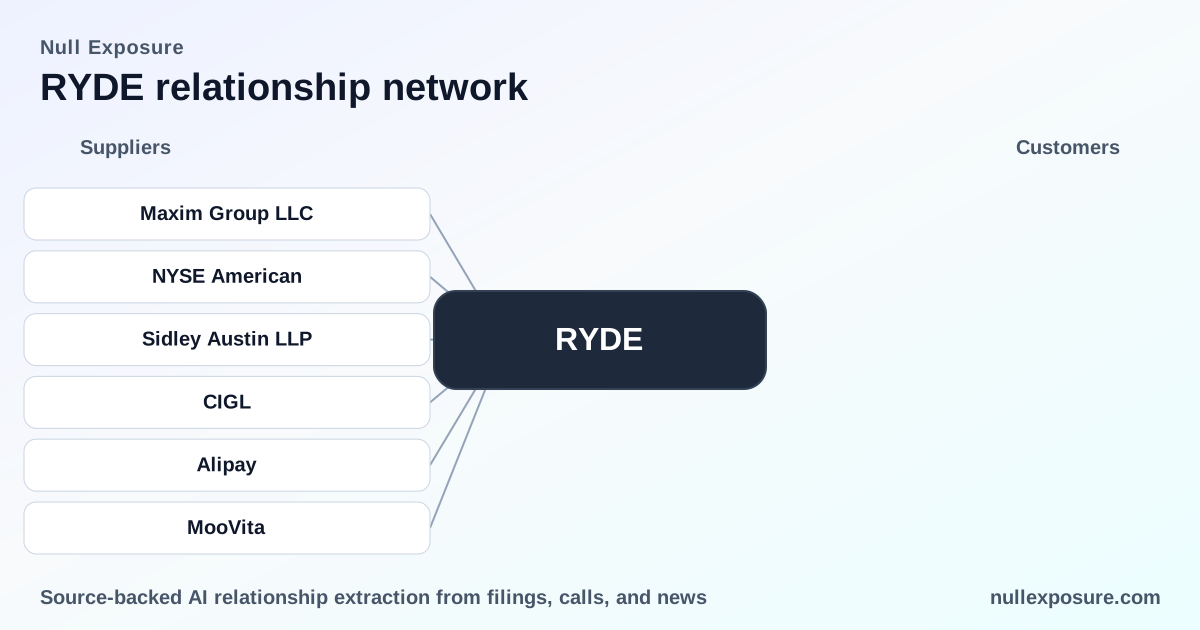
This section reviews every relationship disclosed in public reporting and press coverage. Each entry is a plain‑English summary with a source reference.
Maxim Group LLC
Maxim Group acted as an underwriter for Ryde’s initial public offering. This connection reflects the capital markets channel Ryde used to access public equity and liquidity during its listing process (Sidley announcement, March 2024).
Source: Sidley announcement covering Ryde’s IPO and NYSE American listing (March 2024).
NYSE American
Ryde listed its Class A ordinary shares on the NYSE American in the company’s IPO, providing the exchange venue for public trading and regulatory disclosure obligations (Sidley announcement, March 2024).
Source: Sidley announcement covering Ryde’s IPO and NYSE American listing (March 2024).
Sidley Austin LLP
Sidley Austin served as Ryde’s legal advisor for the IPO and listing, establishing the corporate and securities governance that underpins Ryde’s access to U.S. capital markets (Sidley announcement, March 2024).
Source: Sidley announcement covering Ryde’s IPO and NYSE American listing (March 2024).
Concorde International Group Ltd. (CIGL)
Concorde partnered with Ryde on a Facilities and Security Management Programme to upskill driver‑partners; the first cohort completed professional training under the collaboration, signaling Ryde’s investment in driver quality and retention (FY2025 press release distributed on Yahoo Finance).
Source: Company press release on Yahoo Finance describing driver‑partner upskilling with Concorde (FY2025).
Alipay
Ryde integrated Alipay to provide a seamless payment experience for international visitors, expanding payment options and reducing friction for outbound tourist and cross‑border transactions on Ryde’s platform (FY2025 press release on Yahoo Finance).
Source: Company announcement on Yahoo Finance about integrating Alipay for international payments (FY2025).
MooVita
Ryde partnered with autonomous vehicle technology provider MooVita to propose a driverless shuttle service linking Punggol neighborhoods to MRT stations, advancing Ryde’s pilot programs in AV‑enabled first/last‑mile connectivity for Q4 2025 plans (The Straits Times report, FY2025).
Source: The Straits Times article on Ryde’s partnership with MooVita to propose driverless shuttle services (FY2025).
How these relationships translate into operational constraints and signals
Ryde’s disclosed relationships and corporate profile create a clear set of company‑level signals for investors:
- Contracting posture — partnership‑centric and integration‑driven. Ryde’s model outsources key capabilities (payments, training, AV tech, underwriting/legal for capital markets), indicating a commercial strategy that leverages specialized suppliers rather than building all capabilities in‑house.
- Concentration and counterparty exposure. Integrations with a small set of providers (payments, AV partner, training partner) create single‑point dependencies for specific functionalities—payments acceptance, driver supply quality, or AV technology rollout.
- Criticality of partners to go‑to‑market. Payment and driver upskilling partnerships are operationally critical: payment frictions reduce take rates and training programs affect driver availability and service quality, both of which directly influence revenue.
- Maturity signal — early commercial stage. The company’s negative margins, small revenue base and recent IPO support an immature operating profile where partner execution and scaling are the primary drivers of near‑term value creation.
These signals are company‑level and reflect the operating model; they are not assigned to any single partner unless the partner is explicitly named in source material.
Investment implications: risks and catalysts
- Risk — partner execution can be binary. A failed AV pilot, reversal of a payment integration or a contractual dispute around driver programs would have an outsized operational impact given Ryde’s size and concentrated partner roster. Monitor partner SLAs, contractual terms and pilot outcomes.
- Catalyst — successful commercialization of partnerships. If the MooVita shuttle proposal and driver upskilling scale into recurring services, Ryde can improve unit economics and increase frequency on the platform. Successful cross‑border payment adoption via Alipay can increase tourist volume and transaction value.
- Financial fragility. Negative EBITDA and steep operating losses require capital markets access or profitable scale to de‑risk the business; the IPO and underwriter/legal relationships are therefore economically material.
Mid‑article action: for a deeper supplier risk assessment and counterparty monitoring playbook, visit https://nullexposure.com/.
Final takeaways and recommended monitoring
Ryde’s supplier network is compact but strategically important: payments, driver training and AV technology are core enablers rather than peripheral services. Investors should prioritize transparency on contractual terms, pilot performance metrics, and the timeline to meaningful revenue contribution from each partnership. Given the company’s small market cap, high beta, and weak profitability, partner news will continue to drive share‑price volatility.
For ongoing coverage and to map Ryde’s supplier exposure into an investor risk dashboard, see https://nullexposure.com/.