RYTHM, Inc.: Supplier relationships, brand moves, and what operators should price in
RYTHM, Inc. operates as a consumer-facing supplier to the U.S. cannabis and hemp market by owning and licensing branded intellectual property and coordinating third‑party manufacturing and distribution. The company monetizes through brand licensing, direct product sales via partner co-manufacturers, and strategic acquisitions of brand portfolios that are financed through convertible instruments — a model that mixes asset-light brand economics with sourcing commitments to contract manufacturers. Investors should value RYTHM as a brand-holder whose cash flows depend on partner manufacturing execution, contract commitments with suppliers, and the capital structure consequences of acquisition financing.
If you want a structured view of supplier exposures and brand transaction implications, visit https://nullexposure.com/ for the complete supplier mapping and original filings.
How RYTHM runs the business and turns brands into revenue
RYTHM’s commercial model separates brand ownership from production. The company acquires or licenses consumer brands and then outsources manufacturing to third parties or co-manufacturers; distribution is routed through partner networks. This creates upside from brand scaling with relatively low fixed capital but concentrates operational risk in a small set of manufacturing and supply contracts. The operating playbook produces revenue only when partners convert intellectual property into shelf product and retail sales — hence supplier reliability and contractual commitments are the critical levers.
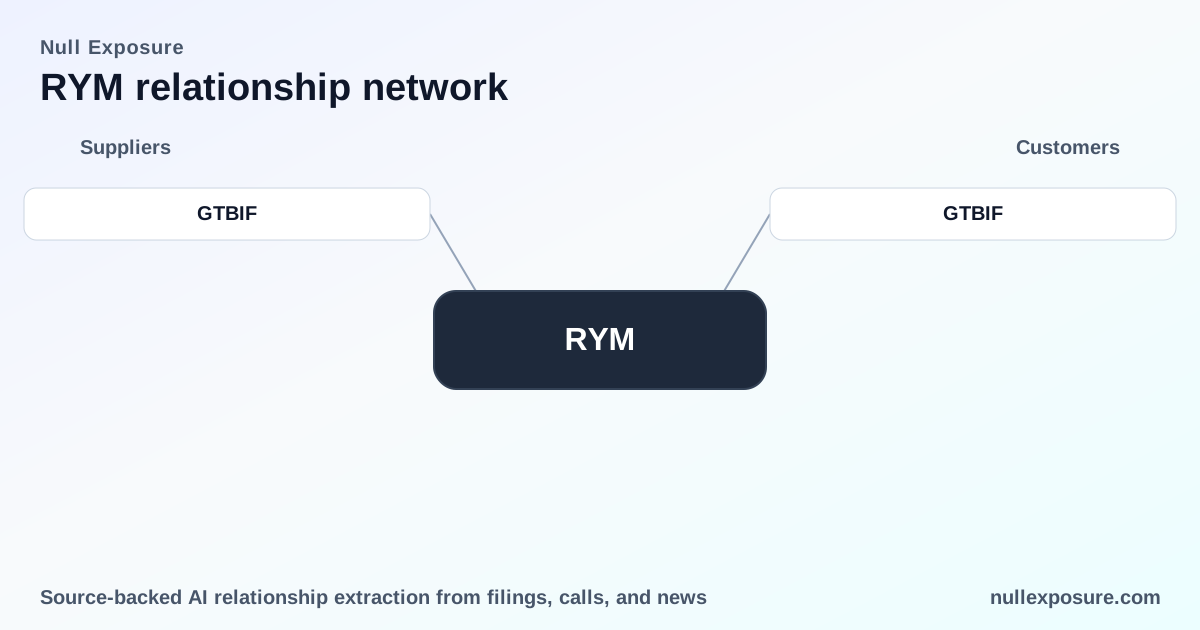
What the public record says about Green Thumb Industries relationships
RYTHM’s public signals around Green Thumb Industries are concentrated in two news reports about brand acquisition and one SEC filing line-item that touches related-party purchases.
- According to RYTHM’s FY2024 10‑K, the company recorded a nominal net purchasing (sales) activity line for Green Thumb Industries showing an amount of $1 (thousand), indicating minimal direct procurement activity with Green Thumb in FY2024 as disclosed in the related‑party table. This is taken from the FY2024 annual filing.
- A March 2026 Yahoo Finance report noted that Agrify Corporation (which rebranded to RYTHM) announced the acquisition of a portfolio of brand intellectual property — including the RYTHM brand itself, Dogwalkers, Beboe, and others — from Green Thumb Industries for US$50 million paid via a convertible note, signaling a balance-sheet financed transfer of brand assets from Green Thumb to RYTHM.
- An industry outlet, MJDaily, echoed the March 2026 announcement, reporting the same $50 million convertible note consideration for the brand portfolio acquisition from Green Thumb, underscoring market coverage and deal confirmation in cannabis trade press in March 2026.
These three items together show a strategic brand purchase from Green Thumb as the material relationship, while direct procurement between the two in FY2024 was immaterial on the company’s disclosed related‑party schedule.
Supplier constraints and the Mack manufacturing relationship that matters
RYTHM’s operating disclosures and contract excerpts reveal a separate, material manufacturing relationship with Mack Molding Co. that drives supply-side risk and committed spend:
- A five‑year supply agreement with Mack was executed in December 2020, under which Mack became a key supplier of Vapor Flow Units (VFUs). The contract framework includes multi-year minimum purchase commitments that increase over time.
- Per the modification agreement, RYTHM was contractually obligated to purchase a minimum of 25 VFUs per quarter during 2024 and 50 VFUs per quarter for the six quarters beginning Q1 2025 at a unit price of $14,000. This structure creates firm future cash obligations tied to production volumes.
- Since February 2021, RYTHM increased purchase orders with Mack to approximately $26.5 million toward VFU production — placing the relationship in the $10m–$100m spend band, a scale that makes Mack a material single-source supplier by spend.
- The company also discloses that certain product lines are co-manufactured by third parties and that RYTHM typically lacks direct operational control over those co‑manufacturers, heightening reliance on supplier execution.
These contract excerpts come directly from the company’s contractual disclosures and provide clear signals about concentration, maturity, and criticality: long‑dated commitments, meaningful spend concentration, and operational dependence on external manufacturers.
Mid‑read resource: for a supplier‑level exposure map and the underlying contract excerpts, visit https://nullexposure.com/.
What this means for investors and operators
- Concentration risk is elevated. A multi‑year supply commitment and a single key manufacturer accounting for tens of millions in purchase orders make RYTHM operationally vulnerable to supplier disruption or cost inflation.
- Cash-flow timing is linked to conversion of brand assets into retail product. The $50 million convertible note used to acquire brands from Green Thumb increases leverage on future brand revenues; investors must track conversion rates from licensed IP to SKU sales.
- Contractual rigidity creates downside in slower demand environments. Committed VFU purchases at fixed unit prices produce downside exposure if market uptake lags; conversely, successful scaling improves margins for an asset-light brand owner.
- Counterparty and financing risk are intertwined. Brand acquisition financed via convertible notes transfers credit and refinancing risk onto RYTHM; supplier obligations to Mack amplify the importance of liquidity management.
Investors should stress-test scenarios where manufacturing ramp is delayed or where marketing-driven SKU sales underperform relative to the balance-sheet obligations.
Actionable steps for a due‑diligence checklist
- Validate conversion metrics: How quickly do acquired brands translate into retail POS and what are wholesale margins under co‑manufacturing agreements?
- Confirm supplier fallback: Is there redundancy beyond Mack for critical components (VFUs), and what are lead times to qualify alternative manufacturers?
- Model financing sensitivity: Run scenarios for the $50M convertible note on dilution, interest run‑rate, and refinancing under adverse conditions.
- Monitor related-party dynamics: The FY2024 related-party table shows minimal procurement from Green Thumb, but the brand acquisition shifts this dynamic from supplier relationships to IP ownership; track subsequent commercial interactions.
If you need a mapped supplier report and the underlying contract excerpts compiled for investor presentations, explore the full supplier mapping at https://nullexposure.com/.
Bottom line and recommended positioning
RYTHM is a brand‑led, asset‑light operator whose economics depend on external manufacturing partners and financing discipline. The company’s value will expand only if third‑party manufacturers execute to plan and brand acquisitions convert to predictable shelf revenues; conversely, long‑term purchase commitments and convertible financing create asymmetric downside if execution slips. For investors, the recommendation is to treat RYTHM as a high‑beta, execution‑sensitive play on cannabis brand monetization — overweight only with strong evidence of manufacturing redundancy, improving retail traction, and manageable refinancing paths.
For the comprehensive supplier roster, contract evidentiary excerpts, and related-party schedules that inform this view, visit https://nullexposure.com/ before structuring exposure.