rYojbaba (RYOJ): A concise supplier-risk read for investors and operators
rYojbaba Co., Ltd. is a small-cap, Japan-headquartered provider of consulting and health services that monetizes through client engagements and recurring service contracts in regional markets. Revenue generation is fee-for-service with a compact cost structure, and upside is concentrated in localized contract wins and any successful scale-up of service lines; the company trades on NASDAQ as RYOJ and shows a mix of positive operating margins alongside a negative diluted EPS, signaling early-stage public-company dynamics. For investors and counterparties, the most relevant supplier relationship signal today is a market linkage to HeartCore through equity warrants, which creates cross-stock exposure and trading-driven balance-sheet sensitivity. Explore more supplier-mapping intelligence at https://nullexposure.com/.
How rYojbaba makes money and why supplier ties matter
rYojbaba sells consulting and health-related services primarily in Japan, collecting fees and potentially recurring payments from institutional and municipal clients. The company operates with narrow market reach but healthy operating margins, reporting Revenue TTM of $11.5M and Operating Margin TTM of roughly 12.7%—metrics that reflect a lean delivery model rather than a broad diversified business. Insider concentration is extreme: insiders hold roughly 80% of shares outstanding, while institutional ownership is negligible, which directly shapes contracting posture, counterparty negotiations, and strategic flexibility.
- Contracting posture: High insider ownership and small public float indicate a tightly controlled contracting posture; counterparties face limited public-market pressure on corporate decisions.
- Concentration: Revenue and influence are concentrated—both operationally (regional customers) and ownership-wise (insiders dominate).
- Criticality: For local customers, rYojbaba can be critical where specialized consulting or health services are scarce; from a global-supplier standpoint, it is not systemically critical.
- Maturity: Publicly listed but early-stage as a listed company: positive margins coexist with negative diluted EPS and limited analyst coverage, indicating transitional maturity.
No third-party operational constraints or supplier-level compliance restrictions are flagged in available records; there are no reported constraints that would affect supplier relationships at the company level.
Relationship map: HeartCore and the equity tie that traders watch
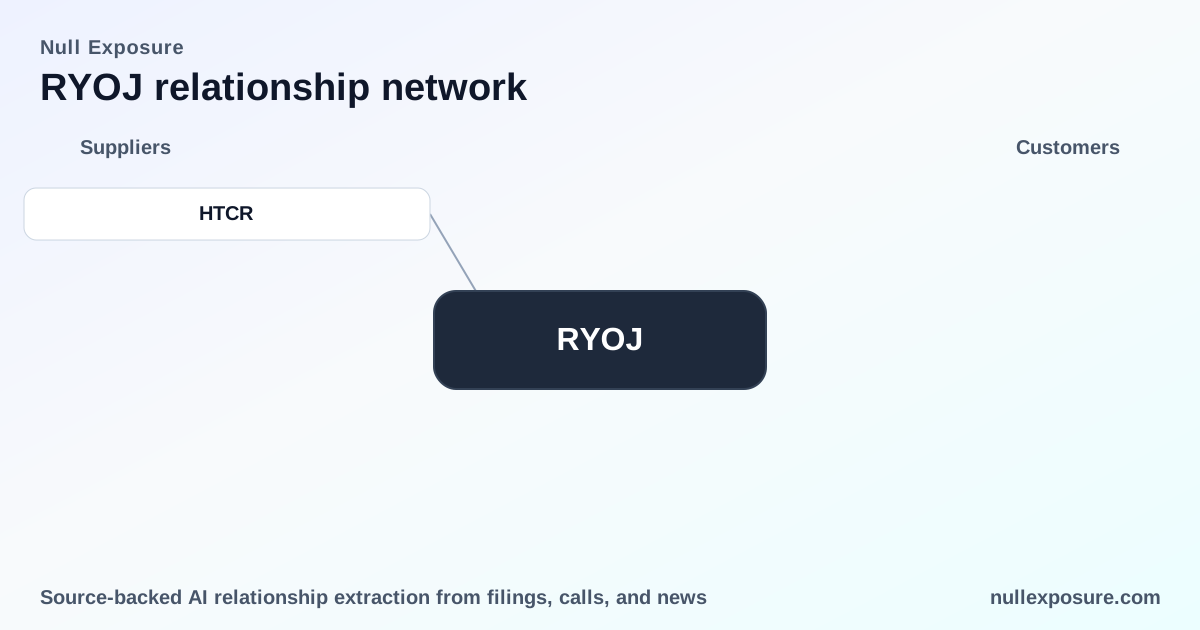
HeartCore (ticker HTCR) holds warrants representing approximately 3% of RYOJ, creating a direct market linkage: a rise in RYOJ’s share price immediately increases the economic value of HeartCore’s warrant position and therefore can influence trading in both names. A TS2.Tech report on March 10, 2026 highlighted that HeartCore helped list RYOJ and that traders were watching HeartCore because a jump in RYOJ “instantly boosts HeartCore’s stake value,” underscoring how small IPO tie-ups ripple through microcap market structure. (TS2.Tech, March 10, 2026: https://ts2.tech/en/ryoj-stock-rockets-180-overnight-whats-fueling-the-surge/)
Why that single relationship matters to investors and operators
From a corporate-supplier risk perspective, the HeartCore warrant position is not an operational supplier contract; it is a financial linkage that amplifies market volatility. For counterparties and procurement teams negotiating contracts with rYojbaba, this means:
- Market-driven valuation swings could influence perceived creditworthiness over short windows if HeartCore’s trading impacts RYOJ’s stock price.
- Inter-company interests from the listing sponsor create alignment that could accelerate strategic initiatives, but also concentrate reputational exposure if either company faces adverse publicity.
This relationship is material for investors focused on liquidity and trading dynamics, and it is a secondary signal for operational counterparties assessing counterparty stability.
Financial posture and implications for supplier credit
rYojbaba’s public metrics present a layered picture: market capitalization around $26M with trailing revenue of $11.5M and positive gross and operating margins, yet diluted EPS is negative and float is tiny (shares float ~1.99M). High insider ownership (80%) reduces free-float liquidity and increases the potential for sharp price moves, which in turn magnifies the impact of any equity-linked relationships such as warrants held by a related party.
Operationally, that profile delivers two practical implications:
- Contract negotiation leverage skews to insiders and management, reducing the signaling power of public markets to constrain behavior.
- Counterparty diligence should emphasize cash flow and contract terms rather than relying on market-cap signals, because equity moves will often reflect microcap trading dynamics more than enterprise resilience.
If you are mapping supplier exposure, treat equity-connected parties like HeartCore as trading-risk vectors rather than traditional supply-chain vendors.
Risk factors and upside drivers
- Upside: The company’s operating margin and gross profit suggest a scalable services platform if rYojbaba secures larger or repeat contracts; insider alignment can accelerate strategic execution when warranted.
- Risk: Low institutional ownership and high insider concentration create liquidity risk and governance concentration. The presence of related-party warrants increases short-term price correlation with HeartCore and raises the prospect of speculative trading episodes disconnected from fundamentals.
Key takeaway: For investors and procurement teams, operational exposure remains bounded by service delivery, while market exposure is amplified by equity linkages; both must be considered in counterparty assessments.
Practical next steps for investors and operators
- Investors should incorporate liquidity-adjusted valuation and scenario analysis that accounts for potential trading shocks originating from HeartCore’s warrant position.
- Procurement teams and operators should insist on contract terms that protect cash flows against short-term market-driven perceptions and conduct regular audits of counterparty concentration and insider governance.
- For a deeper supplier-risk map and ongoing monitoring of cross-holdings and trading links, see NullExposure’s supplier intelligence hub: https://nullexposure.com/.
Final read: synthesis and action
rYojbaba is a compact, margin-positive services provider whose public dynamics are governed as much by ownership structure as by operational results. The sole notable relationship surfaced—HeartCore’s roughly 3% warrant position—functions as a market amplifier rather than an operational supplier tie, creating a higher than normal correlation risk for small-cap investors. No operational constraints have been reported that limit supplier activity at the company level. For investors and operators evaluating exposure, prioritize contract-level protections, monitor liquidity, and track equity-linked relationships as part of supplier risk modeling.
Continue your supplier due diligence and scenario analysis at https://nullexposure.com/ for ongoing alerts and relationship intelligence.