Rezolve AI (RZLV): The financing syndicate that resets supplier and capital risk
Rezolve AI builds and sells AI-driven consumer engagement and commerce software that monetizes through product licensing, platform services and marketing performance solutions to retailers and brands. In January 2026 the company completed a $250 million registered direct financing that materially strengthened the balance sheet and shifted the supplier profile for capital markets services from ad hoc to an explicit, syndicated relationship structure. This note walks investors through the players, the operating implications for supplier risk, and the practical steps to monitor going forward. For deeper supplier mapping and counterparty diligence, visit https://nullexposure.com/.
What the January financing actually changed — one clean move from capital markets
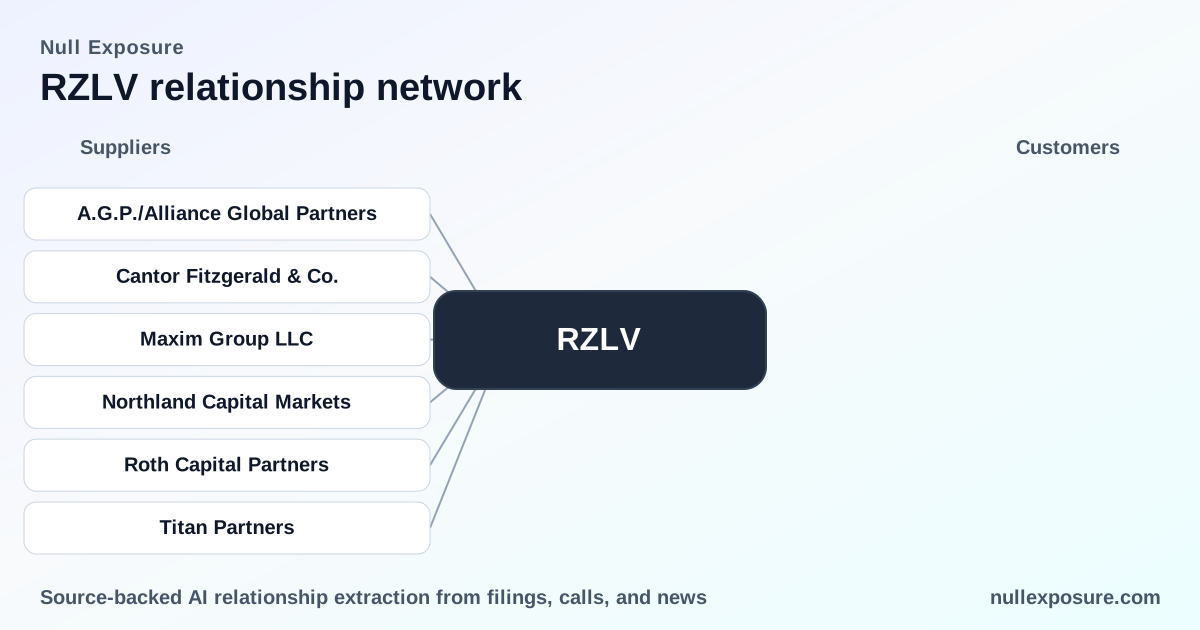
Rezolve’s financing was not a routine capital tap; it was an oversubscribed $250 million raise executed via a defined syndicate of placement agents and advisors. The company’s public materials describe A.G.P./Alliance Global Partners as the lead placement agent, with Titan Partners and Maxim Group listed as co-placement agents, while Cantor Fitzgerald, Roth Capital and Northland served as financial advisors. The paperwork and press coverage make plain that Rezolve structured this as a one-time, institutional capital raise rather than a revolving credit relationship (GlobeNewswire, Jan 21, 2026; Yahoo Finance, Mar 10, 2026).
That financing materially reduces immediate liquidity stress for a company with TTM revenue of $5.3 million, negative EBITDA of $159.4 million and a market capitalization near $958.6 million. The balance sheet relief is meaningful, but the transaction also creates a new supplier profile dominated by capital markets firms — relationships that are transactional and event-driven, rather than ongoing operational suppliers.
For readers who want a supplier-risk playbook across technology and capital relationships, see our analysts’ overview at https://nullexposure.com/.
Operating model signals investors need to synthesize
Read together, the financing and public filings produce several company-level signals about Rezolve’s supplier posture and business model:
- Contracting posture — The named counterparties are capital markets firms engaged on a transactional basis; contracting is event-driven with defined mandates rather than evergreen service agreements.
- Concentration — The syndicate spans multiple boutique and mid-market banks alongside a lead placement agent, which reduces single-counterparty concentration for fundraising but does not create long-term supplier diversity for operational services.
- Criticality — The capital markets relationships are critical for liquidity and growth financing, but they are not operationally critical to product delivery or platform uptime.
- Maturity and sophistication — The presence of established placement agents and advisors signals a sophisticated capital-raising capability, useful to underwrite future capital needs, secondary offerings, or strategic M&A.
No supplier constraints were reported in the relationship data; there are no flagged operational vendor restrictions tied to these counterparties in the available materials. This is a company-level signal: the current supplier footprint, as surfaced here, focuses on financing partners rather than technology or infrastructure vendors.
The syndicate — who did what (each relationship covered)
A.G.P./Alliance Global Partners
A.G.P. served as the lead placement agent on Rezolve’s $250 million registered direct offering, coordinating institutional distribution and syndicate logistics according to the company press release in January 2026. (GlobeNewswire, Jan 21, 2026; Yahoo Finance, Mar 10, 2026)
Titan Partners
Titan Partners is identified as a co-placement agent on the offering, supporting distribution alongside A.G.P. and Maxim Group. (GlobeNewswire, Jan 21, 2026)
Maxim Group LLC
Maxim Group acted as a co-placement agent, participating in the dealer group that placed shares in the oversubscribed offering. (GlobeNewswire, Jan 21, 2026)
Cantor Fitzgerald & Co.
Cantor Fitzgerald is named among the financial advisors for the transaction, providing strategic and advisory services during the registered direct offering process. (SahmCapital, Jan 20, 2026; Yahoo Finance, Mar 10, 2026)
Roth Capital Partners
Roth Capital Partners served as a financial advisor, advising Rezolve on the structure and execution of the financing round. (SahmCapital, Jan 20, 2026)
Northland Capital Markets
Northland Capital Markets acted as a financial advisor to Rezolve for the offering, listed in the official communications alongside Cantor Fitzgerald and Roth. (GlobeNewswire, Jan 21, 2026)
Each of the above relationships is consistently reported across multiple press releases and news wires (GlobeNewswire, Yahoo Finance, SahmCapital — Jan–Mar 2026), which confirms the syndicate composition and roles.
If you track counterparties across raises and advisor panels, we publish continuous counterparty profiles at https://nullexposure.com/ — a practical resource for investor diligence.
Investment implications: risk, runway and what to monitor
The syndicate solves near-term liquidity but does not eliminate execution risk. Key investor takeaways:
- Capital structure impact: The $250 million inflow materially extends runway and gives management optionality for growth or M&A; investors should monitor planned use of proceeds disclosed in subsequent filings.
- Dilution and market perception: Institutional placement can be dilutive; watch insider ownership levels (insiders hold ~45% of shares) and institutional ownership (~10.9%) for shifts post-offering.
- Operational vs. capital supplier risk: These capital markets partners reduce financing risk concentration but do not address operational vendor dependencies — investors should separately map tech, cloud, and data suppliers where operational continuity is critical.
- Valuation vs. fundamentals: Rezolve’s Price-to-Sales is extremely elevated at ~209x, reflecting a market valuation that prices optionality in future growth; investors should reconcile this valuation with the company’s $5.3 million in TTM revenue and negative EBITDA profile.
Analyst coverage shows a consensus target price of $10 with several buy-side ratings in early 2026, a signal that the market is pricing future growth into the equity even as fundamentals remain early-stage.
Bottom line and next steps for diligence
The January 2026 financing repositions Rezolve’s supplier footprint around an institutional capital markets syndicate that reduces immediate liquidity risk but leaves operational supplier exposures unchanged. For investors evaluating counterparty risk or negotiating supplier covenants, the relevant fact pattern is clear: transactional capital partners now dominate the supplier map for financing, and management has increased optionality to execute strategic plans.
For a systematic counterparty risk profile and ongoing monitoring of Rezolve’s supplier relationships, visit our platform at https://nullexposure.com/. For bespoke supplier diligence and deeper syndicate analytics, request a briefing through https://nullexposure.com/ — we curate counterparty histories, press coverage, and financial context for investors and operators.
Key takeaway: Rezolve’s syndicate reduces near-term financing risk but turns supplier risk into a two-track problem — capital is secured; operational vendor mapping still deserves priority attention.