SentinelOne (S): Supplier Map and What It Means for Investors
SentinelOne operates a subscription-driven cybersecurity platform that bundles endpoint detection & response, cloud workload protection, and emerging identity/XDR capabilities into a single commercial offering; the company monetizes primarily through recurring software licenses and cloud-hosted services, supplemented by strategic acquisitions that extend functionality into adjacent security domains. Investors should value SentinelOne as a growth-oriented SaaS security vendor with concentrated infrastructure dependencies and deliberate third‑party licensing posture that materially affects operational resilience and margin trajectories. For a quick vendor-risk snapshot and supplier analytics, visit https://nullexposure.com/.
How supplier relationships shape the business model and operating posture
SentinelOne builds product capability through a mix of internally developed IP and licensed third-party technology, and it runs core services on major cloud infrastructure. The supplier evidence in public disclosures indicates a licensing-based contracting posture—SentinelOne incorporates externally licensed software into its platform and acts as a licensee in those relationships. The company also engages external service providers to support cybersecurity and data privacy operations, signaling mature vendor governance and outsourcing of non-core operational functions.
Operational characteristics for investors:
- Contracting posture: Predominantly licensing and service-provider engagement rather than transactional hardware suppliers; contracts are structured to embed third-party technologies inside SentinelOne’s solution stack.
- Concentration: Hosting and distribution are concentrated on major cloud providers, increasing single‑provider operational exposure but enabling global scale and regional deployment.
- Criticality: Licensed third‑party components are treated as integral inputs to SentinelOne’s product, meaning supplier disruptions would have material product impact.
- Maturity: Explicit third‑party engagement for cybersecurity and privacy indicates a governance process that supports regulated customers and enterprise adoption.
These are company-level signals extracted from public filings and press material; they inform how investors should think about counterparty risk and operational leverage.
The supplier relationships that matter (documented items)
Below are the specific relationships identified in company releases and press material. Each entry is a plain-English summary with source context.
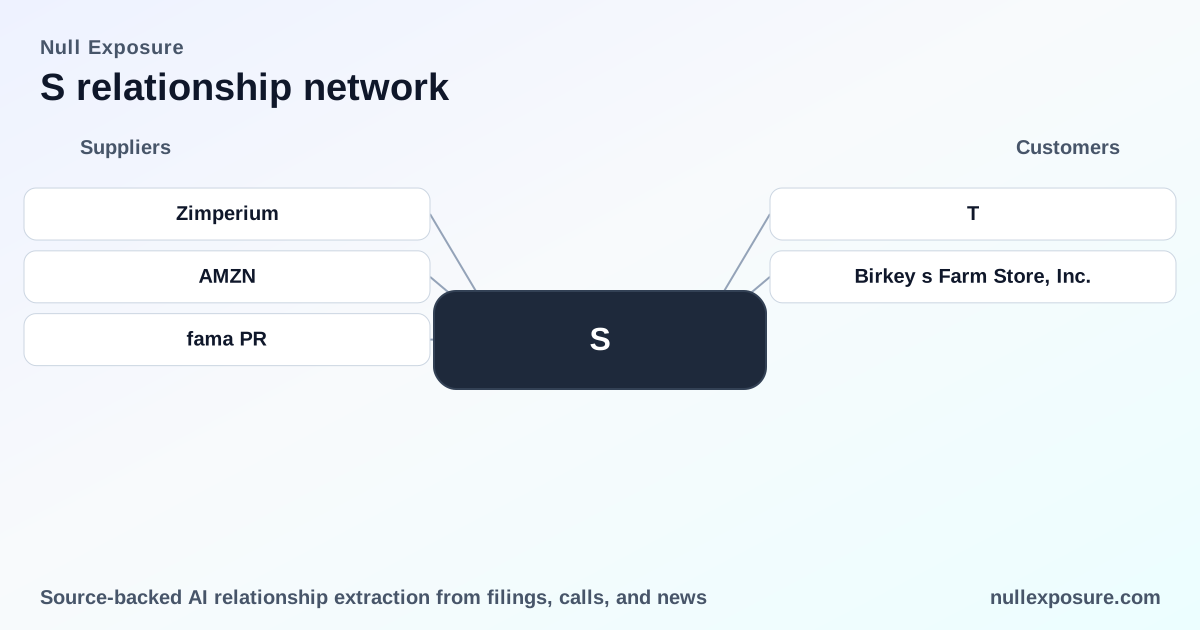
Zimperium — mobile threat partnership (FY2021)
SentinelOne integrated Zimperium’s mobile threat technology into the Singularity Mobile application to extend endpoint protection to Android, iOS, ChromeOS and other device classes, broadening coverage beyond traditional desktops and servers. According to a SentinelOne blog post announcing the Singularity Mobile rollout (FY2021), the Zimperium alliance delivers mobile-focused controls into SentinelOne’s endpoint suite: https://www.sentinelone.com/blog/mobile-threat-defense-bringing-ai-powered-endpoint-security-to-your-mobile-devices/.
AWS — hosting and global infrastructure (FY2022)
SentinelOne offers a product variant hosted in AWS regions globally, indicating AWS is a primary cloud-hosting partner for SentinelOne’s cloud services and regional footprints. This is described in SentinelOne’s press material tied to the Attivo Networks acquisition announcement (FY2022), which references SentinelOne for AWS hosted in AWS regions around the world: https://www.sentinelone.com/press/sentinelone-to-acquire-attivo-networks-bringing-identity-to-xdr/.
Amazon Web Services (AWS) — earlier funding and hosting references (FY2020)
SentinelOne has previously positioned AWS hosting as a core part of its platform narrative, including in fundraising and product press from FY2020 where SentinelOne for AWS is described as being available in AWS regions worldwide. This historical reference was published in the company’s FY2020 press release around its Series F funding: https://www.sentinelone.com/press/sentinelone-announces-267m-series-f-2/.
fama PR — communications partner (FY2022)
SentinelOne uses external PR representation; a press contact listing shows 'fama PR' acting as a media relations firm supporting SentinelOne communications. A SentinelOne press release (FY2022) lists Jake Schuster at fama PR as the press contact for the Attivo acquisition announcement: https://www.sentinelone.com/press/sentinelone-to-acquire-attivo-networks-bringing-identity-to-xdr/.
Investment implications and a practical risk checklist
The supplier map defines a handful of actionable investment implications:
- Cloud concentration is a governance lever and a single‑point-of-failure risk. Hosting in AWS accelerates global scale but concentrates availability, compliance, and contractual dependency with a hyperscaler.
- Licensing as a product strategy reduces near-term R&D spend but increases supplier bargaining exposure. SentinelOne’s incorporation of third‑party licensed technology into product workflows improves time‑to‑market for features such as mobile threat defense or identity signals, while embedding supplier risk into product release cycles.
- Third‑party service providers for security and privacy indicate operational robustness. Engaging specialized vendors for privacy and cybersecurity functions supports enterprise customers’ compliance needs and is consistent with a go‑to‑market strategy targeting regulated industries.
- Comms firm engagement is non‑material to operations but important to market positioning. External PR relationships affect narrative control and should be monitored for signals around strategic shifts, fundraising, or M&A.
Bold takeaways for diligence:
- Monitor AWS contractual terms and SLAs because disruptions or adverse pricing changes would have outsized effects on cost structure and service availability.
- Track license renewals and dependency mappings to surface concentrations of critical third‑party IP and the potential for margin pressure or feature discontinuities.
- Validate vendor governance frameworks in diligence to ensure that outsourced security/privacy activities meet enterprise customer expectations.
If you want supplier-level scoring or continuous monitoring on these vectors, explore our coverage at https://nullexposure.com/.
What to watch next (operational catalysts and triggers)
Investors should watch three categories of forward evidence:
- Contract renewals and cloud-provider disclosures that clarify AWS dependency and regional redundancy plans.
- Product roadmaps and release notes that enumerate which capabilities are internally developed vs. licensed—this influences margin trajectory and IP defensibility.
- M&A and partner announcements that shift supplier concentration or introduce new licensing obligations.
For investors building a watchlist around vendor concentration and contractual risk, review our supplier analytics at https://nullexposure.com/ for ongoing alerts and summary reporting.
SentinelOne’s supplier footprint reflects a deliberate, licensing-forward strategy combined with hyperscaler dependency—an efficient route to scale that requires active vendor governance and continuous contract diligence to preserve margin and operational resilience.