SAB Biotherapeutics (SABSW) — Supplier Relationships and Operational Constraints Investors Should Price In
SAB Biotherapeutics develops polyclonal and monoclonal immunotherapies and monetizes through clinical-stage partnerships, licensing and eventual commercial supply agreements; the company outsources key R&D and manufacturing functions to third parties while carrying capital commitments on facilities that reflect a mix of short- and long-term leasing. Investment thesis: SAB Bio is a capital-intensive biologics developer with clinical progress driving value, but its supplier posture—heavy reliance on CROs and third‑party manufacturers plus legacy lease obligations—creates concentrated operational risk that investors must underwrite alongside clinical and regulatory upside.
Explore supplier intelligence and validated relationship signals: https://nullexposure.com/
How SAB Biotherapeutics runs its R&D and supply chain
SAB Biotherapeutics conducts discovery and early clinical development in-house while relying on third parties for clinical trial execution and manufacturing. Company disclosures state that the firm outsources research, preclinical studies, clinical trials, contract manufacturing and specialized testing to external partners, positioning those suppliers as operationally critical to timelines and eventual commercialization. The balance sheet also reflects prior facility financing: a finance lease taken in 2018 and subsequent short-term leasing events in 2024–2025, indicating a mixed maturity profile across the company’s real estate and capacity commitments.
- Contracting posture: a blend of long-term capital leases (facility financing) and short-term operating leases for continuity, implying both sunk fixed obligations and tactical flexibility.
- Concentration and criticality: high, since clinical outcomes and commercial manufacturing depend on a narrow set of third-party manufacturers and CROs named in filings.
- Maturity: mixed — long-term equipment/real-estate commitments coexist with short-term lease arrangements for specific facilities or transitions.
- Commercial leverage: limited revenue today; monetization depends on successful trials, partnerships, and securing commercial supply agreements with third-party manufacturers.
Visit the homepage for more supplier-focused analysis: https://nullexposure.com/
Active suppliers and trial partners you need to know
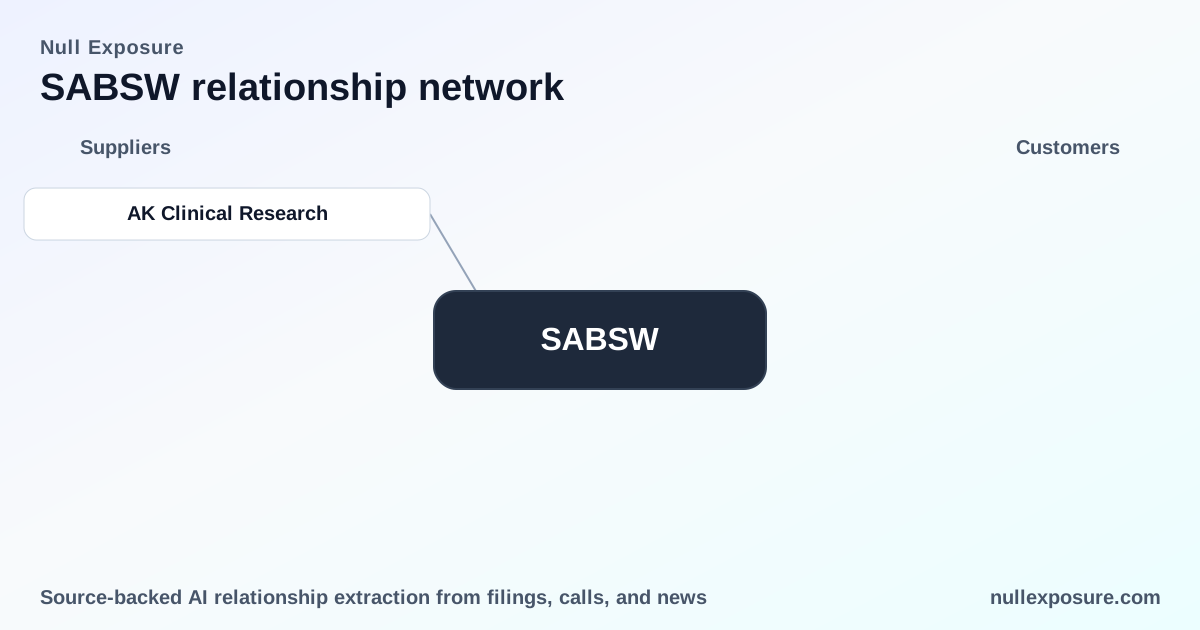
AK Clinical Research — trial collaborator for SAB-142 dosing
AK Clinical Research is listed among collaborating institutions credited for contributing to SAB Biotherapeutics’ clinical trials, including participation in a trial that dosed a first patient for SAB‑142 in stage 3 type 1 diabetes. According to a news release distributed via Sahm Capital on December 18, 2025, AK Clinical Research worked alongside SAB Bio and other trial partners as part of the Australasian Type 1 Diabetes Immunotherapy Collaborative (ATIC). (Source: Sahm Capital news release, Dec 18, 2025.)
What the constraints tell investors about operational risk
SAB Biotherapeutics’ own disclosures provide a concise picture of supplier dependence and lease commitments that will shape cash flow volatility and execution risk.
- Company filings state that SAB relies on third‑party manufacturers and CROs to produce clinical and commercial quantities and to run trials, establishing a service-provider and manufacturer role for outsourced partners. This reliance is a structural feature of the business model and creates single‑point dependencies for key programs. (Source: SAB Biotherapeutics filings, FYs cited in public disclosures.)
- The firm recorded a finance lease with Dakota Ag Properties in December 2018 for a new animal facility and land, structured to repay approximately $4 million in construction costs over a 20‑year term at 8% interest; the lease and asset were treated as separate components. This is an explicit long‑term capital commitment recorded in corporate filings and represents a fixed-cost backbone for preclinical capacity. (Source: SAB Biotherapeutics filings, 2018.)
- A short‑term lease in September 2024 extended occupancy of the same facility until January 30, 2025, indicating tactical lease adjustments alongside longer-term financing arrangements. That short-term posture introduces near-term rollover risk and demonstrates that not all facility capacity is locked into long-term contracts. (Source: SAB Biotherapeutics filings, Sept 2024.)
Taken together, these constraints produce two actionable operating signals: (1) supplier concentration is high and operationally critical—outsourced manufacturers and CROs are core to clinical progress and future revenue; (2) capital structure includes legacy finance leases while tactical short-term leases preserve flexibility but add renewal risk.
Practical implications for investors and operators
- Execution risk is supplier-driven. Clinical timelines and potential near-term value inflection points link directly to the performance of CROs and contract manufacturers; any supplier delay delays value realization.
- Capital commitments reduce optionality. The finance lease and related obligations absorb cash and constrain runway, increasing the importance of judicious liquidity management or partner funding to support trials.
- Negotiation leverage is asymmetric. As a clinical-stage developer with outsourced manufacturing needs, SAB Bio has limited bargaining power on pricing and scheduling relative to established CDMOs and CROs; that dynamic compresses margins post-commercialization unless the company secures favorable long-term supply contracts.
- Monitoring cadence for investors: track CRO status updates, manufacturing batch releases, lease rollovers, and any new long‑term supply agreements that would de‑risk execution and convert dependence into contractual stability.
For vendor validation and supplier tracking services, see https://nullexposure.com/
Recommended actions for investors evaluating SABSW supplier exposure
- Demand granular disclosures on counterparty concentration for manufacturing and CRO partners and on the terms of any commercial supply agreements.
- Stress-test cash runway against 6–12 month supplier delays; model the impact of rollovers or cost increases from third‑party manufacturers.
- Reprice risk on clinical milestones to reflect supplier single points of failure; prioritize equity or debt structures that hedge construction-lease-driven fixed costs.
Bottom line: SAB Biotherapeutics is clinically active and strategically dependent on external manufacturers and CROs, with legacy finance leases adding fixed-cost commitment. Investors should treat supplier performance and lease maturity as first‑order variables in valuation and risk management.
Take a deeper look at supplier relationships and operational signals at https://nullexposure.com/