Safeguard Acquisition Corp. (SAC): Supplier relationships, operating posture, and investor takeaways
Safeguard Acquisition Corp. is a special purpose acquisition company that raised capital through an IPO to acquire growth-oriented businesses in technology and healthcare. The company monetizes by selling units to public investors, holding proceeds in trust while sourcing a target, and ultimately creating value for public shareholders through a successful business combination and stock-market appreciation. For investors and counterparties, SAC presents the classic SPAC profile: capital in trust, a short transactional lifecycle, and acute dependency on a small set of service providers during the pre-deal window. Learn more at https://nullexposure.com/.
Quick operational thesis for investors
Safeguard operates as a transaction vehicle: it raises institutional and public capital via an IPO, places proceeds in trust, and contracts advisers, underwriters, and legal counsel to source and close a merger. Revenue for investors is realized only if SAC completes a business combination that re-rates the combined entity above trust value or if warrants and sponsor economics deliver upside. SAC’s economic model is episodic and event-driven, not a recurring-revenue corporate business. For diligence services and relationship monitoring, visit https://nullexposure.com/.
What SAC does and how it pays the bills
Safeguard is a SPAC focused on technology and healthcare, recruiting a management team and external advisers to execute a merger within the SPAC lifecycle specified in its IPO documentation. The vehicle monetizes indirectly: sponsors and early backers capture a promote and residual upside if a deal succeeds, while public investors profit from post-combination equity appreciation or redemption choices at the deal vote. Cost structure centers on advisory fees, underwriting costs, legal and accounting expenses, and the administrative overhead of running a listed shell. According to SAC’s company profile, the strategy emphasizes creating long-term shareholder value by leveraging management networks in tech and healthcare (company profile).
Active supplier relationships: who SAC is working with now
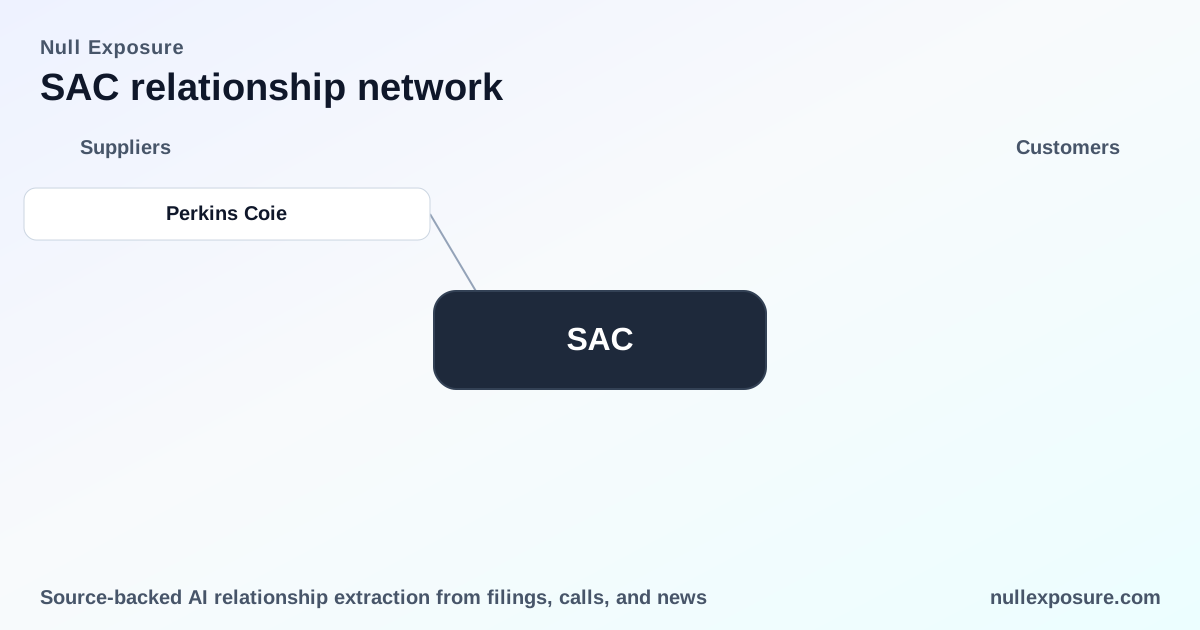
Perkins Coie — legal counsel on the IPO
Perkins Coie advised Safeguard on the completion of its $230 million IPO, which sold 23 million units at $10 each on the NYSE. This engagement confirms Perkins Coie served as lead legal counsel for SAC’s public listing, a critical supplier role during SPAC formation. (Perkins Coie press release, March 10, 2026: https://perkinscoie.com/news/press-release/perkins-coie-advises-safeguard-its-230m-ipo)
(That covers every supplier relationship reported in public filings and press coverage to date.)
What the supplier list tells investors about SAC’s operating posture
Even with a single reported supplier relationship, the sponsorship and supplier dynamics are clear and relevant:
- Contracting posture: transactional and milestone-driven. SPACs contract for specific deliverables—legal opinions, underwriting, and placement services—paid on completion of IPO and later on closing a business combination; long-term vendor lock-in is atypical.
- Concentration risk: high during formation and deal-making phases. A handful of advisers (legal, audit, investment bankers) carry disproportionate execution risk; the Perkins Coie relationship illustrates reliance on top-tier legal counsel for regulatory and disclosure work.
- Criticality: elevated for a short window. Legal and underwriting suppliers are mission-critical before and through the deal vote; failure or breakdown in those services can delay or derail a combination.
- Maturity: early-stage, capital-formation phase. SAC’s public record shows completed IPO financing and readiness to transact; operational maturity is limited until a definitive acquisition is announced and closed.
These are company-level signals rather than relationship-specific constraints because no constraint excerpts explicitly name suppliers beyond the Perkins Coie engagement.
Investment and counterparty implications
For investors, advisers, and potential merger targets, SAC’s profile generates predictable implications:
- Execution risk dominates valuation. The primary variable for shareholder value is whether SAC finds an attractive target and consummates a deal within the SPAC timeline. Legal counsel and underwriters materially influence that execution path.
- Partner selection signals deal quality. Engagement of a reputable firm like Perkins Coie is a positive operational signal: strong legal representation reduces regulatory and disclosure friction and accelerates deal confidence.
- Cost transparency is essential. Expect discrete, high-impact fee events (IPO underwriting, sponsor promote, advisor fees). Investors should model these explicitly when assessing post-combination upside.
- Counterparty diligence should prioritize continuity and depth. Potential merger targets and service providers should assess SAC’s advisers and sponsor track record as a proxy for transaction capability.
If you need detailed counterparty monitoring or transaction diligence for SPAC relationships, start here: https://nullexposure.com/.
Strategic recommendations for operators and research teams
- Prioritize early assessment of SAC’s advisory roster and underwriting syndicate; the calibre of legal and banking partners materially affects a SPAC’s ability to close.
- Model sponsor economics (promote, warrant dilution) conservatively; structure scenarios where redemption rates and post-deal liquidity reduce upside.
- For targets, demand clarity on governance and post-combination capital structure before agreeing to a deal; the SPAC vehicle structure transfers negotiation leverage toward the sponsor and advisers.
- For suppliers, assess whether your service is transaction-critical and price accordingly; short-window urgency supports premium billing but also requires stringent delivery discipline.
Bottom line and next steps
Safeguard Acquisition Corp. is a capital-formation SPAC that completed a $230 million IPO and has engaged Perkins Coie as legal counsel—a strong signal that SAC is positioned to pursue technology or healthcare targets with professional regulatory support. Investors should treat SAC as an event-driven investment with concentrated supplier dependency and short-term execution risk.
For ongoing monitoring of supplier relationships and targeted diligence on SPAC counterparties, visit https://nullexposure.com/ for additional research and service offerings.
If you want a tailored supplier-risk brief or a focused counterparty assessment of SAC’s future advisers and bankers, reach out via https://nullexposure.com/ and we will prioritize an updated supplier map and risk memo.