Sachem Capital (SACH): How counterparties and credit lines shape a small mortgage REIT's runway
Sachem Capital Corp operates as a mortgage-focused real estate company that monetizes primarily through mortgage lending, interest spread capture and structured financing supported by repurchase and revolving credit facilities; it also takes equity-like exposure by investing in third‑party managed development projects. The firm's capital structure — a mix of unsecured notes, a Churchill repurchase facility, and a Needham revolving credit line — drives both upside (leverage to asset returns) and downside (funding and refinancing sensitivity) for investors evaluating supplier and counterparty risk. For a concise map of counterparties and contractual dynamics, visit the Null Exposure homepage: https://nullexposure.com/.
Funding architecture is the core risk/reward lens
Sachem’s operating model is highly financing-dependent. The company’s public filings and transcripts document a $200 million master repurchase facility with Churchill and a separate $45 million revolving credit agreement with Needham Bank, which together create a layered funding stack that supports loan originations and investments. At the company level, constraints in the filing point to a mix of contract types and spend bands: there is both large-scale borrowing (over $100 million of notes outstanding) and mid-range facilities (tens of millions outstanding on repurchase agreements and the Needham facility). That structure highlights two operational realities:
- Concentration of funding sources: framework credit facilities and master repurchase terms create dependency on a small set of lenders.
- Maturity and refinancing sensitivity: the company repaid two tranches of five‑year unsecured notes in 2024, showing active liability management and the need to manage refinancings.
These characteristics should be interpreted as company-level signals rather than isolated supplier facts: they shape capital flexibility, cost of capital, and the pace at which management can deploy capital into new mortgage originations or investments.
The counterparties you should track now
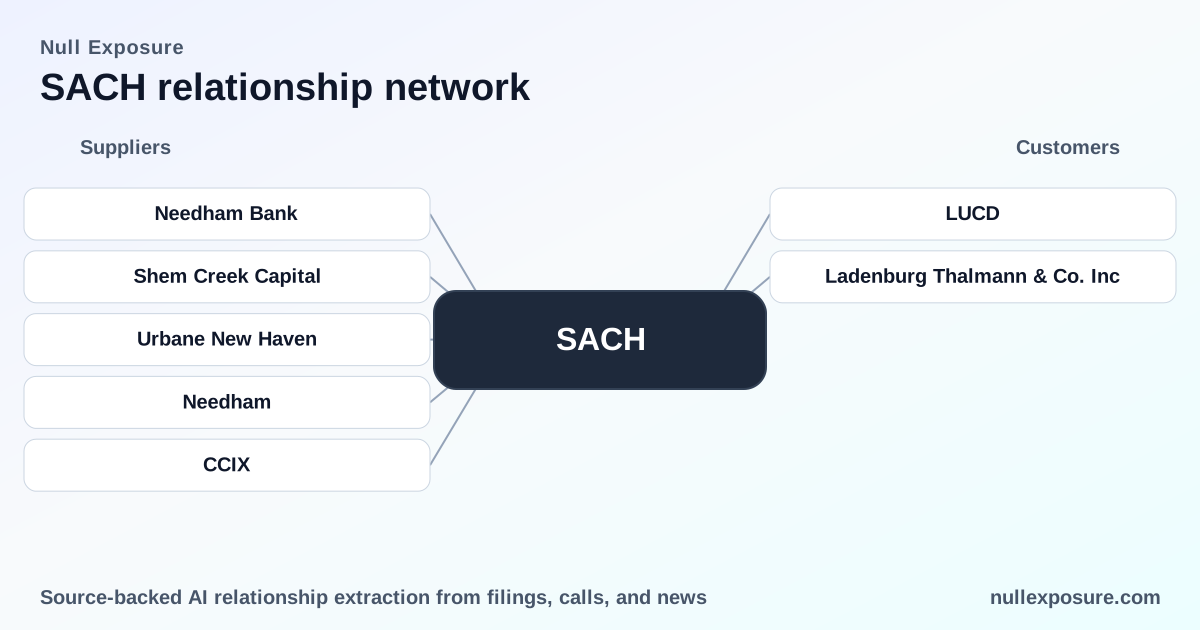
Below are every named counterparty in the reporting results, summarized in plain English with source context so you can prioritize monitoring.
Needham Bank
- Sachem uses a revolving credit facility with Needham Bank; the Needham line provides working capital and funds for projects, with reported outstanding principal balances of $40.0 million as of December 31, 2024. According to a TradingView report on March 10, 2026, Sachem signed a credit facility amendment with Needham Bank and other lenders that impacts its available liquidity. (TradingView, March 10, 2026)
Shem Creek Capital
- Sachem has invested directly into projects managed by Shem Creek Capital: the company reported a $41.2 million aggregate investment across six Shem Creek-managed funds, signaling meaningful exposure to third-party sponsor-managed development activity. This position was disclosed in the Q2 2025 earnings call transcript. (InsiderMonkey, Q2 2025 earnings call transcript)
Urbane New Haven
- Urbane New Haven is identified as a local development partner helping Sachem work through current projects, indicating an operational sponsorship role for specific development assets rather than a financing-only counterparty. This mention is from the same Q2 2025 earnings call transcript. (InsiderMonkey, Q2 2025 earnings call transcript)
Needham (general reference)
- Management reiterated in the earnings call that cash and the Needham credit facility, together with the Churchill facility, supply available funds for development and investment activity; the Needham facility remains a central source of liquidity for near-term funding needs. (InsiderMonkey, Q2 2025 earnings call transcript)
Churchill (Churchill MRA Funding I LLC / CCIX)
- Sachem’s master repurchase facility is with Churchill (Churchill MRA Funding I LLC), a vertically integrated real estate finance entity; the Churchill facility was originally documented as a $200 million master repurchase financing agreement and continues to be cited as primary programmatic financing. The earnings call and prior filings describe this facility as a core funding frame. (InsiderMonkey Q2 2025 transcript; company filings referencing Churchill Facility)
What the relationship map implies for investors
Sachem’s counterparty footprint is compact but consequential. A small number of financing relationships — notably Churchill and Needham — provide the framework for asset deployment and liquidity. The company-level constraints show that some commitments operate as long-term constructs (e.g., master repurchase facility), while others require active management (note maturities that were repaid in 2024). Additional company signals:
- Contracting posture: The presence of framework-style facilities (Churchill and Needham) indicates structured, ongoing funding relationships rather than one-off loans.
- Concentration and criticality: Funding is concentrated among a few counterparties; disruption or tightening from any of them would quickly affect origination and development timelines.
- Maturity and cashflow sensitivity: The repayment of two five-year note tranches in 2024 demonstrates active liability management but also highlights the need for continuous access to capital markets or lender renegotiation.
- Vendor/service-provider exposure: Management discloses reliance on third-party vendors for non-core services (SEO and ad analytics) and has implemented vendor risk controls; those are operationally important but not capital-critical.
Investment implications and what to watch next
- Monitor lender covenant changes and amendments: Any amendment to the Needham or Churchill facilities will materially alter liquidity flexibility and funding cost; the March 10, 2026 TradingView note on a Needham amendment is a live example. (TradingView, March 10, 2026)
- Track development exposure: The $41.2 million invested with Shem Creek and the operational partnership with Urbane New Haven create direct exposure to local development execution risk and real estate cycle sensitivity. (InsiderMonkey, Q2 2025 earnings call transcript)
- Watch leverage and note balances: The company reported $230.2 million of unsecured notes outstanding at year-end 2024; that scale versus market capitalization warrants scrutiny of refinancing capacity and cost of capital in a rising-rate environment.
For a practical counterparty dashboard and deeper visibility into supplier-level documentation, visit our research hub at https://nullexposure.com/ — the best next step for investors who need detailed supplier risk scores and amendment tracking.
Final takeaways and action points
Sachem is a small mortgage REIT whose performance and survivability are intrinsically tied to a few named financing partners and to the execution of sponsored development projects. The operational model combines secured repurchase financing, a corporate revolver, unsecured notes, and selective equity-like investments in manager-run projects; collectively these elements create both leverage and execution risk.
- Key takeaway: Funding relationships (Churchill, Needham) are the strategic fulcrum; watch facility terms, covenants, and any public amendments.
- Operational exposure: Investments with Shem Creek and partnerships with Urbane New Haven create concentrated project-level risk that complements the balance-sheet view.
If you are building a monitoring plan for SACH counterparties or want supplier-level alerts on future amendments and filings, return to the Null Exposure homepage for tailored supplier intelligence: https://nullexposure.com/.