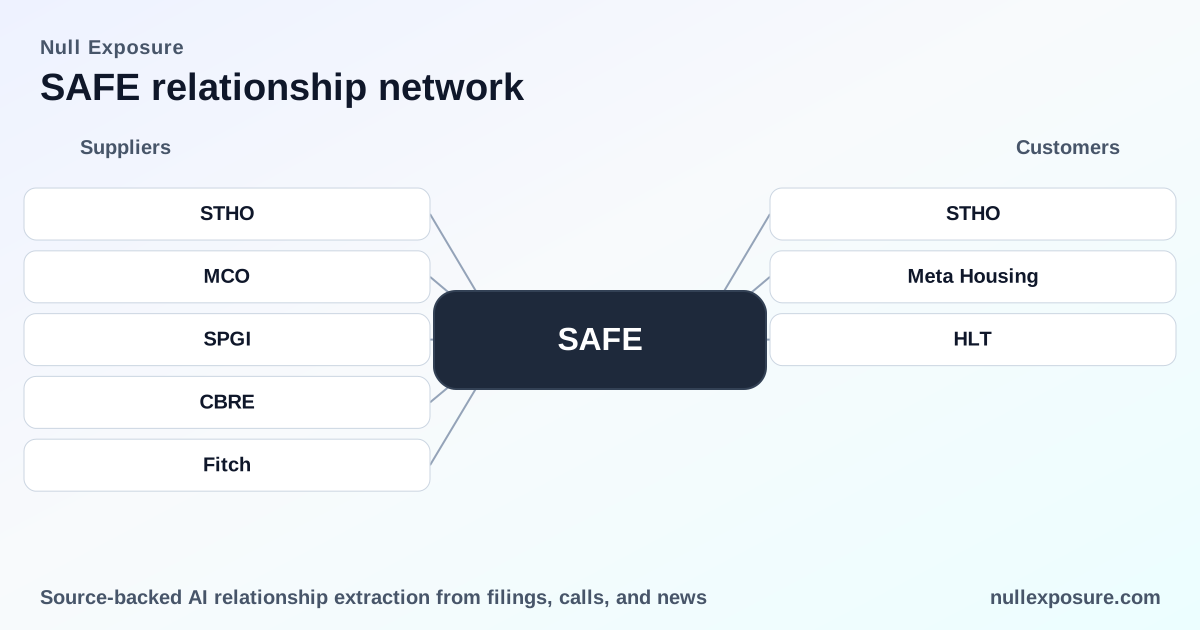
Safehold Inc (SAFE): Supplier relationships and what they mean for investors
Safehold Inc operates a focused REIT business that acquires and manages long-duration ground leases on prime commercial real estate, monetizing through stable contractual ground-lease cash flows, selective portfolio growth, and capital market access for financing. The company pairs predictable rental-like yield with credit-sensitive financing, generating recurring revenue while preserving upside through land appreciation. For investors, Safehold’s supplier and third‑party relationships — from appraisers to credit agencies and asset managers — directly influence valuation transparency, financing flexibility, and underwriting discipline. Learn more about coverage and supplier risk at https://nullexposure.com/.
Why supplier relationships matter for a ground-lease REIT
Ground-lease economics depend on three operational pillars: accurate asset valuation, durable financing, and active portfolio management. Suppliers and external counterparties plug into each pillar:
- Appraisers and valuation partners determine GLTV and valuation-based covenants.
- Credit rating agencies influence borrowing costs and capital access.
- Asset managers and servicers affect the monetization and upkeep of legacy or non-core assets.
- Banks and capital markets providers supply funding that sets strategic optionality.
These relationships are not ancillary — they are structural inputs into Safehold’s cash-flow profile, cost of capital, and strategic flexibility. For investors, understanding each counterparty’s role clarifies concentration, criticality, and maturity of operational dependencies.
The counterparty map: each relationship and the practical takeaway
Star Holdings
- Safehold entered into a management agreement with Star Holdings to manage and monetize legacy non-ground lease assets, creating a partner for active asset disposition and specialized management of non-core holdings. According to TradingView’s coverage of Safehold’s SEC 10‑K disclosures (reported March 2026), Star Holdings will handle legacy monetization efforts.
Moody’s (MCO)
- Moody’s has assigned Safehold an A3 rating, giving the company a solid credit profile that supports lower borrowing spreads and broader access to institutional debt markets. Moody’s rating and outlook were cited in Safehold’s FY2026 reporting and subsequent earnings commentary (insider and Finviz reports, March 2026).
S&P Ratings / S&P
- Standard & Poor’s upgraded Safehold to an A‑ rating with a stable outlook, directly improving the company’s capital-cost profile and validating underwriting across the ground-lease portfolio; S&P’s upgrade was widely reported alongside Q4 and FY2025 results (Finviz and Sahm Capital commentary, February–March 2026).
CBRE
- CBRE provides the annual asset appraisals that underpin Safehold’s portfolio GLTV metric; the firm’s appraisals supported a reported portfolio GLTV of 52% and a rent coverage ratio of 3.4x, reinforcing valuation assumptions used for lender reporting and covenant testing (earnings-call transcripts and coverage, March 2026).
Fitch
- Fitch’s A‑ rating (reported with a stable outlook) complements S&P and Moody’s, giving Safehold a convergent credit view across the major agencies and reinforcing access to diversified debt channels; this was included in Safehold’s FY2026 reporting and market summaries in March 2026.
(Each of the above relationships is drawn from company reporting and press coverage around Safehold’s Q4 and FY2025/FY2026 disclosures; source details were reported in March 2026 across TradingView, Finviz, InsiderMonkey, The Globe and Mail, and firm commentary outlets.)
What the relationships imply about contracting posture and concentration
Safehold’s supplier footprint signals a mature, institutionally oriented contracting posture:
- The presence of the three major rating agencies all assigning A‑/A3/A‑ with stable outlooks implies credit discipline and predictable covenant frameworks that lenders and investors accept.
- Annual appraisals from a global real‑estate firm like CBRE indicate transparent valuation processes, which reduces idiosyncratic valuation risk and supports market confidence in reported GLTV metrics.
- The engagement with a specialist manager for non-core assets (Star Holdings) shows active asset management rather than passive disposition, preserving value extraction options.
Concentration is moderate and intentional: credit agency coverage is highly concentrated among the three majors (a structural industry norm), while appraisal and asset‑management relationships are purpose‑built rather than broad vendor networks. This structure supports operational clarity but creates single‑point dependencies where material execution failures at a key supplier could transmit to covenant stress or market repricing.
Financial constraints and corporate signals (company‑level)
Several company-level contract and financing signals are present in Safehold’s public disclosures:
- Mixed-maturity capital structure: evidence of long-term notes (6.10% senior notes due 2034) coexists with a short-term commercial paper program, indicating deliberate maturity layering to balance cost and liquidity.
- Large-scale committed facilities: a $2.0 billion unsecured revolving credit facility with significant undrawn capacity ($1.2 billion as of December 31, 2025) signals ample liquidity runway and flexibility to fund acquisitions or address working-capital needs.
- Counterparty profile: credit agreements list major banks (including JPMorgan Chase) as administrative agent and lenders, consistent with large-enterprise financing counterparties.
These constraints together reflect a capital structure that is mature, diversified on tenor, and reliant on institutional lenders and rating agencies — favorable for stability but sensitive to macro credit cycles and agency views.
Risk profile driven by suppliers and how to think about it
- Credit and funding risk: Upgrades from S&P and supportive ratings from Moody’s and Fitch lower funding cost and increase optionality; a reversal in rating sentiment would immediately raise financing costs and reduce refinancing flexibility. The ratings coverage therefore represents a critical control point for valuation and liquidity.
- Valuation risk: CBRE appraisals anchor GLTV and covenant testing; systematic valuation shifts across major appraisal cycles can compress leverage capacity or trigger covenant negotiations.
- Operational execution: Reliance on a third party (Star Holdings) to manage legacy non-ground lease assets concentrates monetization execution outside the company’s core teams, increasing counterparty execution risk if transitions or incentives are misaligned.
Investors should weight the positive credit signals against concentration on a few large counterparties and an asset-base whose valuation is periodically re-confirmed by a single global appraiser.
For a deeper view on how supplier relationships affect portfolio-level exposure and counterparty concentration, visit https://nullexposure.com/ to explore vendor risk mapping and credit-service analysis.
What investors should watch next
- Monitor rating-agency commentary and any changes to outlooks that would affect Safehold’s cost of capital and optionality.
- Track CBRE appraisal results at the next annual confirmation to ensure GLTV and rent-coverage metrics remain within covenant buffers.
- Watch asset-management KPIs from the Star Holdings engagement for realized proceeds and any changes in monetization pacing.
If you are evaluating SAFE for allocation or operational partnership, review public filings and the issuer’s disclosures alongside third-party rating commentary. For a concise supplier-risk briefing and ongoing monitoring options, visit https://nullexposure.com/ and subscribe for alerts.
Bottom line
Safehold’s supplier map reinforces a business built around institutional credit access, disciplined valuation inputs, and targeted asset-management partnerships. These relationships materially support the REIT’s predictable cash flows and capital strategy, but they also concentrate critical functions — notably valuation and credit access — with a few large counterparties. For investors, the combination is constructive for yield and growth control so long as credit ratings and appraisal discipline remain intact. Explore tailored supplier risk briefings at https://nullexposure.com/ for actionable intelligence on Safehold and comparable REITs.