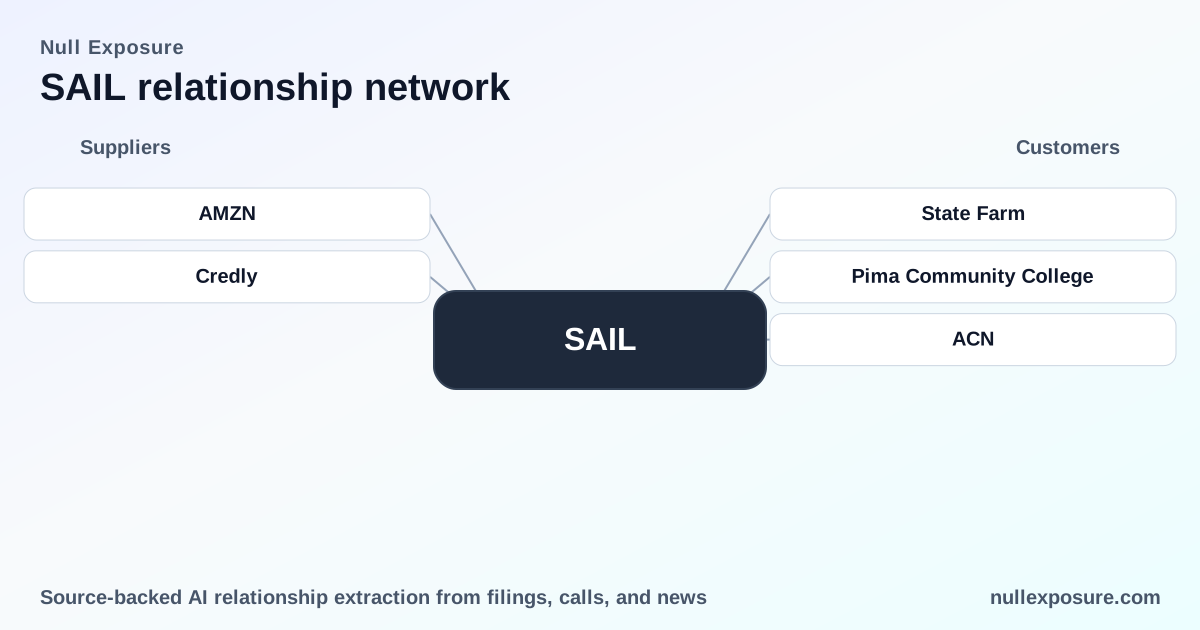
SailPoint (SAIL): Identity security vendor with embedded cloud relationships and multi-year supplier commitments
SailPoint sells enterprise identity governance and access-management software to large organizations and monetizes through a mix of subscription licenses, professional services, and cloud integrations. The business model depends on recurring SaaS revenue, strategic integrations with major cloud platforms, and multi-year supplier commitments that lock in capacity and predictable unit economics. Investors should evaluate both the revenue durability from subscription customers and the vendor-side contract exposure that creates cost inflexibility.
If you want a concise supplier-risk profile and relationship map for buy-side diligence, visit https://nullexposure.com/ for the full picture.
How SailPoint makes money and why suppliers matter
SailPoint generates revenue primarily from enterprise subscriptions and associated implementation and support services; latest reported revenue is $904 million TTM with negative operating margins, reflecting scale-up and integration costs. The product roadmap prioritizes cloud-native integrations — which convert large channel and cloud partners into both revenue multipliers and single points of operational dependency. Supplier arrangements therefore influence gross margin trajectory and go-to-market economics as much as product development.
What the relationships tell you: AWS and Credly, in plain language
Amazon Web Services — integrated security and simplified procurement
SailPoint announced integration of its Identity Security Accelerator with the AWS Security Hub Extended plan, positioning the product for procurement through AWS where customers benefit from one contract, one bill and consolidated support. According to a GlobeNewswire release dated February 26, 2026, the integration emphasizes a single-vendor buying experience and flexible pricing through AWS, which accelerates enterprise deployment where customers already standardize on AWS. (GlobeNewswire, Feb 26, 2026)
Credly — digital badging for SailPoint certification and recertification
SailPoint adopted Credly as its digital badging platform to modernize recognition and recording of certifications tied to its recertification program. A press release circulated via The Globe and Mail in March 2026 describes Credly as the technology SailPoint is using to issue and manage professional credentials for its cybersecurity skills program, supporting partner enablement and customer adoption. (The Globe and Mail press release, March 2026)
What the contract and spend constraints reveal about operating posture
SailPoint’s supplier constraints form a coherent company-level signal: the firm runs with multi-year, high-dollar commitments to cloud vendors and measured reliance on select professional-services suppliers. These constraints imply a contracting posture that prioritizes capacity and integration at the cost of flexibility.
- Long-term contracting: SailPoint discloses a commitment with a cloud storage provider running from July 2023 through June 2028, which is recorded in aggregate contractual purchase commitments as of January 31, 2025. This is a clear indicator of multi-year lock-in that shapes future unit costs and renewal negotiations.
- Service-provider role and material committed spend: SailPoint documents a contract (entered June 2023) with a cloud hosting provider that carries explicit minimum spend obligations totaling $307.5 million over five years ($54M, $59M, $62M, $65M, $67.5M by year), and notes financial consequences if minimums are not met. This demonstrates highly committed cloud spend at scale, consistent with a supplier relationship that is operationally critical and financially material.
- Spend concentration bands: Evidence indicates $100M+ commitments on cloud hosting, $10M–$100M activity on M&A and financing-linked counterparties, and $1M–$10M for professional services (Ernst & Young LLP fees reported at ~$5.1M for fiscal 2025). These bands suggest a supplier mix of large cloud vendors, mid-size strategic partners, and selective professional firms.
Collectively, these constraints paint an operating model that is capitalized for scale but less flexible on variable cost control. Contractual minimums reduce margin volatility when utilization is high but create downside if customer growth slows.
If you want to model supplier-side cash flow commitments against ARR growth scenarios, start your diligence at https://nullexposure.com/.
Strategic implications for investors and operators
- Revenue leverage vs. cost inflexibility: Integrations with major cloud platforms such as AWS expand addressable market and simplify procurement for customers, strengthening subscription growth. However, multi-year cloud commitments and minimum purchase obligations create fixed-cost pressure that can compress margins if ARR growth decelerates.
- Channel risk and concentration: The AWS integration accelerates distribution but increases strategic concentration around one dominant cloud channel. This is beneficial for scaling in AWS-centric accounts but also concentrates negotiation leverage with that cloud provider.
- Operational criticality: Long-term cloud contracts and large committed spend reflect that cloud hosting and storage are operationally critical to product delivery — outages, pricing changes, or contract disputes would have outsized effects on gross margins and service continuity.
- Professional services control: The company’s use of established auditors and measurable professional fees suggests mature governance and predictable non-cloud operating expenses.
Relationship-by-relationship takeaway (short and actionable)
-
Amazon Web Services: Integration with AWS Security Hub’s Extended plan enables SailPoint to be procured and billed through AWS with consolidated support, which should accelerate deployments where customers already buy cloud services via AWS and simplify channel economics. (GlobeNewswire, Feb 26, 2026)
-
Credly: Adoption of Credly for digital badging modernizes certification issuance for SailPoint’s recertification and training programs, improving partner enablement and signal quality in professional credentialing. (The Globe and Mail press release, March 2026)
Risk checklist for supplier diligence
- Monitor renewal windows and minimum-spend true-ups for cloud contracts that run through 2028; these are potential liquidity and margin levers if customer consumption lags.
- Evaluate the extent to which AWS billing/channel arrangement substitutes direct sales vs. creates incremental revenue; channel economics can materially change gross retention and CAC.
- Confirm backup or multi-cloud strategy to assess operational resiliency and bargaining power with major cloud suppliers.
For a deeper supplier-risk report and ongoing monitoring, explore tailored insights at https://nullexposure.com/.
Bottom line
SailPoint’s business model pairs recurring subscription revenue with strategic cloud integrations that accelerate customer adoption but also embed multi-year supplier commitments and significant committed spend. For investors, the key trade-off is between revenue acceleration through cloud channel leverage and margin vulnerability from fixed supplier obligations. Operators should prioritize clear contract management, active usage forecasting against minimums, and diversification where possible to preserve margin optionality.