Saratoga Investment Corp (SAJ) — supplier relationships, commercial posture, and investor implications
Saratoga Investment Corp (Ticker: SAJ) is a business development company that generates income by originating and buying middle‑market debt and equity instruments, then extracting yield through interest payments, fees and realized gains on exits; the firm is externally managed and receives operating and advisory fees from its adviser relationship while funding its balance sheet via bank facilities and public note issuances. For investors and counterparties, the story is one of a credit‑focused BDC with concentrated sector exposure, long‑dated cashflow profiles, and externally critical service relationships. Learn more about mapped supplier relationships and operational signals at https://nullexposure.com/.
What matters up front: the operating model in one paragraph
Saratoga operates as an externally managed BDC: it originates and holds primarily interest‑only loans with balloon maturities, invests heavily in SaaS and middle‑market credits, and finances its asset book with a combination of bank facilities and unsecured note issuances. External management, custodial and trust relationships are operationally critical because they control investment decision flow, cash services, and debt issuance mechanics; the firm’s concentration in SaaS (52.7% of investments as of 2/28/2025) and sizeable average investment size ($20.1m) create sector and counterparty concentration risk that investors must price explicitly. Explore supplier-level detail and model implications at https://nullexposure.com/.
Who Saratoga contracts with — the relationship inventory
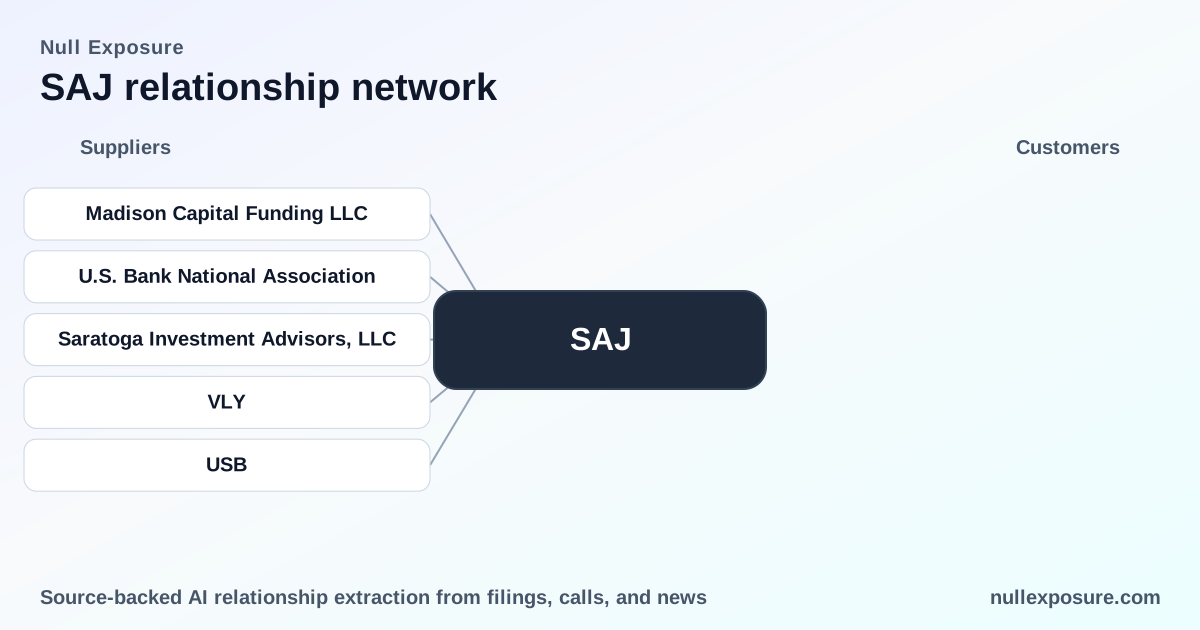
Below I list each supplier/counterparty pulled from filings and market coverage, with a concise business‑facing description and source reference.
Madison Capital Funding LLC
Madison Capital Funding LLC is referenced in the FY2025 10‑K in connection with a financing event that produced a realized loss on extinguishment of debt of $0.8 million, indicating an extinguished liability or debt restructuring with a modest hit to results. According to the FY2025 Form 10‑K filing, the $0.8m realized loss is recorded in relationship to that counterparty interaction (FY2025 10‑K).
U.S. Bank National Association
U.S. Bank National Association serves as custodian and collateral administrator under a Live Oak Credit Agreement: in that facility SIF III is borrower, Saratoga is collateral manager and equityholder, Live Oak is administrative agent, U.S. Bank NA is custodian, and U.S. Bank Trust Company is collateral administrator. This assigns U.S. Bank roles in custody and collateral services crucial to securitized or structured funding arrangements (FY2025 10‑K).
Saratoga Investment Advisors, LLC
Saratoga Investment Advisors, LLC is the external investment adviser and administrator that runs day‑to‑day investment decisions, provides office and administrative services, and has granted a non‑exclusive, royalty‑free license to use the “Saratoga” name. This relationship is the operational fulcrum of SAJ’s model — management, governance execution and brand licensing flow through this entity (company filing and MarketScreener coverage, March 2026).
Valley National Bank (VLY)
Valley National Bank provides an $85.0 million credit facility that Saratoga used to repay the prior Encina Credit Facility; the new facility is a primary bank funding source for working capital and portfolio financing. MarketScreener and TradingView reports in March 2026 documented the $85m credit agreement and its role in refinancing existing indebtedness (MarketScreener, March 2026; TradingView, March 2026).
U.S. Bank Trust Company (USB)
U.S. Bank Trust Company acted as trustee/indenture manager on a supplemental indenture enabling Saratoga to issue $100 million of 7.50% notes due 2031, supporting unsecured note financing on the corporate balance sheet. TradingView reported the Sixteenth Supplemental Indenture and the $100m 7.50% note issuance in March 2026 (TradingView, March 2026).
What the constraints tell investors about SAJ’s commercial risk profile
The extracted constraints reflect company‑level operating characteristics that require credit and counterparty analysis.
- Long‑term contracting posture: multiple excerpts reference maturities up to ten years and specific maturity dates (for example, April 20, 2033), implying SAJ’s assets and liabilities are often long dated and create duration and refinancing risk if markets tighten.
- Licensing tied to the adviser: the explicit license granting Saratoga Investment Advisors the right to use the “Saratoga” name is a relationship‑specific contractual element that reinforces the adviser’s operational centrality and brand dependency.
- Counterparty mix concentrated in U.S. middle‑market: the firm targets private U.S. middle‑market companies (EBITDA $2m–$50m), signaling higher idiosyncratic credit risk and weaker diversification versus broadly syndicated markets.
- Sector concentration: software (SaaS) represents 52.7% of investments, a material sector tilt that increases sensitivity to software sector cycles and buyer concentration.
- Funding scale and individual exposure: total investment size signals in the $100m+ band and an average portfolio company commitment of ~$20.1m indicate material single‑name exposure and active balance sheet deployment.
- Service provider dependence: the adviser, custodian and trust roles are identified as active service relationships, making operational continuity and indemnities key negotiation points.
These constraints combine into a business model that is capital‑intensive, externally managed, sector‑concentrated, and structurally long‑dated — a profile that matters to liquidity providers, note investors, and counterparties.
Risk and contract negotiation takeaways for investors and operators
- Operational criticality of the adviser: strengthen governance oversight around the investment management agreement and ensure fee alignment and termination protections are investor‑friendly.
- Refinancing and maturity management: insist on disclosure and covenants around balloon maturities and interest‑only loan structures that concentrate repayment risk.
- Concentration mitigation: given the SaaS overweight, underwrite sector stress scenarios and require enhanced covenant packages where possible.
- Counterparty service resilience: custodial and trust relationships with U.S. Bank entities and Valley National Bank are core plumbing for debt issuance and collateral flows — evaluate replacement cost and contingency plans.
For a deeper supplier mapping and negotiation playbook for BDC counterparties, see the supplier profiles and analysis tools at https://nullexposure.com/ (explore supplier intelligence).
Bottom line and next steps
Saratoga Investment Corp’s model is reliant on an externally managed platform, concentrated sector exposure, long‑dated interest‑only assets, and a mix of bank and unsecured funding. Each supplier relationship — from the investment adviser down to custodial and bank lenders — is structurally material to investment performance and operational continuity. Investors should price in concentration and refinancing risk, and counterparties should prioritize contractual clarity around custody, collateral administration and the adviser license.
If you need tailored diligence on SAJ’s counterparties or want to benchmark supplier risk across BDCs, start your research at https://nullexposure.com/.