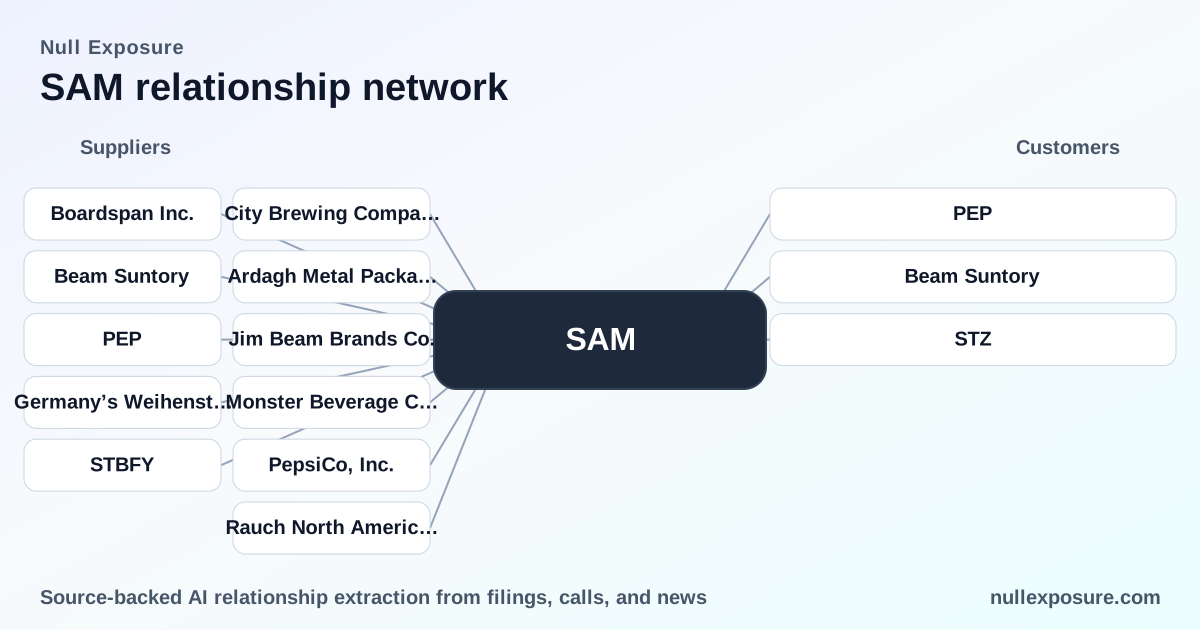
Boston Beer (SAM) — supplier map and strategic implications for investors
The Boston Beer Company operates as a branded alcoholic beverage company that owns and operates breweries for roughly three quarters of its domestic volume while outsourcing the remainder under production service agreements, and monetizes through branded product sales and licensing partnerships. Revenue drivers combine direct beverage sales (Samuel Adams, Truly and other brands), licensing income from trademark and product collaborations, and cost structures tied to raw-material and packaging commitments. For active supplier risk monitoring and counterparty diligence, review Boston Beer’s supplier footprint and contractual profile at https://nullexposure.com/.
How Boston Beer sources production and IP — the executive summary
Boston Beer brews, ferments and packages about 74% of domestic volume in-house and relies on third-party production for the balance; City Brewing supplied approximately 26% of domestic shipments in 2024, making that relationship operationally material. The company also uses licensing and co-branding arrangements (PepsiCo, Jim Beam, Beam Suntory) to expand product reach and creates multi-year procurement commitments for key agricultural inputs such as hops. Legal friction with a major can supplier (Ardagh) over minimum purchase commitments and an amendment to a production agreement with Rauch in December 2024 are immediate counterparty items to monitor.
Explore supplier-level intelligence and alerts at https://nullexposure.com/ to track these counterparties in real time.
Material manufacturers and packaging partners you should know about
City Brewing Company, LLC
City Brewing brewed about a quarter of Boston Beer’s domestic shipments in 2024 and is engaged under production services agreements that are central to the company’s outsourced brewing capacity. According to Boston Beer’s 2024 Form 10‑K, City Brewing supplied approximately 26% of domestic shipment volume in 2024 (FY2024 10‑K).
Ardagh Metal Packaging USA Corp.
Ardagh initiated legal action alleging Boston Beer failed to meet contractual minimum purchases of aluminum cans for 2021 and 2022, creating potential exposure around packaging obligations and contingent liabilities. This dispute is disclosed in the company’s 2024 Form 10‑K (FY2024 10‑K).
Rauch North America Inc.
Boston Beer amended and restated an existing production agreement with Rauch in December 2024, indicating an operational update to a third‑party supplier arrangement for processing or ingredient supply (FY2024 10‑K).
Licensing, co‑branding and white‑label partners shaping growth
PepsiCo / Pepsi
Boston Beer signed licensing agreements with PepsiCo in August 2021 to develop and market alcoholic beverages that leverage Pepsi trademarks and certain proprietary ingredients; the partnership supported product launches like Hard MTN DEW. Public releases and news coverage document the 2021 agreement and subsequent product plans (press releases and news coverage, 2021).
Jim Beam Brands Co.
In 2021 Boston Beer entered licensing agreements with Jim Beam to develop, market and sell alcohol beverages, leveraging Jim Beam’s spirits expertise and brand equity under contractual licensing terms (FY2024 10‑K referencing 2021 agreements).
Beam Suntory / Suntory
Boston Beer formalized a strategic partnership with Beam Suntory in 2021 to expand Truly into spirits and RTD formats, using Suntory’s distilling know‑how and distribution relationships to accelerate brand extensions (news reports and company releases, 2021–2022).
Monster Beverage Corporation
The 2024 10‑K references Monster Beverage’s acquisition of CaNarchy and subsequent launch of flavored malt beverage brands, highlighting competitive dynamics in flavored malt and RTD segments that affect Boston Beer’s market positioning (FY2024 10‑K).
Germany’s Weihenstephan
Boston Beer consulted globally recognized brewing scientists, including Germany’s Weihenstephan, when developing a non‑alcoholic IPA product, reflecting the company’s use of external technical expertise for product innovation (industry press, 2020).
Boardspan Inc.
Boardspan, a governance advisory firm, advised Boston Beer on board appointments in 2024, indicating engagement of external governance and director search expertise (Boston Beer press release, 2024).
What the contract and procurement constraints signal about Boston Beer’s operating model
- Contracting posture: The company mixes long‑term commitments (multi‑year hops purchase commitments through crop year 2029) with production service agreements that include extension rights; this produces a hybrid posture that balances in‑house control with outsourced flexibility. The 10‑K documents multi‑year hop commitments and production agreement terms (FY2024 10‑K).
- Concentration and criticality: With ~26% of domestic volume produced by City Brewing, that supplier is operationally critical and concentration risk is material to supply continuity and cost exposure (FY2024 10‑K). Production agreement expiration dates (some in 2025 and 2028 with rights to extend through 2035) create renewal and counterpart risk windows.
- Contract type mix: Licensing agreements (Pepsi, Jim Beam, Beam Suntory) are strategic revenue extensions and IP‑driven; the company also uses limited‑term supply agreements to secure preferential pricing on certain inputs. The 10‑K explicitly references licensing deals with Pepsi and limited‑term supplier agreements.
- Financial exposure and maturity: Hops purchase commitments outstanding totaled $10.3 million at December 28, 2024, establishing a mid‑single‑digit million committed spend band for a key raw material and tying procurement to FX and crop‑year risk (FY2024 10‑K).
Risks and monitoring priorities for investors and operators
- Counterparty concentration: Monitor City Brewing contract renewals and performance metrics given the operational concentration. Renewal windows in 2025 and 2028 are governance focal points (FY2024 10‑K).
- Contract disputes: Track the Ardagh litigation for potential inventory, cash or reputational impacts stemming from alleged minimum purchase breaches (FY2024 10‑K).
- Licensing dependency: Evaluate the commercial performance of co‑branded products (Hard MTN DEW, Truly extensions) because licensing partners control trademarks and certain proprietary inputs that influence gross margin and go‑to‑market execution (press releases and news, 2021–2022).
- Commodity and FX exposure: Hops commitments through 2029 and $10.3 million outstanding point to medium‑term price exposure; hedging and supplier diversity strategies are value‑relevant (FY2024 10‑K).
- Competitive new entrants: Monster’s moves into flavored malt beverages shift category dynamics and pricing pressure; maintain relative market share monitoring (FY2024 10‑K).
If you want supplier‑level alerts and counterparty scoring on Boston Beer’s network, start with supplier intelligence at https://nullexposure.com/.
Actionable takeaways
- Operationally material supplier: City Brewing is a single supplier providing a large share of outsourced production; contract renewal risk is a clear operational lever for investors.
- Mixed maturity in contracting: Boston Beer manages a portfolio of long‑term raw material commitments and shorter supplier agreements, which creates both predictability and tactical flexibility.
- Licensing is strategic growth: Partnerships with Pepsi, Jim Beam and Beam Suntory expand addressable markets but embed dependency on partner IP and marketing muscle.
For a closer look at each counterparty, legal exposure, and rolling monitoring of contractual expiries, visit https://nullexposure.com/ and review the Boston Beer supplier profile.
Boston Beer’s supplier footprint combines scale in owned capacity with targeted outsourcing and IP partnerships—understanding how those contracts roll up into supply continuity, margin pressure and brand leverage is essential for investors and operators assessing near‑term risk and mid‑cycle growth upside.