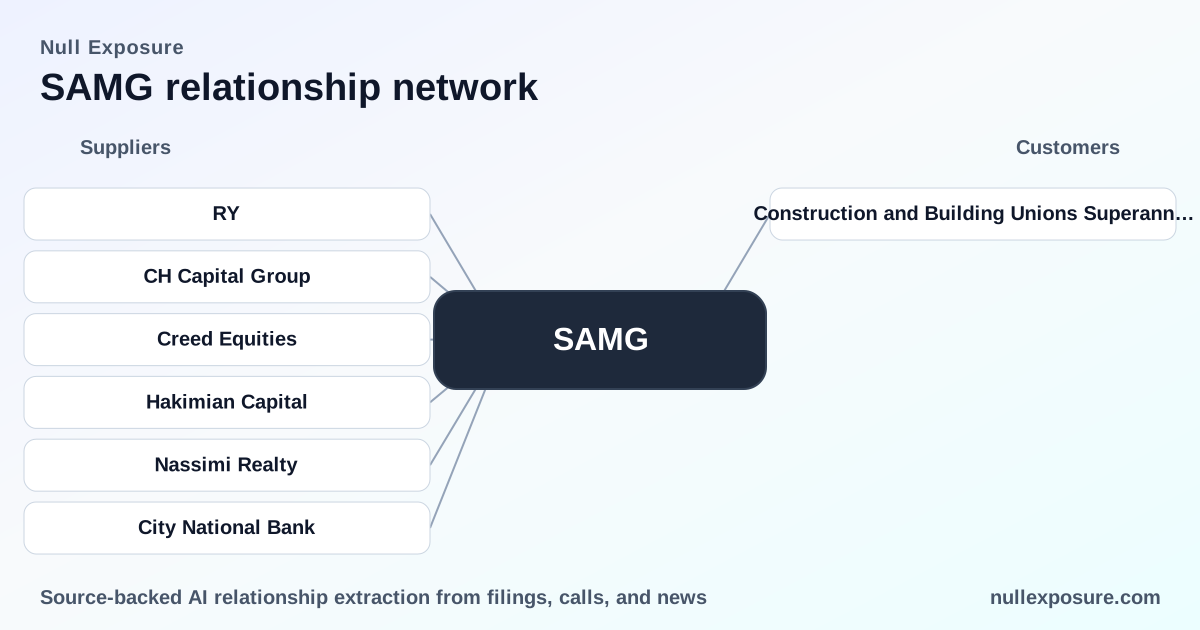
Silvercrest Asset Management Group (SAMG): Supplier relationships that shape a compact wealth manager
Silvercrest Asset Management Group runs a boutique wealth and family-office advisory business headquartered in New York and monetizes through advisory fees, investment management fees and related client services tied to its ~$37.6 billion in reported AUM and recurring client mandates. The firm's capital structure and supplier posture reflect a mid‑sized asset manager: moderate leverage capacity, concentrated real‑estate occupancy, and dependence on standard prime‑broker/custody service relationships that are operationally critical but not capital‑intensive. For a concise supplier risk view, visit the NullExposure homepage: https://nullexposure.com/.
Business snapshot and financial framing
Silvercrest is listed on NASDAQ (SAMG) and reports a compact income statement and balance sheet: revenues of roughly $125.3M TTM, profit margins near 5% and forward P/E of ~11.1, with institutional ownership around 66% and insiders holding just under 20%. These figures place Silvercrest in the small‑cap wealth manager cohort where operational continuity depends heavily on service partners for custody, clearing and office infrastructure rather than on large corporate credit lines.
Key structural signals: small revolving credit capacity ($10M revolver plus $10M term loan commitment available historically), a low outstanding balance under the City National Bank facility as of Sept. 30, 2025, and anchor tenancy in a single boutique Midtown office building. These are company‑level signals that shape supplier concentration, contracting posture, and operational criticality.
What the supplier map actually contains
Below I list every supplier relationship surfaced in public filings and news coverage, with a short plain‑English takeaway and the source for each mention.
-
City National Bank — Silvercrest reported no outstanding balance under its term loan and revolving credit facility with City National Bank as of September 30, 2025, indicating the firm currently operates without drawing on that committed facility. (Source: Silvercrest Q3 2025 results press release, GlobeNewswire, Oct. 30, 2025; corroborating QuiverQuant summary of Q3 2025 results.)
-
CH Capital Group — CH Capital is a joint‑venture partner in the ownership group that acquired Silvercrest’s office building at 1330 Avenue of the Americas, with Silvercrest listed as an anchor tenant in that property. This places CH Capital in a landlord/real‑estate partner role relative to Silvercrest’s office occupancy. (Source: JLL newsroom coverage of leasing activity at 1330 Avenue, FY2024.)
-
Creed Equities — Creed Equities is also part of the joint venture that owns the 525,000‑square‑foot Midtown tower where Silvercrest is an anchor tenant, positioning Creed as a landlord investor whose decisions on leasing and redevelopment affect Silvercrest’s occupancy cost and location continuity. (Source: JLL newsroom article about new owners and leasing at 1330 Avenue, FY2024.)
-
Hakimian Capital — Hakimian Capital joined the joint venture purchase of 1330 Avenue, making them another landlord partner with influence over the property where Silvercrest is headquartered; this is relevant for office‑market and occupancy risk. (Source: JLL newsroom coverage, FY2024.)
-
Nassimi Realty — Nassimi Realty completes the ownership syndicate for 1330 Avenue and is therefore part of the group that controls Silvercrest’s primary office lease dynamics. (Source: JLL newsroom article on 1330 Avenue leasing, FY2024.)
How these relationships translate into operational constraints
Two constraint signals in the public record yield clear company‑level implications:
-
Service provider dependency: Silvercrest states that its business relies on prime brokers, custodians and administrators to execute client transactions and safekeep assets. That is a standard but critical supplier dependence: losing or degrading those relationships would directly interrupt revenue generation and client service. Treat this as a core operational concentration risk, not a peripheral vendor relationship. (Company disclosure on reliance on prime brokers/custodians, cited in public filings.)
-
Medium‑sized committed credit capacity: The firm’s subsidiaries historically had borrowing authority up to $20.0 million (a $10.0 million term loan and a $10.0 million revolver). This spend band signals limited short‑term liquidity backstop relative to larger managers, which constrains growth funding and increases sensitivity to cash flow volatility. (Disclosure around subsidiary borrowing capacity cited in company materials.)
Practical implications for investors and operators
-
Counterparty criticality is high but concentrated: Custodians and prime brokers are operationally critical; commercial banking access (City National Bank facility) currently carries low outstanding leverage yet remains an important backstop. Investors should prioritize continuity and SLAs with custody/clearing partners when assessing operational risk.
-
Real‑estate exposure is a landlord concentration, not a corporate ownership risk: Silvercrest is an anchor tenant at 1330 Avenue; the ownership group (Creed, Hakimian, CH Capital, Nassimi) controls the property. This creates occupancy concentration risk—changes in leasing strategy or redevelopment could affect Silvercrest’s occupancy cost and staff location continuity.
-
Liquidity and growth constrained by modest credit capacity: The disclosed $20M borrowing envelope positions Silvercrest to manage working capital swings but limits large, opportunistic balance‑sheet moves. That constraint is consistent with its boutique advisory model and lower capital intensity.
Mid‑analysis action if you need a deeper supplier due diligence
If you’re evaluating counterparty risk or the operational resilience of a portfolio company like Silvercrest, prioritize:
- direct confirmation of custody and prime‑broker contracts and termination terms,
- lease terms at 1330 Avenue and landlord‑centric clauses, and
- covenant and usage details for the City National Bank facility.
For a structured supplier risk report on Silvercrest and its counterparties, visit the NullExposure homepage: https://nullexposure.com/.
Risk factors and opportunities to watch
- Operational disruption risk from custody/prime broker failure or contract termination is the highest single supplier risk; ensure redundancy and contingency arrangements are in place.
- Occupancy cost risk is medium: being an anchor tenant in a boutique Midtown building is strategically attractive but concentrates exposure to a single real‑estate owner group.
- Liquidity risk is manageable but finite; with a modest revolver and term loan commitment, Silvercrest cannot rely on large on‑balance liquidity for rapid expansion without tapping capital markets or raising strategic capital.
Bottom line and actionable verdict
Silvercrest operates as a compact, fee‑driven wealth manager whose supplier footprint is traditional but concentrated: critical dependency on custody/prime‑broker services, modest committed bank credit capacity, and office tenancy determined by a multi‑partner real‑estate JV. For investors and operators, the prudential focus is clear—validate custody contracts, monitor bank facility covenants and track landlord decisions at 1330 Avenue. For an in‑depth supplier exposure briefing and ongoing monitoring capabilities, see NullExposure: https://nullexposure.com/.
Sources and document notes
Primary public sources used above include Silvercrest’s Q3 2025 earnings release (GlobeNewswire, Oct. 30, 2025), QuiverQuant news summarizing the Q3 2025 results, and a JLL newsroom article on leasing activity at 1330 Avenue (FY2024) that lists Creed Equities, Hakimian Capital, CH Capital Group and Nassimi Realty as the ownership syndicate for the property where Silvercrest is an anchor tenant. URLs for these items are available in the public record.