Sangoma Technologies (SANG): Supplier Relationships and Strategic Implications for Investors
Sangoma Technologies operates as a communications infrastructure supplier that designs, manufactures, and supports voice and data connectivity components while packaging those capabilities into UCaaS and contact-center solutions. The company monetizes through a mix of product sales (hardware and connectivity modules), software licensing, and hosted service offerings—revenue reported at $219.7M TTM with gross profit of $155.1M and a small positive EBITDA of $7.36M, while operating margins remain slightly negative. For investors and operators assessing supplier risk and opportunity, the supplier relationships Sangoma discloses in recent commentary signal a strategic push toward cloud-native delivery and vertical integration with hospitality hardware vendors. For a deeper read into portfolio-level supplier signals and what they mean for contracts and operational resilience, visit https://nullexposure.com/.
Quick take: What matters to an investor evaluating Sangoma's suppliers
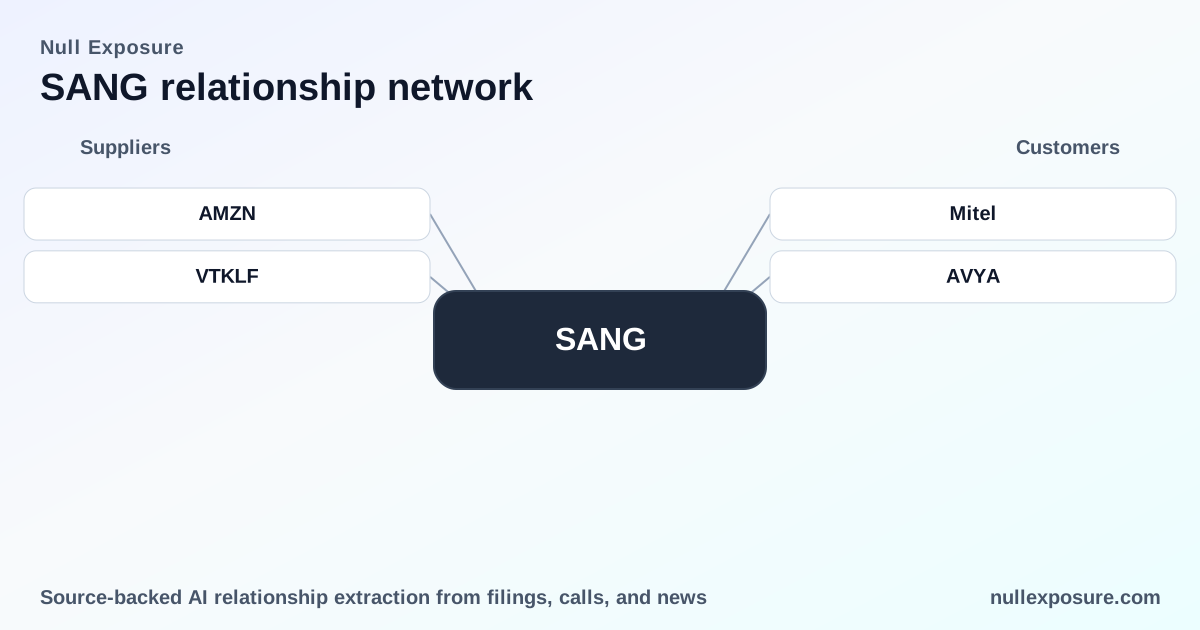
Sangoma’s public disclosures show two named supplier/partner relationships that are strategically distinct: one emphasizes cloud infrastructure scale, and the other underscores device-level integration for a vertical market (hospitality). These relationships affect Sangoma’s cost structure, go-to-market packaging, and customer stickiness. Keep in mind the company’s market cap is approximately $151M, insiders hold a material 26.8% stake, and institutional ownership sits at 33.2%, which concentrates governance and strategic continuity.
- Investment highlight: Cloud partnership prioritizes scalability for UCaaS and contact center products and reduces Sangoma’s need to vertically provision core compute and security infrastructure.
- Operational risk: Hardware integrations and hospitality channel work introduce supply and logistics complexity distinct from cloud services.
If you want to map supplier exposure across Sangoma’s commercial stack, start here: https://nullexposure.com/.
Supplier relationships disclosed in the 2025 Q4 earnings call
Amazon Web Services — cloud infrastructure partnership
Sangoma described a partnership with Amazon Web Services announced earlier in the summer, explicitly stating that Sangoma leverages AWS technologies to deliver scalable, secure, high-performance communication infrastructure for its UCaaS and Contact Center platforms globally. This is a technology and delivery relationship that shifts core runtime and platform dependencies onto AWS infrastructure, improving Sangoma’s ability to scale and standardize operations across geographies. According to the 2025 Q4 earnings call, the partnership is framed as bi-directional: Sangoma both consumes AWS capabilities and positions its communications stack to run on AWS services.
Source: Sangoma 2025 Q4 earnings call (remarks referencing an AWS partnership announced in the summer; first seen in the 2025Q4 call transcript).
VTech Hospitality — device integration for hotel and resort customers
In hospitality vertical use cases, Sangoma reported a partnership with VTech Hospitality to integrate VTech’s phones with Sangoma’s UC platform, delivering a unified guest communications experience for hotels and resorts. This relationship is a product-level integration that supports Sangoma’s channel sales into hospitality and helps lock in customers through combined hardware-software solutions. The mention was included in the 2025 Q4 earnings call as an example of verticalized distribution and product bundling.
Source: Sangoma 2025 Q4 earnings call (remarks referencing integration work with VTech Hospitality).
What the supplier mix implies about Sangoma’s operating model
These two named relationships point to a hybrid delivery posture:
- Sangoma uses third-party cloud infrastructure (AWS) for core platform running and scale, which reduces capital intensity for data center infrastructure and accelerates international deployment.
- Sangoma pursues vertical device integrations (VTech) to deepen channel penetration in hospitality, creating bundled value propositions that combine recurring software/services revenue with one-off device sales.
From a contracting and maturity perspective, this mix implies Sangoma is operating at the intersection of recurring cloud-hosted services and distributed hardware contracts. That dual posture requires both cloud vendor contracting discipline (service-level agreements, security attestations) and supply-chain management for physical devices.
Company-level financial signals reinforce this hybrid model: revenue TTM $219.7M, negative net margins but positive EBITDA, and a Price-to-Sales ratio near 0.69. Those metrics reflect a company scaling hosted services while absorbing margin pressure from product and integration costs.
Constraints and governance signals investors should note
No explicit contractual constraints or regulatory limitations were captured in the supplier relationship disclosures for Sangoma. The dataset contains no constraint excerpts to attribute to specific suppliers. As a company-level signal, the absence of recorded constraints in this set suggests limited public disclosure of vendor contractual terms through earnings commentary, so investors should request supplier SLA and dependency detail directly during diligence to fully assess concentration and operational risk.
Strategic risks and upside from the supplier profile
- Upside: AWS partnership materially improves Sangoma’s ability to scale UCaaS/contact center offerings and expand internationally without equivalent capital investment; this supports recurring revenue growth and lowers time-to-market for new regions.
- Risk: Dependence on major cloud providers creates single-vendor exposure for critical runtime and potentially for cost inflation tied to cloud pricing. Separately, hardware integrations (VTech) reintroduce supply-chain and logistical complexity and can compress margins if device sales remain capital-intensive.
Practical next steps for investors and operators
- Request the AWS contractual terms covering availability, data locality, and exit provisions to understand concentration risk and service guarantees.
- Review Sangoma’s device procurement and inventory policies for hospitality integrations to evaluate working capital implications.
- Monitor margin trends quarterly; operating margin recovery or continued compression will indicate whether the hybrid model is delivering profitable scale.
Explore more supplier intelligence and supplier-network risk analysis at https://nullexposure.com/ to benchmark Sangoma’s supplier posture against peers.
Bottom line
Sangoma’s public supplier disclosures in 2025Q4 highlight a deliberate strategy to combine cloud-scale delivery (AWS) with vertical device integrations (VTech Hospitality). That combination supports faster global growth for UCaaS and contact center offerings while creating a two-front operational requirement—cloud vendor management and device supply-chain control—that investors must evaluate. For deeper benchmarking and contract-level diligence, start your analysis at https://nullexposure.com/.