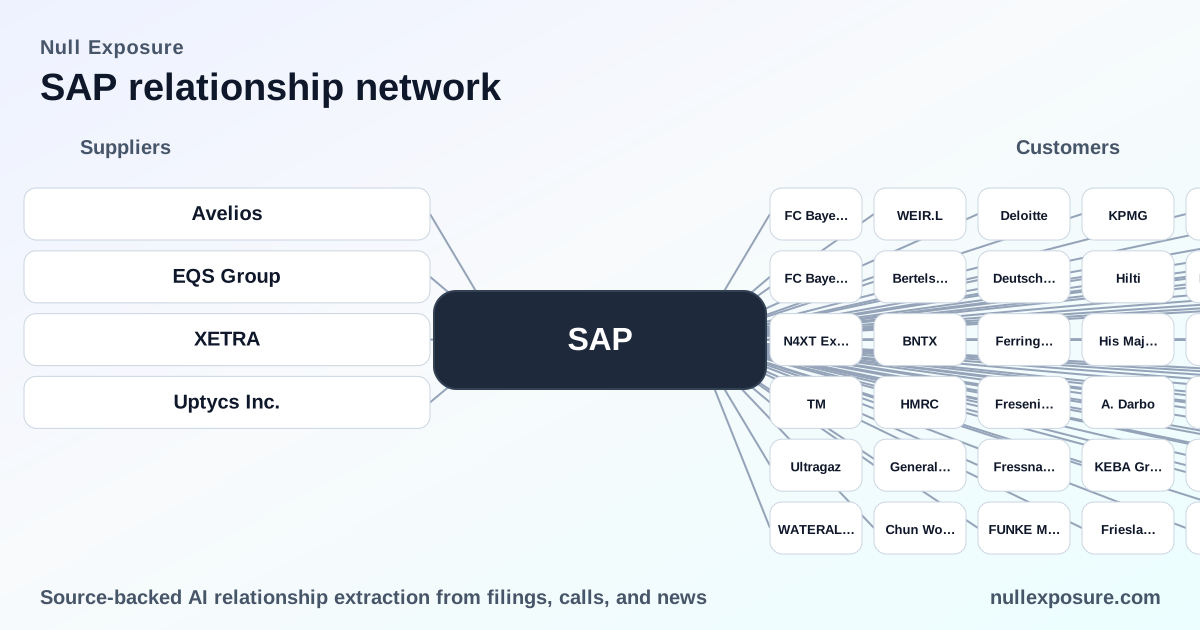
SAP supplier relationships: platform partnerships, capital-market partners, and security integrations investors should track
SAP SE is a mature global enterprise software company that monetizes through cloud subscriptions, software licenses, support services, and professional services layered on top of its core enterprise applications. With a market capitalization around $225 billion, trailing revenue of $36.8 billion and a strong operating margin, SAP runs a platform-oriented commercial model that converts large, long-duration customer contracts into predictable recurring revenue while leveraging a broad partner and supplier ecosystem for vertical solutions and security capabilities.
Explore how these supplier and partner signals feed into SAP’s operating posture and risks at https://nullexposure.com/.
How these supplier signals map to SAP’s business model
SAP’s commercial reality is shaped by three structural forces that investors must internalize: platform-led monetization, ecosystem dependency, and capital-allocation signaling. SAP wins large enterprise deals and then extends monetization through cloud migrations, add-on modules, and services sold via direct and partner channels. That model depends on a stable of specialized partners for verticalization (healthcare, industry-specific workflows) and security integrations, while capital-market partners and execution (for example, trading venues and news dissemination services) influence shareholder liquidity and perception.
- Contracting posture: Enterprise contracts are long-dated and relationship-driven, favoring predictable recurring revenue and multi-year partner engagements.
- Concentration and criticality: Customer-facing solutions are mission-critical for large enterprises; supplier concentration is moderate because SAP uses many partners, but the criticality of a small set of platform and security partners is high.
- Maturity: SAP’s supplier roster is typical of a mature software firm—diverse partners, recurring vendor relationships, and active capital-market mechanics such as buybacks and regulated disclosure.
No supplier constraints were flagged in the available signals as a company-wide indicator during this review, which is itself a company-level signal about the absence of public constraint reporting in the sampled period.
Supplier and partner signals observed in public filings and news
Below are concise, plain-English summaries for every supplier or related entity surfaced in the public signals for SAP during FY2026 and Q4 2025.
Avelios — collaboration on a healthcare patient-management solution
SAP disclosed in its 2025 Q4 earnings call that it is co-developing a new patient management solution with Fresenius and Avelios on SAP’s platform, indicating continued investment in verticalized healthcare offerings and partner-led solution delivery. This was mentioned in the Q4 2025 earnings call transcript (first seen March 7, 2026).
EQS Group — regulatory and capital-market communications distributor
EQS Group is reported as the service used for disseminating SAP’s post-admission duties announcement in FY2026, demonstrating SAP’s use of regulated news-distribution services for compliance and investor communications. TradingView referenced EQS News distributing SAP’s post-admission duties announcements on March 10, 2026.
XETRA — trading venue executing share buybacks
XETRA executed share purchases on behalf of SAP as part of SAP’s ongoing buy-back program, with 299,063 shares bought via XETRA from February 23–27, 2026 and 1,865,850 shares bought via XETRA from February 16–20, 2026, reflecting active capital return operations during FY2026. These transactions were reported via TradingView posts referencing XETRA activity on March 10, 2026.
Uptycs Inc. — security partnership deploying verifiable AI analysts
Uptycs announced a strategic partnership with SAP to deploy verifiable AI analysts aimed at strengthening enterprise security teams, signaling SAP’s ongoing integration of third-party security capabilities and AI-driven analytics into its ecosystem. This partnership was reported by SCWorld and references coverage from Silicon Angle on March 10, 2026.
(Each of the items above reflects the public signal set for SAP suppliers and partners during the periods noted.)
Explore a consolidated view of partner and supplier signals for investment research at https://nullexposure.com/.
What these relationships mean for investors
The mix of relationships is intentional and instructive:
- Vertical productization: The Avelios–Fresenius collaboration confirms SAP’s strategy to drive adoption through industry-specific solutions, which supports upsell and stickiness in regulated verticals such as healthcare.
- Security and AI integration: The Uptycs tie illustrates SAP’s reliance on specialist security vendors to add differentiated, high-value capabilities without building everything in-house, accelerating time-to-market for advanced features.
- Capital-allocation transparency: Repeated use of EQS and execution on XETRA for buybacks shows disciplined capital-market mechanics—SAP is actively managing its share count and investor communications through established market infrastructure.
These signals collectively reinforce SAP’s platform-centric revenue engine: partners extend product breadth and help monetize niche use cases, while capital-market actions manage shareholder returns.
Key risks and operational constraints to watch
- Partner execution risk: Verticalization depends on partner delivery quality; failure by a key partner to deliver could slow adoption in a targeted industry.
- Security integration risk: Reliance on third-party security vendors raises integration and support complexity, which is critical given the enterprise-critical nature of SAP deployments.
- Capital-allocation trade-offs: Continued buybacks signal shareholder return priorities but also reduce capital available for inorganic growth or larger strategic acquisitions.
No public supplier-specific constraints were identified in the sampled signals, which implies no immediate regulatory or contractual constraint flags in the reviewed period; however, investors should monitor ongoing disclosures for changes.
Next steps for investors and operators
- If you are tracking SAP’s ecosystem trajectory, prioritize vertical partnerships (healthcare, financial services) and security integrations as indicators of product differentiation and upsell opportunity.
- Monitor buyback cadence and disclosures via XETRA and EQS channels for signals on capital-allocation priorities and liquidity management.
For deeper signal aggregation and ongoing monitoring of SAP’s supplier relationships, visit https://nullexposure.com/ to get continuous coverage and context.
Bottom line
The public signals for FY2026 show SAP actively executing a two-pronged strategy: expand platform value through partner-led vertical solutions and shore up enterprise trust through specialist security integrations, while simultaneously using established capital-market channels to manage shareholder returns. These are classic signs of a mature enterprise-software franchise balancing growth, product depth, and investor stewardship. For a focused feed of supplier and partner signals impacting valuation and operational risk, go to https://nullexposure.com/.