Saratoga Investment Corp (SAR): Supplier relationships, constraints, and what investors should watch
Saratoga Investment Corp operates as a publicly traded business development company that originates and holds debt and equity positions in middle‑market companies, monetizing through interest income, fee income and capital appreciation while distributing a consistent dividend yield to shareholders. The company is externally managed and administered, uses third‑party custodial and collateral services for credit facilities, and leverages SBA‑backed SBIC capital to enhance long‑term funding capacity. For investors evaluating counterparty and supplier risk, the core exposures are the external manager (operational control), banking custodians (operational continuity), and the funding profile (long‑dated notes and credit facilities). Learn more about supplier intelligence at NullExposure: https://nullexposure.com/.
Quick read: how supplier relationships translate into economic and operational risk
Saratoga’s business model depends on two supplier archetypes: service providers that run day‑to‑day investment and administrative operations, and financial counterparties that provide custody, collateral administration and committed funding. The manager relationship concentrates decision rights and operational dependency; banking counterparties create single‑point operational risk for cash and collateral flows; and government‑sponsored SBIC capacity influences capital structure and maturity profile.
The relationships you need to know
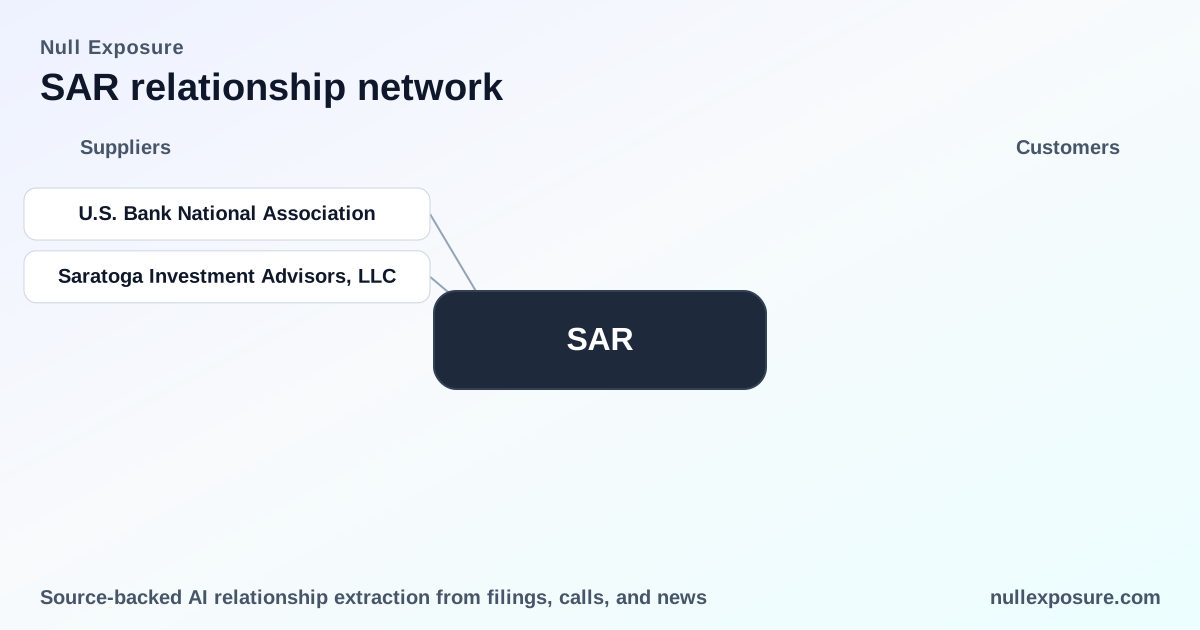
U.S. Bank National Association — custodian & collateral administrator (Live Oak Credit Facility)
U.S. Bank National Association serves as custodian and U.S. Bank Trust Company, National Association as collateral administrator for Saratoga’s Live Oak Credit Facility, providing essential custody and collateral services that underpin secured borrowing and settlement operations. This role is documented in Saratoga’s FY2025 10‑K filing (filed Feb 28, 2025). (Source: FY2025 10‑K, sar-2025-02-28)
Saratoga Investment Advisors, LLC — external manager and administrative services (news citation: Yahoo Finance)
Saratoga Investment Advisors, LLC is identified in external reporting as the external manager that implements Saratoga’s investment strategy and performs day‑to‑day administrative functions, reflecting the company’s externally‑managed BDC structure. This arrangement is described in news coverage summarizing the FY2025 results. (Source: Yahoo Finance report on Saratoga fiscal 2025 results, published Mar 2026)
Saratoga Investment Advisors, LLC — external manager and administrator (news citation: QuiverQuant)
A second news reference reiterates that Saratoga Investment Advisors, LLC is the SEC‑registered investment adviser responsible for management and administration of the company’s credit‑driven strategies, reinforcing the operational centrality of this single external manager in FY2025 disclosures. (Source: QuiverQuant announcement referencing FY2025/early FY2026 reporting, Oct 2025 filing notice)
What the disclosed constraints tell investors about the operating model
The document‑level constraints and excerpts provide a clear picture of corporate contracting posture, concentration, criticality and maturity profile that directly inform supplier risk.
-
Contracting posture: long‑term funding and agreements. Saratoga’s capital structure contains multiple long‑dated instruments—notes maturing in 2027 and 2028, SBA‑guaranteed debentures with ten‑year terms, and credit facilities with multi‑year tenor—indicating a deliberate preference for multi‑year funding that reduces immediate refinancing pressure but locks in rate exposure over time. Evidence for this posture is present across FY2025 filings and notes schedules (examples include the 4.35% 2027 Notes, 8.50% 2028 Notes, and Live Oak and Encina credit facility maturities).
-
Concentration and criticality: heavy reliance on an external manager. The company is externally managed and administered by Saratoga Investment Advisors, LLC under a management agreement and related administrative agreements, with explicit license terms permitting use of the “Saratoga” name. This creates single‑counterparty operational concentration where investment decision‑making, compliance oversight and administrative continuity depend on the manager’s performance and governance.
-
Operational dependencies: custodians and collateral administrators are critical. Custodial and collateral administrative services provided by U.S. Bank are operationally critical to secured lending programs like the Live Oak facility; disruption or contractual friction with that bank would have an outsized impact on funding and settlement of secured positions.
-
Public‑sector funding tailwind: SBIC/SBA capacity expands long‑term capital. Saratoga’s SBIC license (SBIC III LP) provides up to $175 million in SBA‑guaranteed debenture capacity, effectively lowering the cost and lengthening the tenor of available capital while introducing regulatory interdependence with a government counterparty.
-
Vendor spend is operationally modest in disclosed commitments. Unfunded commitments referenced in filings are small (for example $0.3 million of unfunded commitments as of Feb 28, 2025), which signals that direct procurement dollar exposure to suppliers is limited, even as operational dependence on a small set of critical providers remains high.
Mid‑article action: dig deeper on supplier concentration
If you are modeling counterparty stress or operational downtime scenarios, start with the external manager and the custodial relationship: those two suppliers drive the lion’s share of operational and reputational risk for Saratoga. For an organized supplier‑risk review, explore NullExposure’s supplier intelligence hub: https://nullexposure.com/.
Practical implications for portfolio managers and operators
- Operational risk is concentrated. External management and license agreements mean the firm’s governance and operational continuity hinge on a single manager; investors should prioritize contractual termination clauses, renewal mechanics and change‑of‑control provisions in diligence.
- Refinancing risk is mitigated but rate exposure persists. Long‑dated notes and SBIC debentures reduce rollover frequency but carry interest‑rate and liquidity implications as markets reprice credit.
- Custody and settlement are non‑negotiable operational vectors. U.S. Bank’s custodial role is mission‑critical; operational SLAs, disaster recovery testing and successor arrangements should be a focus of supplier due diligence.
- Spend exposure is low but strategic dependence is high. Low direct procurement numbers do not reduce supplier importance—small annual spend can house critical services.
Investor takeaways — concise and actionable
- Primary supplier risks: external manager concentration and custodian dependency. Both are explicitly documented across filings and news coverage for FY2025.
- Funding profile is long‑dated and supplemented by SBIC capacity. This reduces short‑term refinancing risk while creating government counterparty interdependence.
- Operational spend is small but strategic vendor relationships are essential. Focus due diligence on contract terms, renewal mechanics, and contingency planning.
For a comprehensive supplier‑risk scorecard and comparator benchmarking, visit NullExposure’s resource center: https://nullexposure.com/.
Saratoga’s public disclosures lay out a clear supplier topology: a dominant external manager, essential banking counterparties, and supportive public‑sector funding channels. Investors should prioritize contractual details and contingency playbooks around those relationships to convert this structural understanding into actionable risk limits and scenario analyses.