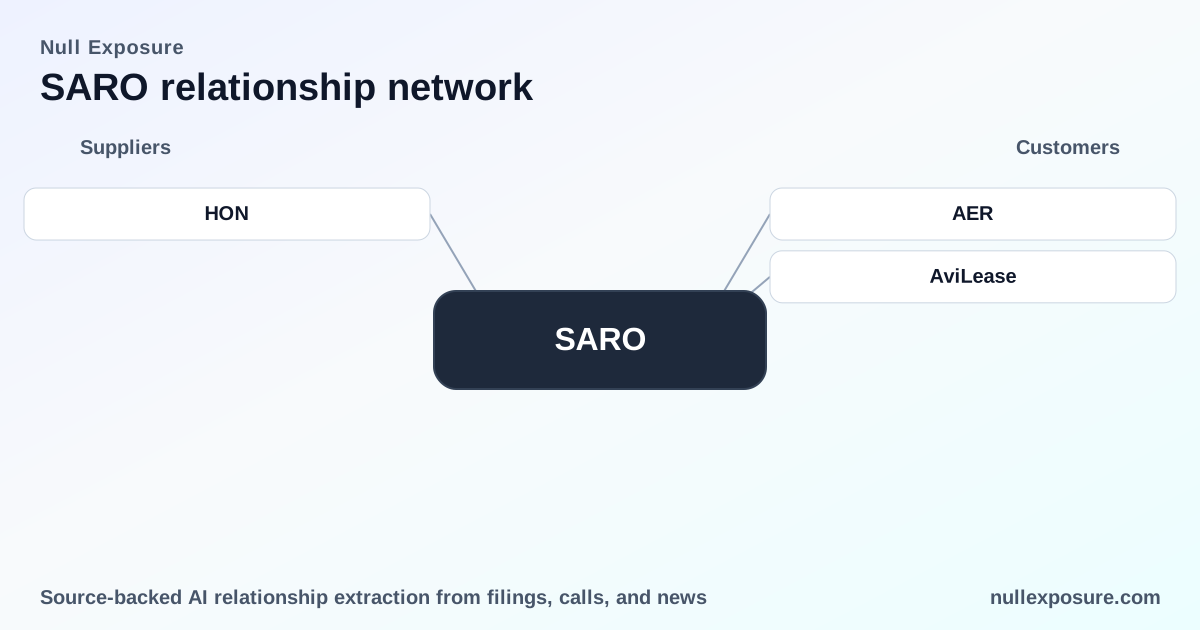
StandardAero (SARO): supplier relationships and what they mean for investors
StandardAero is a global aerospace engine aftermarket services provider that monetizes through repair, overhaul, and parts sales for fixed- and rotary-wing engines, supplemented by authorized licensing arrangements with OEMs that create semi-exclusive service corridors. The company captures revenue from MRO (maintenance, repair and overhaul) labor, OEM parts purchases and resale, and subcontracted aftermarket work that OEMs delegate; margins depend on authorization status, parts sourcing, and the scale of OEM subcontracting. For investors evaluating supplier counterparty risk and strategic positioning, the interplay of OEM authorizations and concentrated parts purchasing is the central thesis. Learn more at https://nullexposure.com/.
How StandardAero runs its business and where the cash comes from
StandardAero operates as an independent aftermarket specialist that competes to service engines through two interlocking economic levers: authorized repair rights (licenses) from OEMs that limit competition on certain platforms, and scale in parts procurement and shop capacity that captures volume economics. The firm’s revenue base is dominated by MRO billings and parts sales, while subcontracting work from OEMs and airlines supplements direct customer flows. Public financials show meaningful scale—over $6 billion in trailing revenue—and profitability driven by aftermarket margins rather than new-engine sales.
This operational profile produces several investor-relevant dynamics: high dependence on OEM authorizations for addressable market access, significant concentration in parts suppliers, and earnings leverage to utilization and parts cost control. Those characteristics should guide diligence on supplier credit, contract tenure, and runway for license renewals. For further supplier-risk intelligence, visit https://nullexposure.com/.
The Honeywell relationship — succinct, source-backed take
StandardAero reports that aircraft engine OEMs, including Honeywell, contract or subcontract aftermarket services to the company, and OEMs are significant customers in addition to providing authorizations to service engines they manufacture. According to StandardAero’s Form 10‑K for the year ended December 31, 2024, OEMs such as Honeywell subcontract aftermarket work to StandardAero, creating both supplier and customer dynamics between the parties (FY2024 company filing).
Why that matters: being both a supplier customer and an authorized service provider to OEMs binds StandardAero into OEM commercial ecosystems where subcontract volume and licensing access materially affect revenue mix and margin negotiation leverage.
Operational constraints that shape risk and opportunity
Several constraints disclosed by StandardAero give a clear picture of the company’s operating posture:
- Concentration in parts sourcing is material. The company states that for the year ended December 31, 2024, the four largest parts suppliers—OEMs—accounted for a substantial majority of parts purchases. This is a company-level signal that parts supply concentration is a material risk to margins and continuity of operations.
- Licensing and semi-exclusive authorizations are a structural advantage. StandardAero holds exclusive or semi‑exclusive licenses with OEMs for specific platforms and has been the first independent provider in the Americas for select engine programs, including engines from manufacturers such as Honeywell. That licensing posture creates higher barriers to market entry and supports pricing power on covered platforms.
- Multiple relationship roles exist across the supply base. OEMs play dual roles as manufacturers (parts sources) and licensors/customers (authorizing and subcontracting service work)—a reality that concentrates both commercial risk and revenue opportunity around the same counterparty set.
- Use of external service providers for specialized functions is routine. The company uses outside firms for functions such as security assessments and accounting advisory; StandardAero disclosed payments to CFGI, a Carlyle-affiliated accounting adviser, in 2024. This signals a reliance on niche third parties for governance and control functions rather than those being fully insourced.
These constraints together indicate a company that leverages authorized access and scale to generate aftermarket value but is sensitive to OEM commercial decisions and parts-supply concentration.
What the supplier-customer duality means in practice
StandardAero’s relationships with OEMs such as Honeywell create a two-way economic dependency:
- As an authorized service provider, StandardAero secures addressable market share and can price services with less direct competition on licensed platforms.
- As a purchaser of OEM parts, the firm is exposed to parts pricing, lead times, and supply allocation decisions made by those same OEMs.
This duality elevates the strategic importance of contract tenure, renewal terms, and dispute-resolution clauses; investors should prioritize diligence on license durations, exclusivity periods, and any change-of-control triggers that could affect service rights.
Risk factors investors should track now
Key operational and financial risks to watch include:
- Parts-supply concentration and pricing shocks from the handful of OEM manufacturers that supply most parts.
- License renewal and scope risk, especially where StandardAero is semi‑exclusive on a small number of high-value platforms.
- Subcontracting volume variability from OEMs: if OEMs change sourcing strategy, subcontract volumes and utilization could swing earnings.
- Reliance on third-party specialists for core governance and diagnostic work (e.g., accounting advisers), which raises outsourcing and vendor‑management risk.
Investors should monitor quarterly disclosures for changes in the composition of the top parts suppliers, any amendments to OEM service authorizations, and development in OEM-subcontracted business lines.
Quick, actionable takeaways for investors and operators
- Positive structural moat: Authorized licensing on key engine platforms gives StandardAero a defensible aftermarket position on specific engines.
- Concentration is a double-edged sword: The same OEMs that enable service rights also supply the majority of parts, creating supply-side vulnerability.
- Operational focus: Active contract management with OEMs and diversified parts sourcing are top levers to protect margins.
If you’re modeling SARO, stress-test parts-cost inflation and scenarios where OEM subcontracting reduces or re-routes volume. For operational partners, prioritize supply-chain visibility and contract clauses that secure parts allocation in tight markets.
For a deeper supplier-risk view and ongoing updates on SARO’s counterparty landscape, visit https://nullexposure.com/.
Final read: what to watch next and where to dig
Monitor upcoming SEC filings and quarterly commentary for changes in the mix of the four largest parts suppliers, any new OEM authorizations or losses of exclusive service rights, and commentary on subcontract revenue from OEM partners like Honeywell. These items drive the company’s revenue durability and margin sensitivity more than short-term cyclical demand shifts.
To track these supplier relationships and constraints with a focus on investment decisions, return to https://nullexposure.com/ for structured intelligence and alerts.