Sigma Additive Solutions (SASI): Supplier Relationships and Strategic Implications for Investors
Sigma Additive Solutions (NASDAQ: SASI) provides quality assurance software and integrated inspection solutions for the commercial 3D printing industry and monetizes through software licensing, integrated hardware/software offerings, and partner-driven bundled solutions. Revenue depends on enterprise software deals, integrated hardware partnerships that increase deal size, and recurring support or licensing agreements tied to post-processing and in-process inspection workflows. This analysis focuses on Sigma’s supplier relationships, what they reveal about the company’s go-to-market posture, and the operational signals that matter to investors evaluating supplier concentration and strategic dependency.
Explore a consolidated view of Sigma’s supplier relationships at the Null Exposure homepage: https://nullexposure.com/
Why partnerships shape SASI’s commercial reality
Sigma’s operating model is partnership-centric: the company sells quality assurance as part of a broader manufacturing stack rather than as a standalone niche tool. Partner integrations expand addressable markets—from firmware and computation engines to post-processing hardware—and convert single-product customers into platform customers paying for integrated solutions and services. For investors, the value proposition is straightforward: partnerships increase per-customer revenue and lock-in through interoperability, but they also introduce dependency on partner go-to-market execution and product roadmaps.
Learn more about supplier mapping at Null Exposure: https://nullexposure.com/
The partner map: two active supplier relationships
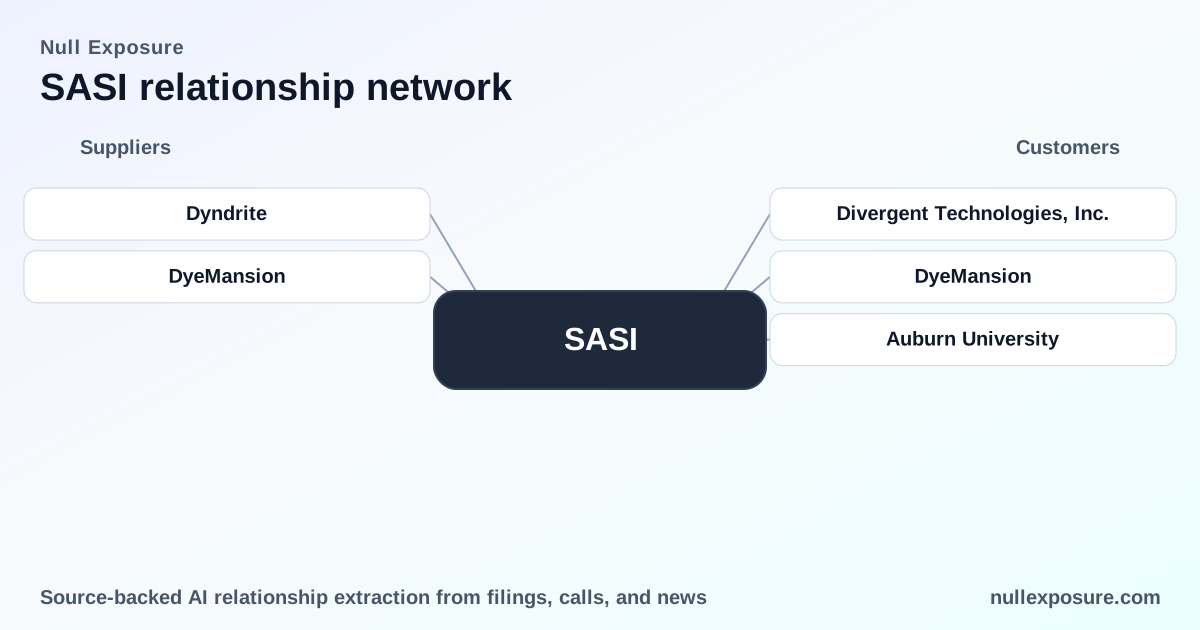
Sigma’s recent disclosures and press coverage identify two notable supplier relationships. Both partnerships are operationally meaningful: one strengthens Sigma’s in-process data capabilities; the other embeds Sigma into the post-processing value chain.
Dyndrite — accelerating in-process compute and integration
According to a FinancialContent press release in November 2022, Sigma entered an agreement with Dyndrite to build connected in-process data software using Dyndrite’s GPU-accelerated computation engine. This relationship positions Sigma to leverage high-performance computation for next‑generation digital manufacturing workflows, improving real-time inspection and enabling tighter integration with advanced toolchains (FinancialContent press release, Nov 2022).
Why this matters: Dyndrite’s computation engine reduces latency and scales complex geometry computations, which directly enhances Sigma’s inspection software capabilities and strengthens its competitive positioning in high-throughput additive manufacturing customers.
Source: FinancialContent press release, November 2022 (press announcement via markets.financialcontent.com).
DyeMansion — embedding QA into post-processing hardware
Sigma announced a partnership with DyeMansion to offer an integrated hardware/software solution option that enhances quality assurance for DyeMansion’s post-processing systems (reported FY2023). That arrangement delivers a bundled option for post-processing lines—DM60, Powershot Performance, and Powerfuse S—where Sigma’s software provides an “extra quality assurance” layer before and after finishing operations (TCT Magazine, FY2023).
Why this matters: DyeMansion’s installed base in industrial finishing lines gives Sigma direct access to post-processing workflows where inspection and traceability deliver immediate ROI, thereby creating cross-sell opportunities and recurring software lift for hardware customers.
Source: TCT Magazine coverage of Sigma and DyeMansion partnership, FY2023.
Company-level constraints and operating signals
The public relationship summary contains no explicit constraints disclosures. That absence is a signal in itself: Sigma has not publicly listed binding supply constraints or relationship-specific limitations in these excerpts, so investors should treat this as a neutral evidence set rather than proof of operational resilience.
From the relationship activity and the lack of enumerated constraints, several company-level operating characteristics become visible:
- Contracting posture: Partnership-led and integration-focused. Sigma negotiates cooperative arrangements with hardware and software engine providers rather than exclusive, captive-supplier models. This posture helps scale distribution but increases reliance on partner roadmaps and joint engineering timelines.
- Concentration: Current public evidence points to a small set of strategically chosen partners rather than a broad supplier ecosystem. Concentration increases execution risk if any single partner experiences disruption, but it also signals targeted, high-value integrations.
- Criticality: Partnerships address critical workflow nodes—in-process computation and post-processing QA—so supplier relationships are operationally consequential, not peripheral add-ons. Partners are important to product differentiation and customer retention.
- Maturity: Relationship maturity spans multiple fiscal periods (FY2022–FY2023), indicating an ongoing, iterative approach to partnerships rather than one-off pilots. This suggests Sigma prioritizes deep integrations that unlock commercial deals over fleeting integrations.
Risk and upside — what investors should model
Sigma’s partner strategy creates a clear risk/reward profile:
- Upside: Bundled solutions with established hardware vendors accelerate enterprise adoption and increase recurring revenue potential. High-performance compute integrations allow entry into higher-margin, high-complexity segments of additive manufacturing.
- Risk: Concentration in a few partnerships risks co-dependence—execution delays or partner product issues can directly impact Sigma’s sales cycles. Integration timelines and engineering alignment will determine near-term revenue ramp.
Monitor partner announcements, joint go-to-market progress, and contract terms for renewals and exclusivity clauses to quantify this exposure.
For deeper supplier relationship intelligence and to track updates, visit Null Exposure: https://nullexposure.com/
Practical watchlist for the next 12 months
- Track joint product launches and customer case studies with Dyndrite and DyeMansion to confirm commercial traction.
- Watch for any disclosure of revenue attribution to integrated solutions versus standalone software to measure the financial impact of partnerships.
- Evaluate partner concentration by looking for additional integrations or expanded partner lists; diversification reduces execution risk.
Conclusion: partnership-driven growth under scrutiny
Sigma Additive Solutions is executing a focused partner integration strategy that enhances product differentiation and expands commercial channels. Dyndrite strengthens Sigma’s in-process computation capability, and DyeMansion embeds Sigma into post-processing workflows—both partnerships are operationally material. Investors should value the potential revenue upside from bundled solutions while closely monitoring partner execution and any signs of concentration risk. For ongoing supplier relationship analysis and to view summarized relationship intelligence, visit Null Exposure’s homepage: https://nullexposure.com/