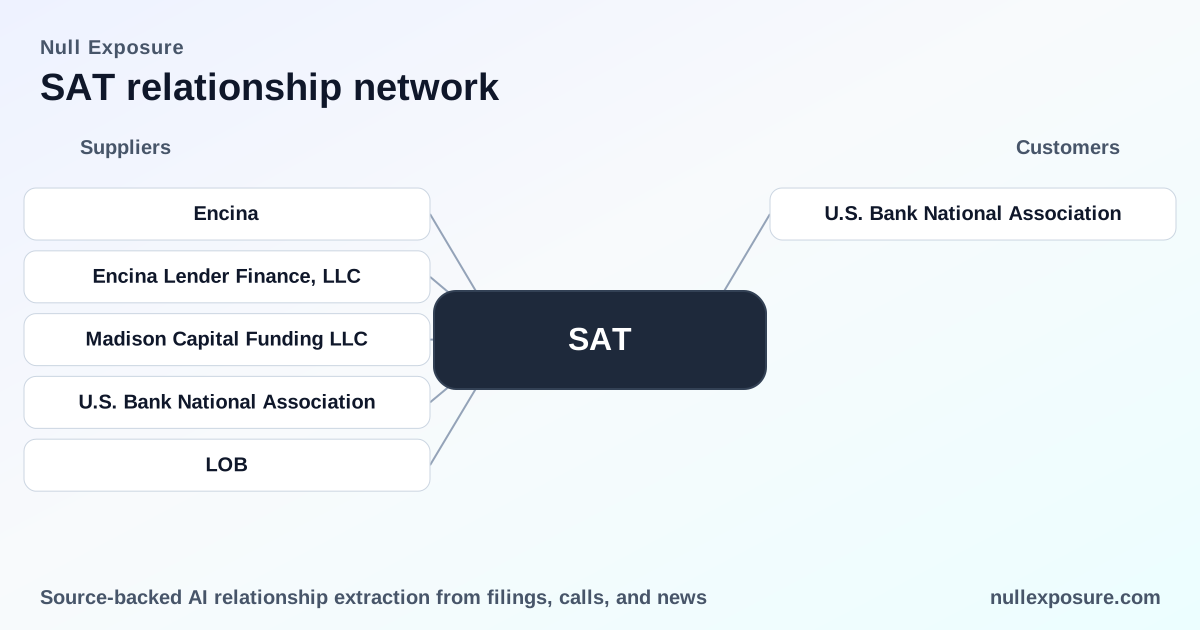
Saratoga Investment Corp (SAT): supplier map and what it means for investors
Saratoga Investment Corp operates as a closed-end investment company that generates income and capital appreciation by originating and buying debt and equity positions in middle‑market private companies and by leveraging secured credit facilities and management fee income to support portfolio activity. The company monetizes through interest and principal cash flows from portfolio investments, management and administrative fee arrangements, and access to committed credit lines that provide working capital and leverage for deal activity. For income-focused allocators, SAT’s steady dividend profile and explicit credit relationships are the operational levers to watch.
For a quick look at the platform and related counterparties, visit the NullExposure homepage: https://nullexposure.com/
How SAT’s contracting posture and supplier map drive value
Saratoga’s public filing and relationship list reveal a business model oriented around long-term contractual relationships, concentrated service providers, and bank counterparties that supply liquidity. The operational pattern is clear:
- Long-term contracts dominate the operating model. The company relies on multi-year management and financing arrangements that are renewed on a predictable cadence, supporting steady fee income and predictable servicing obligations.
- Service providers are mission-critical. Investment management, administration and audit relationships generate recurring fees and operational dependence rather than one-off purchases. This creates both stability and vendor risk concentration.
- Counterparties are mid‑market borrowers and regulated government channels. The firm’s loans and SBIC subsidiaries expose SAT to middle‑market credit dynamics while maintaining regulatory touchpoints with the SBA.
- Spend and capital access sit in the $10M–$100M band. Base management fees and outstanding borrowings reflect meaningful recurring outflows and financing capacity that underpin deal activity.
- Geographic concentration is North America‑centric. Portfolio headquarters are primarily domestic, which concentrates credit and economic exposure to U.S. macro cycles.
These operating signals translate into a capital-efficient, fee-driven private credit platform with liquidity buffered by committed credit facilities and SBA access, and operational dependence on a limited set of counterparties and administrators.
Detailed counterparties and supplier relationships cited in the FY2025 10‑K
Encina
On October 4, 2021, SAT entered into a $50.0 million senior secured revolving credit facility with Encina. The facility is a standing source of liquidity used to support portfolio investment and short-term working capital. According to the company’s FY2025 Form 10‑K, the Encina Credit Agreement is a named, active financing arrangement. (FY2025 10‑K)
As of February 28, 2025, SAT reported $32.5 million in outstanding borrowings under the Encina Credit Facility, confirming this relationship is operational and material to near‑term liquidity. (FY2025 10‑K)
Encina Lender Finance, LLC
SAT reimbursed documented out‑of‑pocket costs and legal fees to Encina Lender Finance, LLC in connection with the Encina credit facility and the closing of related transactions, indicating customary administrative and legal expense flows tied to the credit arrangement. The FY2025 filing records this fee reimbursement to Encina Lender Finance, LLC. (FY2025 10‑K)
Madison Capital Funding LLC
SAT historically used proceeds and committed availability under a $45.0 million senior secured revolving credit facility with Madison Capital Funding LLC as part of financing and capital structure activity, referenced in the company’s disclosure of past financings dating to July 30, 2010. This shows prior reliance on institutional revolver capacity as a funding tool. (FY2025 10‑K)
U.S. Bank National Association
On March 27, 2024, SAT and its wholly owned special purpose subsidiary SIF III executed a credit and security agreement in which U.S. Bank National Association serves as custodian for the financing structure supporting SIF III. The FY2025 10‑K documents U.S. Bank’s role as custodian in the Live Oak Credit Agreement package. (FY2025 10‑K)
Live Oak (Live Oak Bank / LOB)
The same March 27, 2024 agreement names Live Oak as administrative agent and collateral agent for SIF III’s credit facility, designating Live Oak as the agent that administers lender instructions and collateral control for that special purpose financing vehicle. The FY2025 Form 10‑K records Live Oak’s agency role in the Live Oak Credit Agreement. (FY2025 10‑K)
What these relationships mean for investors: concentration, criticality, and runway
The counterparty list and the constraint signals in the filing produce several actionable investor conclusions:
- Liquidity is facility‑dependent. SAT’s access to committed revolvers (Encina, Live Oak/SIF III) is a core operational constraint; outstanding draws are a primary lever for funding new investments and managing cash timing. The active status of the Encina borrowings demonstrates current reliance on this debt line.
- Service provider concentration is material to operations. Recurring base management fees in the range reported in the filing (roughly $18M–$19M per annum historically) indicate a repeatable cost base and an administrative dependency on the management and administration contracts that deliver day‑to‑day execution. These relationships are service‑provider critical rather than transactional. (FY2025 10‑K)
- Counterparty profile skews mid‑market and U.S.-centric. Portfolio composition and the firm’s SBIC governance expose SAT to middle‑market credit cycles and SBA regulatory oversight—this is a deliberate positioning that concentrates both yield and idiosyncratic borrower risk. (FY2025 10‑K)
- Financial exposures show both material and immaterial items. Large working capital and fee lines sit in a mid‑tens of millions band, while certain investments—like subordinated notes in a related CLO at $0.2M—are immaterial to the portfolio, demonstrating selective concentration. (FY2025 10‑K)
If you want a consolidated view of counterparties and operational implications tailored to allocators or risk teams, start here: https://nullexposure.com/
Practical takeaways for due diligence and portfolio managers
- Prioritize monitoring of SAT’s encumbered liquidity and revolver usage—encumbrance levels and lender covenants are the first-order risk to distribution sustainability.
- Treat management and administration agreements as control points: renewals, fee levels, and indemnity language materially affect operating expense and service continuity.
- Evaluate credit risk through a mid‑market lens—benchmark portfolio company cashflows and covenant enforcement across similar sponsor-led lending pools.
- Maintain awareness of geographic concentration in North America and the regulatory overlay from SBIC entities when stress‑testing scenarios.
For a consolidated supplier map and ongoing alerts on counterparties, visit NullExposure: https://nullexposure.com/
Bottom line
Saratoga Investment Corp operates as a fee- and interest-driven middle‑market credit platform that depends on a small set of lending and service relationships for liquidity and operations. The FY2025 disclosures make it clear where operational dependencies sit—revolver capacity with Encina and Live Oak/SIF III, custodial support from U.S. Bank, legacy facility relationships with Madison, and transactional reimbursements to Encina Lender Finance. Investors should focus diligence on revolver availability, management/administration contract terms, and the ongoing health of the middle‑market borrower book.
For more detailed counterparty intelligence and to map supplier risk into investment decisions, see NullExposure’s resources: https://nullexposure.com/