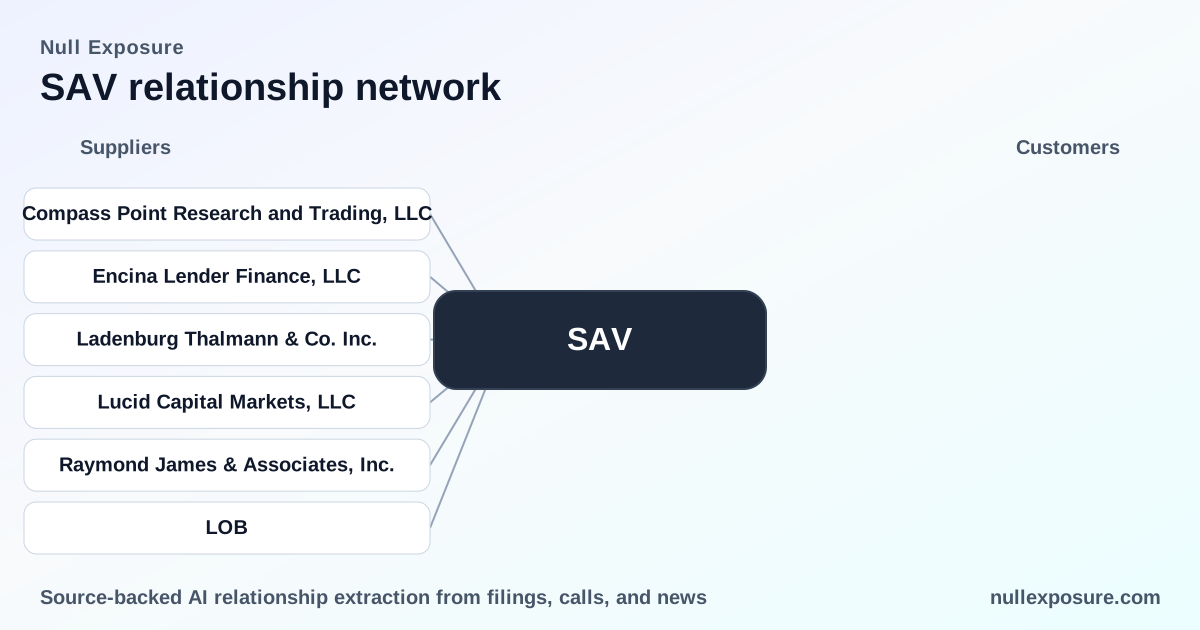
SAV supplier relationships: distribution agents, lenders, and operational counterparties
SAV operates as a technology-focused investment and services vehicle that monetizes through active investment deployment, fee-bearing management arrangements, and capital markets activity including equity distributions. Revenue drivers are portfolio investment returns and recurring management/administration fees, while capital markets relationships substitute for traditional underwriting when raising equity. For investors and operators, the supplier map reflects a mix of distribution partners, financing providers, and an administrative agent that together enable capital access and secured lending structures. Visit https://nullexposure.com/ for a consolidated view of supplier signals and filings.
How SAV structures the commercial stack and monetizes access
SAV’s filings describe a company that combines asset origination and portfolio management with selective use of capital markets to raise equity and secured credit facilities to finance portfolio positions. Equity Distribution Agreements with broker-dealers convert ownership into immediate liquidity and underwriting capacity without a traditional shelf offering, while credit facilities and administrative agents provide secured leverage and operational control over special-purpose borrower entities. Management and license arrangements (described in the constraints) show a firm reliant on third-party service providers to run day-to-day operations and brand usage.
The supplier roster you need to know
Below are the counterparties disclosed in SAV’s FY2025 Form 10-K and the functional role each plays in SAV’s commercial model.
-
Compass Point Research and Trading, LLC — SAV uses Compass Point as one of the distribution agents under its Equity Distribution Agreement, enabling on-demand sales of newly issued shares into the market. According to SAV’s FY2025 10‑K, Compass Point is explicitly named as a distribution agent alongside other brokers. (SAV FY2025 10‑K)
-
Ladenburg Thalmann & Co. Inc. — Ladenburg is a co-agent on the company’s Equity Distribution Agreement, serving the same distribution function as other broker-dealers to place equity shares into the market. The FY2025 filing lists Ladenburg as a named distribution agent in the Equity Distribution Agreement. (SAV FY2025 10‑K)
-
Lucid Capital Markets, LLC — Added by amendment on May 15, 2024, Lucid is one of the Agents under the amended Equity Distribution Agreement, widening SAV’s distribution network for secondary or primary equity placements. The 10‑K notes Lucid’s addition to the distribution agent group. (SAV FY2025 10‑K)
-
Raymond James & Associates, Inc. — Raymond James was added as an additional distribution agent via an amendment dated July 19, 2023, expanding brokerage capacity and market channels for equity distribution. This addition is recorded in the FY2025 10‑K. (SAV FY2025 10‑K)
-
Encina Lender Finance, LLC — SAV reimbursed Encina for documented out-of-pocket costs and legal fees connected with the Encina Credit Facility and the execution of related transactions, indicating a lender‑arranger role where Encina provided credit capacity to SAV or a related borrower. The FY2025 10‑K references fee and expense reimbursements to Encina in connection with the facility. (SAV FY2025 10‑K)
-
Live Oak (LOB) — Identified as administrative agent and collateral agent for a securitized borrower (SIF III), Live Oak performs administrative and collateral management functions on a secured lending arrangement where SAV acts as collateral manager and equityholder. The FY2025 filing names Live Oak in that agent role. (SAV FY2025 10‑K)
What the relationship mix signals about SAV’s operating model
The disclosed counterparties and the constraints derived from public filings reveal actionable characteristics of SAV’s supplier posture:
-
Contracting posture: hybrid and renewal-driven. SAV operates with both amendable capital markets agreements (equity distribution agreements that can be expanded with additional agents) and management agreements that are renewed on an annual cadence; this combination produces flexibility in distribution capacity while retaining annual oversight over service partners.
-
Concentration and criticality: distributed distribution network, centralized operations. Multiple named broker-dealers (Ladenburg, Compass Point, Lucid, Raymond James) indicate deliberate distribution diversification to avoid dependency on a single placement channel, while management and administration services are concentrated with a single manager / advisor arrangement that the board renews annually—making that service provider operationally critical.
-
Contract maturity profile: coexistence of short and long horizons. The Management Agreement shows annual renewals (short-term approval cycles) but many financing instruments (e.g., senior secured notes and certain credit facilities) have multi-year maturities, indicating a portfolio of both short governance cycles and long-dated financing commitments.
-
Spend and operational scale signals. Filings disclose an increased cap on reimbursement of administrative expenses from $4.3M to $5.0M effective August 1, 2024, suggesting mid-single-digit millions in recurring vendor expense capacity, consistent with a modest but material outsized reliance on external administration and advisory spend.
-
Business segments supported by suppliers. The company references investments in services and software verticals—evidence that supplier relationships support a mix of portfolio operational needs and capital-raising activities rather than a single product line.
Risk and opportunity implications for investors and operators
-
Risk: counterparty and operational concentration. While distribution is diversified, management and administrative services concentrate operational control. If the manager relationship were to break down, SAV would face near-term operational risk and potential disruptions to portfolio oversight.
-
Opportunity: scalable capital markets access. The expanded agent roster strengthens SAV’s ability to access equity capital on a rolling basis without engaging in full underwritings, enabling opportunistic dilutive or non-dilutive raises that can fund growth or portfolio deployments quickly.
-
Risk: financing terms and lender economics. Reimbursements to lender-arrangers like Encina and reliance on administrative agents such as Live Oak indicate embedded financing costs and covenant oversight that can constrain free cash flow if credit conditions deteriorate.
Practical steps for diligence and sourcing
- Validate the terms of the Equity Distribution Agreement (capacity, fees, and termination mechanics) with the named agents and request any vendor scorecards used by SAV to monitor execution quality.
- Audit the Management/Administration agreement renewal history and expense caps, and quantify the operational functions that would require immediate replacement in a termination scenario.
- Review credit facility covenants and agent appointment letters with Encina and Live Oak to determine collateral triggers, cure periods, and reimbursement liabilities.
Explore deeper supplier and counterparty analytics at https://nullexposure.com/ for the filings and relationship footprints that informed this analysis.
Final read: what matters most to portfolio managers
SAV’s supplier mix is pragmatic: diversified brokerage partners for capital access, single-source management for day-to-day operations, and targeted lender/agent relationships for secured financing. For investors the primary questions are governance around manager renewals, fee and reimbursement exposure to lenders, and the execution quality of distribution agents during equity raises. Operators should prioritize redundancy planning for administrative functions and continuous monitoring of distribution performance metrics.
If you want a tailored supplier risk brief or a files-backed counterparty map, start your research at https://nullexposure.com/ and request the SAV supplier packet for a rapid, filing-driven briefing.