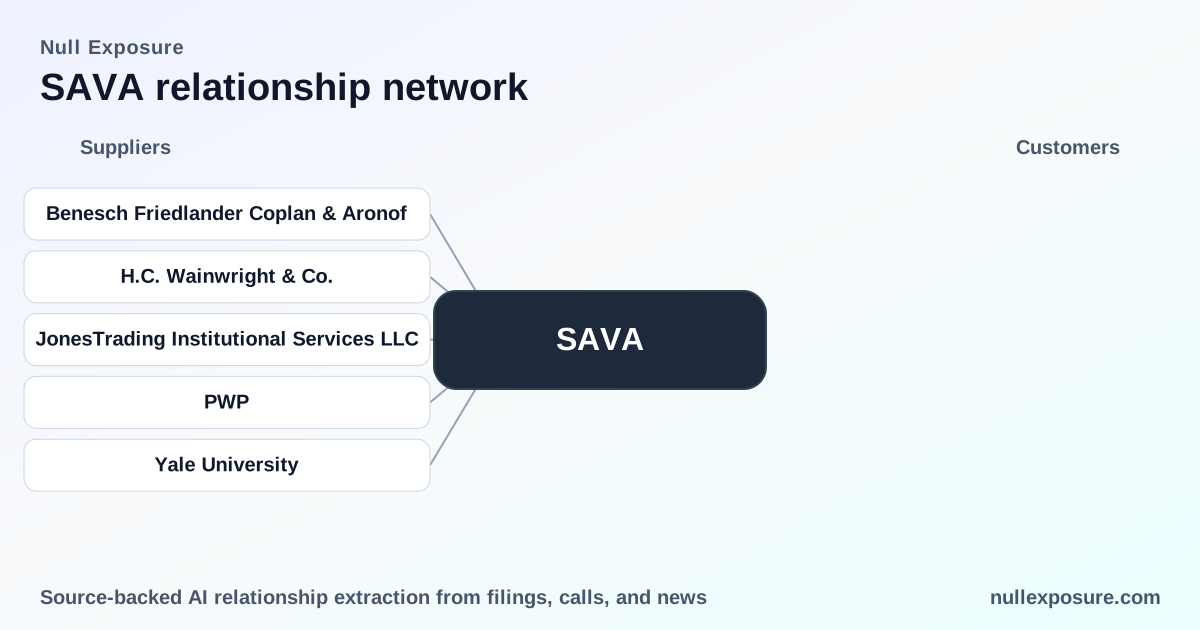
Cassava Sciences (SAVA): supplier map, operating posture, and what suppliers reveal for investors
Cassava Sciences is a clinical-stage biotechnology company that develops therapies for neurodegenerative disease and currently monetizes through capital markets activity, licensing of intellectual property, and the prospect of future commercial partnerships rather than product revenue. The company runs an asset-light research and development model, outsources manufacturing and clinical operations to third parties, and funds operations with equity placements and capital-market advisory arrangements. For investors evaluating supplier risk and counterparty exposure, the supplier list and public filings reveal a reliance on the capital markets, university-licensed IP, and a distributed supply chain for clinical product — all of which drive both valuation upside and operational vulnerability.
Explore supplier intelligence at https://nullexposure.com/ to track counterparties and event-driven risk.
How Cassava operates and where it creates value
Cassava is a classic clinical-stage biotech: no product revenue, negative EBITDA, and heavy dependence on clinical outcomes and intellectual property to unlock value. Market capitalization and balance-sheet activity show the company relies on periodic equity offerings and advisory relationships to raise cash; the business model monetizes primarily through future drug commercialization or licensing events rather than recurring sales today. Financial indicators in public filings show zero revenue TTM, negative operating performance, and a capital markets-dependent funding model (market cap and EBITDA noted in company disclosures).
Operationally, Cassava maintains no internal manufacturing capacity and outsources formulation, manufacturing, quality control, storage and distribution to contract partners. Clinical trial execution, data management and investigator relationships are outsourced to CROs and academic institutions, creating an operating posture that is scalable but dependent on third-party performance and regulatory-compliant supply chains.
Outsourced execution, global trial footprint, and supply roles
Cassava’s clinical trials and supply chain demonstrate geographic breadth and third-party reliance. Company statements list Phase 3 sites across North America and the Asia-Pacific region — specifically the United States, Canada, Puerto Rico, Australia and South Korea — which signals multi-region regulatory complexity and exposure to cross-border logistics. Public commentary and filings confirm Cassava uses third parties for labeling, storage, distribution and contract manufacturing, and relies on CROs and clinical research sites for trial execution.
Key structural implications for investors:
- Contracting posture: Outsourced manufacturing and CRO relationships create operational leverage but elevate vendor concentration and compliance risk.
- Concentration and criticality: No in-house manufacturing means a smaller number of third parties are critical to trial continuity and any commercial launch.
- Maturity of capabilities: The company’s lack of internal manufacturing and commercialization capabilities places emphasis on partnerships and advisors for near-term funding and long-term market access.
Who Cassava is working with — every supplier and advisor in the public record
Benesch Friedlander Coplan & Aronof
Cassava retained J. Erik Connolly of Benesch Friedlander Coplan & Aronof to represent the company in litigation matters tied to public disputes; the engagement reflects active legal defense posture and the need for outside counsel in securities-related proceedings (InvestorPlace coverage, November 2022: https://investorplace.com/2022/11/cassava-sciences-has-a-big-warning-for-sava-stock-short-sellers/).
H.C. Wainwright & Co.
H.C. Wainwright acted as the exclusive placement agent on a $50 million registered direct offering, illustrating Cassava’s reliance on boutique investment banks to underwrite equity raises and to provide placement capabilities for cash needs (CityBiz report on the offering: https://www.citybiz.co/article/351464/cassava-sciences-closes-of-50-million-registered-direct-offering/).
JonesTrading Institutional Services LLC
JonesTrading served as an independent capital markets advisor in the same offering, providing advisory support that supplements placement and syndication services for corporate financings (CityBiz coverage: https://www.citybiz.co/article/351464/cassava-sciences-closes-of-50-million-registered-direct-offering/).
Perella Weinberg Partners LP (PWP)
Perella Weinberg acted as an independent capital markets advisor to Cassava on the registered direct offering, representing a higher-tier advisory relationship that supports strategic financing and investor outreach (CityBiz report; Perella Weinberg referenced: https://www.citybiz.co/article/351464/cassava-sciences-closes-of-50-million-registered-direct-offering/).
Yale University (intellectual property licensor)
Cassava’s program for simufilam is based on a method-of-treatment patent that was issued in 2025 and in-licensed from Yale University; the license underpins the core IP position and is central to long-term commercial value (GlobeNewswire release, December 23, 2025: https://www.globenewswire.com/news-release/2025/12/23/3209829/0/en/Cassava-Announces-Agreement-to-Settle-Securities-Class-Action-Litigation.html).
Yale licensing is referenced again in relation to publication and trial results — the academic origin of the patent set provides both scientific credibility and dependency on university-derived IP rights (GlobeNewswire release, January 13, 2026: https://www.globenewswire.com/news-release/2026/01/13/3217761/0/en/Cassava-Announces-Publication-of-Peer-Reviewed-Phase-3-Results-for-Simufilam-in-Alzheimer-s-Disease-in-the-Journal-of-Prevention-of-Alzheimer-s-Disease.html).
What the supplier map and constraints tell investors about operational risk
The public relationships and constraint signals paint a cohesive picture: Cassava operates an outsourced, service-heavy model with critical third-party nodes for manufacturing, logistics and clinical execution. Company-level constraint evidence shows:
- Geographic scope: Clinical sites in North America and APAC impose regulatory and logistics complexity across multiple jurisdictions.
- Supplier roles: The company explicitly outsources manufacturing and distribution, and depends on CROs and clinical research sites for trials — these are core service-provider relationships rather than incidental vendors.
- Cost segments: Contract manufacturing (CMC) and CRO costs are material components of operating expenses, linking supplier performance directly to burn rate and timeline risk.
These are company-level signals about concentration, criticality and maturity rather than attributes of a single supplier: the model is scalable but exposes Cassava to single-vendor failures, regulatory interruptions, and trial-site variability that will directly affect timelines and financing needs.
Capital markets and legal overlays that influence counterparty dynamics
Capital-raising partners (H.C. Wainwright, JonesTrading, Perella Weinberg) and outside counsel (Benesch) play outsized roles for a company without product revenue. Equity placements and legal settlements shape liquidity and investor perception as much as clinical outcomes. The Yale license secures IP value but also concentrates outcome dependency on the enforceability and scope of that licensed patent.
Middle-reader action: if you track counterparties and event-driven supplier risk, learn more at https://nullexposure.com/.
Investment implications and the final read
For operators and investors evaluating SAVA supplier relationships, the bottom line is straightforward: value is driven by clinical readouts and IP, while operational continuity depends on a small number of outsourced suppliers and capital markets intermediaries. Key investment considerations:
- Catalyst-driven valuation: Clinical data releases and patent/licensing milestones will move the stock; suppliers enable or delay those catalysts.
- Counterparty concentration risk: No in-house manufacturing increases exposure to CDMOs and logistics partners.
- Funding sensitivity: Equity offerings and advisory engagements are central to short-term survival; any interruption in placement capacity or adverse legal outcomes increases refinancing risk.
Final call-to-action: to monitor supplier-level signals and event risk around SAVA and peers, visit https://nullexposure.com/ for ongoing coverage and counterparty tracking.
Bold takeaway: Cassava’s upside is binary and scientific — commercial value depends on successful trial outcomes and the strength of Yale-licensed IP — while downside is anchored in vendor concentration, funding dependency, and regulatory execution risk.