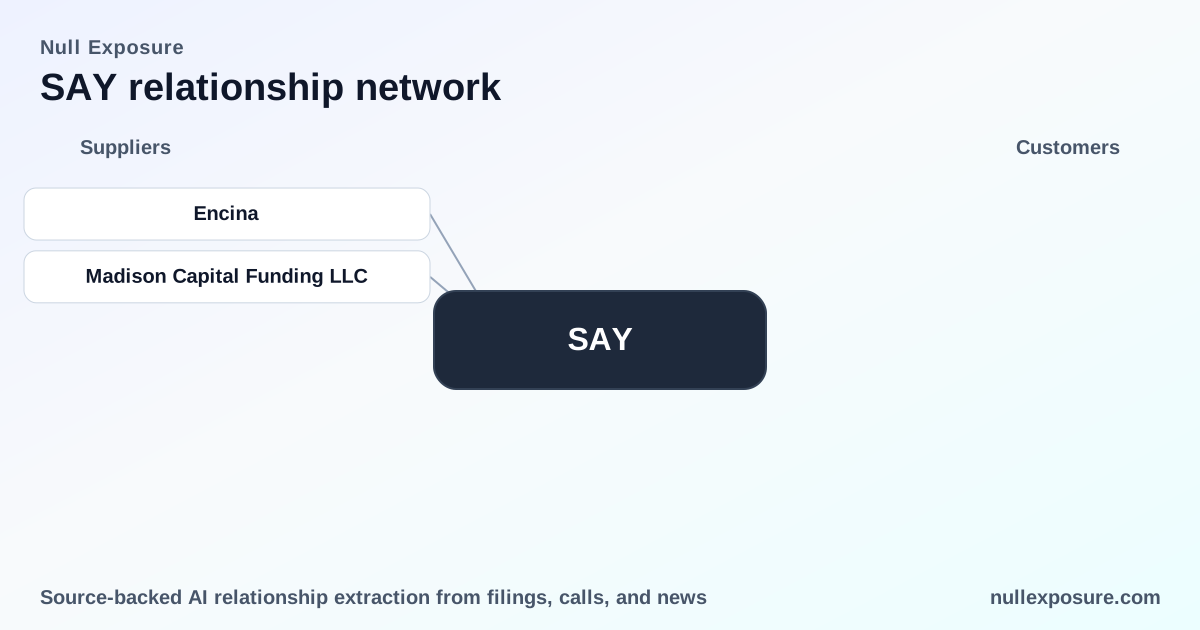
Saratoga Investment Corp (SAY) — supplier relationship briefing for investors and operators
Saratoga Investment Corp operates as a business development company that monetizes through interest income, management and incentive fees, and capital gains on middle‑market debt and equity investments, while returning cash to shareholders via a disciplined dividend policy. The firm funds its balance sheet with a mix of secured revolving credit lines and longer‑dated notes, and outsources day‑to‑day investment management and administrative services under contractual agreements that drive both costs and operational dependency. For quick access to supplier intelligence and continuous monitoring, visit https://nullexposure.com/.
How the company’s operating model structures supplier risk
Saratoga’s commercial posture is typical of externally‑managed BDCs: capital and liquidity come from a blend of short‑term bank facilities and longer‑dated fixed‑rate debt, while operational execution is delegated to an external manager and administrator for fees. That combination produces a two‑fold supplier dynamic:
- Funding counterparties (banks, credit providers, noteholders) are critical to liquidity and leverage management; changes in facility terms or availability directly influence the firm’s underwriting capacity.
- Service providers (investment manager, administrative agent, licensor) are operationally critical because they run sourcing, asset management and back‑office operations under contractual fees and incentive structures.
Company‑level signals from recent filings reinforce this structure: the 10‑K enumerates both short‑term credit facilities and multi‑year notes/term loans, a non‑exclusive license to use the “Saratoga” name, and SBIC subsidiary regulation. These factors shape counterparty concentration, contract duration, and substitution cost for operators and vendors.
Operating constraints that matter to counterparties
Several constraints in the filings translate into concrete risk characteristics for suppliers and investors:
- Contracting posture — mixed maturity: The firm runs short‑term revolving credit facilities with three‑year terms alongside longer‑dated notes and term loans maturing beyond 2027, creating a laddered maturity profile that reduces single‑date refinancing risk but keeps recurring lender negotiation cycles.
- Concentration and criticality: Reliance on secured revolving facilities and secured notes means few funding counterparties can materially affect Saratoga’s capacity; lenders securing liens on the portfolio are strategically important to operations.
- Service dependency: The Management and Administration Agreements create ongoing fee obligations and operational concentration with Saratoga Investment Advisors (management and licensing), making the manager a de facto strategic supplier.
- Regulatory overlay: SBIC licensing for certain subsidiaries introduces a government counterparty/regulator dimension to operations and funding choices.
These characteristics should shape diligence on counterparty credit, replacement cost for key services, and covenant negotiation strategy.
Supplier roster: every relationship disclosed in the FY2025 filing
Encina
Saratoga entered into a $50.0 million senior secured revolving credit facility with Encina effective October 4, 2021; the facility underwrites short‑term liquidity needs and is a secured source of revolving capital. According to SAY’s FY2025 10‑K filing (filed Feb 28, 2025), the Encina Credit Agreement provides a committed, senior secured revolver used to support portfolio activity. The same filing notes the Encina facility carries a three‑year term, which defines the near‑term refinancing timeline for that line.
Madison Capital Funding LLC
Saratoga previously utilized proceeds and a portion of funds available under a $45.0 million senior secured revolving credit facility with Madison Capital Funding LLC, which was part of financing activity dating to July 30, 2010; the facility supported initial transactions and balance sheet flexibility. SAY’s FY2025 10‑K references the Madison Credit Facility as a historical source of committed revolving credit used in conjunction with other financing and equity transactions (FY2025 10‑K, Feb 28, 2025).
Key takeaway: both named relationships are secured revolving facilities that function as working capital and deal‑execution lines; monitoring these agreements is essential for understanding short‑term liquidity constraints and covenant exposure.
For continuous supplier mapping and to benchmark these counterparties against industry peers, see https://nullexposure.com/.
What these supplier ties mean for investors and operators
The two disclosed revolvers reflect a financing strategy that is liquidity‑driven and lender‑dependent in the near term while supported by longer‑dated notes and term loans over the medium term. Practically:
- Refinancing cadence is a core risk vector. Facilities with three‑year terms force periodic renegotiation or refinancing, which can reset spreads or collateral terms in adverse markets. The Encina facility’s three‑year term is an explicit example of this cadence.
- Operational continuity depends on the investment manager and licensor relationships. Management and administration agreements create fixed cost lines and incentive alignment that are central to NII (net investment income) and fee volatility.
- Regulation and structure add complexity. SBIC‑related subsidiaries introduce government oversight that can influence portfolio selection, fee arrangements and capital access.
Risk mitigation for counterparties involves scenario planning for facility rollovers, stress testing covenant headroom, and validating manager replacement options and associated costs.
Actionable next steps for diligence and partner negotiations
- Negotiate facility terms with attention to covenant flexibility and collateral scope, especially if you are a prospective lender or note purchaser.
- Demand transparency on manager fee calculations and incentive waterfalls, since these flow directly to operating expenses and influence distributable cash.
- Stress‑test Saratoga’s ability to sustain dividend policy under adverse refinancing scenarios given the mix of short and long maturities.
For operator playbooks, benchmarking the manager and funding counterparties against BDC peers improves negotiation leverage; more supplier intelligence is available at https://nullexposure.com/.
Bottom line
Saratoga’s supplier landscape is defined by secured short‑term revolvers for liquidity and longer‑dated securities for structural funding, coupled with concentrated service provider arrangements that handle investment and administrative execution. For investors and counterparties, the practical focus is on facility maturities, covenant exposure, and the replaceability of the external manager. Maintain active monitoring of the Encina and Madison facility terms and the manager’s contractual rights and fee mechanics to assess how supplier dynamics will affect future cash flows and refinancing outcomes.
To keep tracking these supplier relationships and automate monitoring for your portfolio, visit https://nullexposure.com/.