SB-P-C (Safe Bulkers Series C Preferred): What investors and operators need to know
Safe Bulkers’ Series C perpetual preferred is a capital-structure instrument backed by an operating seaborne bulk-carrier platform that outsources day-to-day vessel operations to a small set of managers and uses public press channels for investor communications. The security’s economic upside is driven by Safe Bulkers’ ability to maintain fleet utilization and chartering economics while servicing cumulative preferred dividends; the balance of operational control and outsourced chartering arrangements concentrates counterparty importance in a few named managers and external IR/distribution partners. Investors should value this preferred stake not as a standalone operating business but as a claim on a shipping operator that relies on a narrow network of service providers. Learn more about supplier relationships and exposure at https://nullexposure.com/.
How Safe Bulkers earns cash and why supplier relationships matter
Safe Bulkers monetizes by owning and operating dry bulk vessels and realizing revenue through time charters and the spot market; it then services equity and preferred claims from that cash flow. Operational economics depend heavily on chartering outcomes and vessel renewal activity, while disclosure and market access are funneled via a consistent set of IR and wire services. For holders of SB-P-C, counterparty concentration in fleet managers and the channels that shape investor perception are direct drivers of execution risk and valuation multiples.
Explore supplier mapping and relationship analytics here: https://nullexposure.com/.
The managers that run the fleet — a compact, low-fee operating posture
Safe Bulkers contracts its vessel management and chartering functions to a small roster of managers. Public releases state that the chartering of vessels is arranged by the company's managers without any management commission, a structural detail that reduces visible intercompany fees but increases reliance on those external managers for commercial performance and fleet deployment.
- Contracting posture: outsourced chartering and technical management; fees and commissions are structured to minimize intra-group management commissions, aligning operating leverage with market charter rates rather than internal commission capture.
- Concentration: a small number of named managers execute critical tasks — this concentrates operational counterparty risk.
- Criticality: managers are mission-critical to revenue generation because they arrange charters and day-to-day commercial decisions.
- Maturity: the pattern of recurring press releases and named manager references implies an established, repeatable outsourcing model rather than ad hoc one-off arrangements.
These are company-level operating signals derived from public release language and the relationship footprint in recent filings and press coverage.
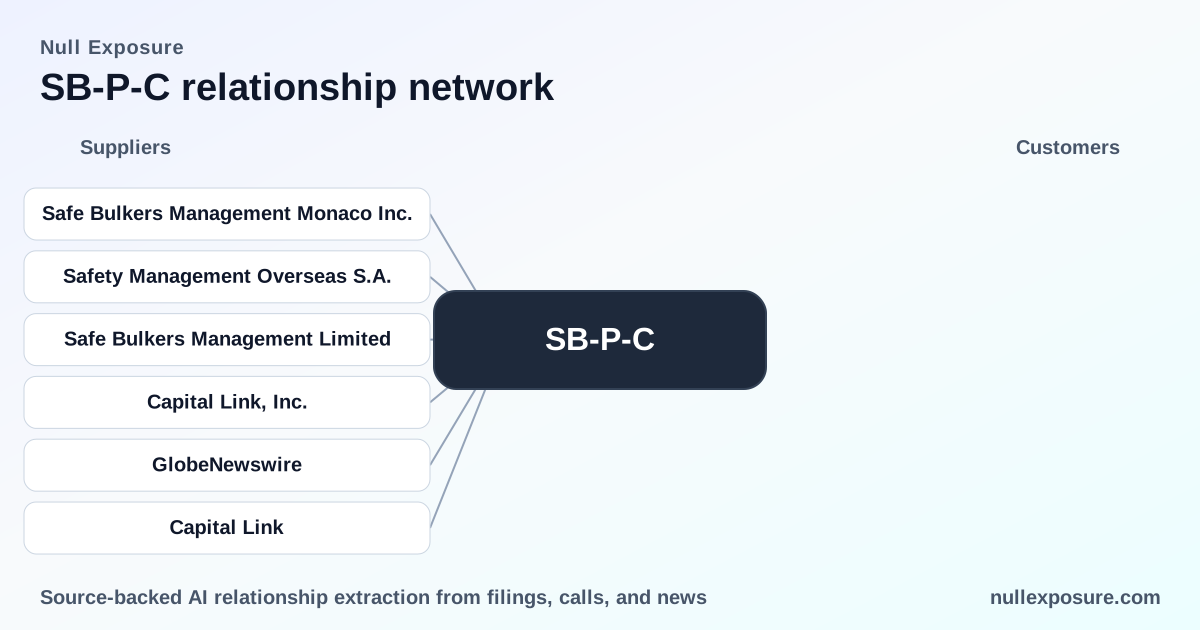
Relationship map: every named partner in the feed
Below are the named counterparties and distribution partners identified in the public feed, with a concise, plain-English summary and source citation for each.
-
Safe Bulkers Management Monaco Inc. — Listed among the company’s designated managers, Safe Bulkers Management Monaco Inc. is named in Safe Bulkers’ investor releases as one of the managers that arrange vessel chartering and fleet operations. (GlobeNewswire press release, Feb 18, 2026)
-
Safety Management Overseas S.A. — Cited as a fellow manager responsible for arranging charters and operational oversight, Safety Management Overseas S.A. participates in the consolidated management structure Safe Bulkers uses to operate vessels. (GlobeNewswire press release, Feb 18, 2026)
-
Safe Bulkers Management Limited — Presented alongside the other managers, Safe Bulkers Management Limited is explicitly referenced in corporate disclosures as a manager that helps arrange chartering and does not charge a management commission for those services. (GlobeNewswire press release, Feb 18, 2026)
-
Capital Link, Inc. — Repeatedly identified as Safe Bulkers’ investor-relations and media contact, Capital Link facilitates distribution of earnings dates, annual report availability and press-release contacts; its details appear across multiple press releases and filings in FY2025–FY2026. (GlobeNewswire press releases and QuiverQuant postings, FY2025–FY2026)
-
Capital Link (alternate references) — References to “Capital Link” in aggregator feeds and secondary distribution channels echo Capital Link, Inc.’s IR role and the firm’s repeated presence as the press contact for Safe Bulkers announcements. (QuiverQuant and Bitget reposts, FY2026)
-
GlobeNewswire — GlobeNewswire functions as the primary newswire distributor for Safe Bulkers’ formal announcements, including quarterly results and vessel acquisition/sale updates; some aggregator entries carry a note that third-party summaries were AI-generated. (GlobeNewswire distribution of Safe Bulkers press releases, Feb 18, 2026; QuiverQuant repost with AI-summary disclaimer, Mar 2026)
Each of these entries is drawn from the company’s public press stream in FY2025–FY2026 and identifies the external parties that materially influence execution, disclosure and market perception.
What the relationship set tells investors about risks and operational leverage
The relationship footprint conveys several actionable signals:
- Operational dependence on a focused management trio. With chartering arranged by a handful of managers, Safe Bulkers concentrates execution risk; any operational disruption at those managers would have an outsized effect on cash flow available to service preferred dividends.
- Low internal commission posture. The disclosure that managers arrange chartering “without any management commission” indicates the company minimizes internal fee leakage, shifting the economics toward net charter performance. That structure reduces one type of related-party profitability risk but raises transparency and outsized counterparty exposure risk.
- Disclosure and market access centralized through a single IR conduit. Capital Link’s recurring role as IR contact and the use of GlobeNewswire for distribution means investor messaging is channeled and consistent — helpful for liquidity and market relations but also a single point for narrative control.
- Maturity and repeatability. The steady cadence of announcements about charters, vessel sales and annual reporting suggests an established operating rhythm rather than a transitional setup.
These characteristics affect preferred security valuation: preferred holders value stable, predictable cash coverage and low operational surprise. Concentration in managers and channels elevates the need for ongoing monitoring of these exact counterparties.
Read deeper supplier profiles and relationship risk matrices at https://nullexposure.com/.
Bottom line for investors and operators
For SB-P-C holders, the instrument is a claim on a shipping operator that has deliberately outsourced commercial execution and relies on a narrow network of managers and established IR/distribution partners. The core investment thesis is straightforward: if the managers keep vessels consistently earning attractive charter rates and Safe Bulkers maintains its distribution and disclosure cadence, the preferred’s cash coverage is robust; if manager performance or charter markets deteriorate, counterparty concentration amplifies downside.
If you evaluate supplier risk for vessel-backed securities, map the manager counterparties and monitor press-distribution behavior continuously — start that process here: https://nullexposure.com/.
For bespoke exposure maps, scenario modeling and supplier risk monitoring for shipping-focused instruments, contact our team via the site and get an analyst-ready relationship pack tailored to SB-P-C.