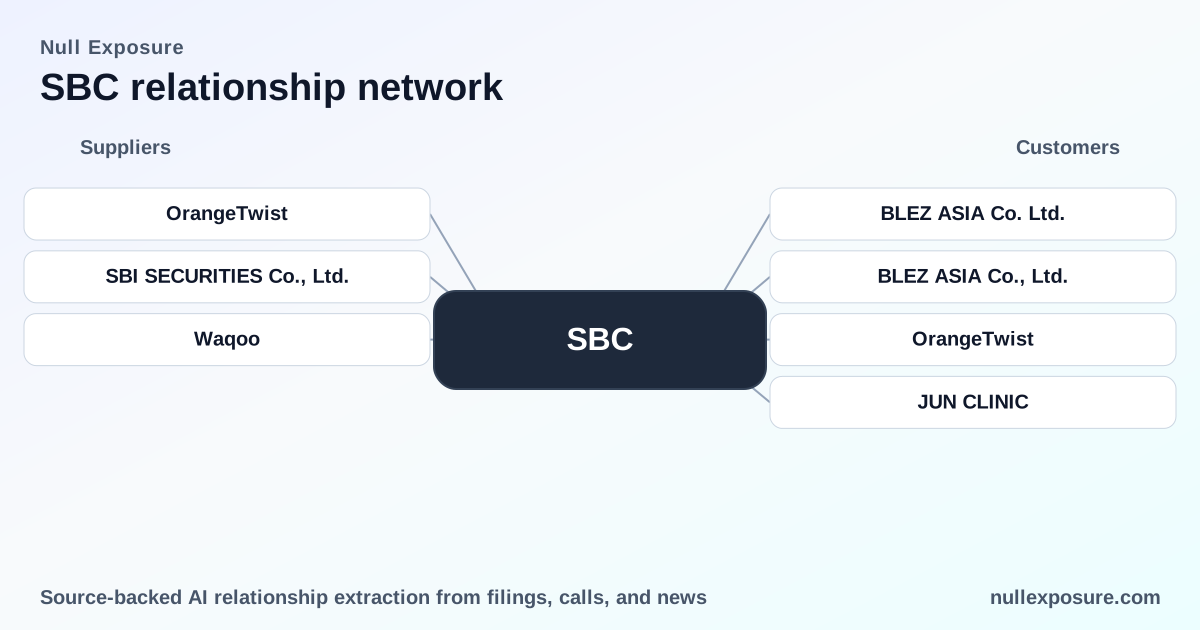
SBC Medical Group Holdings (SBC) — supplier relationships and what investors should price in
SBC Medical Group operates and monetizes as a management-services platform for cosmetic treatment centers, earning revenue from clinic operations, management fees, product sales and procurement margins when it buys advertising and medical materials on behalf of managed clinics (MCs). The company also pursues strategic investments and JV arrangements to accelerate international expansion and product development, which convert operating scale into proprietary product revenues and cross-border distribution. For investors evaluating supplier exposure, the key questions are contracting posture, supplier concentration, operational criticality of purchases, and how supplier ties support SBC’s expansion strategy. Explore supplier profiles and relational intelligence at https://nullexposure.com/.
Quick read: how SBC’s supplier relationships fit the business model
SBC’s model combines clinic-level revenue with centralized procurement and product co-development. That structure makes certain supplier relationships operationally critical (medical materials, cosmetics, production partners) while others are tactical or strategic (investment partners, tender offer agents). SBC’s reported margins (gross and operating) and recent M&A/investment activity indicate a company translating scale into margin capture and product ownership. That dynamic raises the value of suppliers that contribute to product differentiation or distribution reach.
Relationship roll-call: the counterparties that matter
This section summarizes every relationship surfaced in the source set. Each entry is a concise, plain-English description with the relevant source cited.
OrangeTwist
SBC has undertaken a strategic investment and operational tie-up with OrangeTwist to jointly operate clinics, cross-sell services and collaborate on co‑developed beauty products for U.S. and Japanese markets. This is positioned as part of SBC’s U.S. expansion and product-distribution strategy. According to press coverage in March 2026, the companies will sell each other’s services and develop branded products across both markets (EQS and NewMediaWire, March 2026).
Waqoo
SBC acquired a stake in Waqoo, a Japanese R&D and medical-support business, to co-develop proprietary skincare and to leverage Waqoo’s blood-derived processing and related technologies as part of SBC’s international roll-out and treatment upgrades. The company publicly framed Waqoo as a technology partner supporting SBC’s expansion (NewMediaWire; The Globe and Mail press releases, March 2026).
SBI SECURITIES Co., Ltd.
SBI Securities is identified as the tender offer agent in SBC’s announced tender offer activity around Waqoo, reflecting engagement with a major securities services provider for deal execution and shareholder procedures. An Antara News report from March 2026 lists SBI Securities in this agent role for SBC’s tender offer process.
Japan Medical & Beauty Inc.
SBC’s filings disclose material procurement from Japan Medical & Beauty Inc., with purchases of medical equipment and cosmetics of $8,472,202 in 2024 and $2,842,588 in 2023 recorded in cost of revenues, making this supplier a meaningful line-item in procurement spend (company disclosures for the years ended December 31, 2024 and 2023).
What the disclosed constraints tell an investor about SBC’s supplier posture
SBC’s public disclosures produce several company-level signals that affect supplier risk and negotiating leverage:
-
Contracting posture is mixed. The firm reports operating leases for offices with multi‑year terms (two to seven years), signaling a degree of fixed‑cost commitment in premises, while procurement relationships are described as largely short-term and transactional, which gives SBC procurement flexibility but reduces supplier lock‑in on the buy side.
-
Buyer role and procurement model are explicit. SBC acknowledges it purchases advertising services and medical materials on behalf of MCs and recognizes procurement revenue from that activity, which makes supplier performance directly tied to clinic throughput and brand consistency.
-
Spend concentration is non-trivial. A named supplier (Japan Medical & Beauty Inc.) accounted for several million dollars of purchases in 2023–2024, which indicates pockets of vendor concentration that could influence pricing or supply continuity if disrupted.
-
Fault or misstatement risk is treated as immaterial historically. Management disclosed prior misappropriation uncertainty but classified the amounts as immaterial to current estimates, which signals historical control weaknesses that the company has judged not to be material to operations.
-
Contract maturity and operational criticality diverge. Leases are medium-term and procurement contracts are short-term; this combination supports fast supplier substitution in procurement but creates operational dependency when specialist suppliers (R&D partners or product manufacturers) are required for proprietary offerings.
Taken together, these constraints imply a business that is operationally mature in clinic operations and margin capture, but still strategically flexible on procurement. That flexibility improves negotiating leverage for common inputs but elevates the importance of strategic partners (Waqoo, OrangeTwist) that enable product differentiation and international distribution.
Explore SBC’s broader supplier map and risk scoring at https://nullexposure.com/.
Investment implications — practical takeaways for allocators and operators
-
Strategic partnerships are the lever for growth. Investments and JVs (OrangeTwist, Waqoo) are central to SBC’s playbook for entering new markets and owning product IP, and these tie-ups should be valued not only for revenue contribution but for distribution and R&D optionality.
-
Supplier concentration is a tactical risk. Multi‑million dollar purchases from a single supplier (Japan Medical & Beauty Inc.) create sourcing concentration; investors should track whether SBC diversifies manufacturing and procurement as it scales internationally.
-
Operational risk is manageable if supplier substitution is effective. Short-term procurement contracts give SBC agility, but proprietary treatments and co-developed products increase criticality of a small set of partners; stewardship of those relationships will determine downside exposure.
-
Deal execution uses established capital markets intermediaries. Engagement of SBI Securities as tender offer agent indicates SBC uses experienced counterparties for capital transactions, which reduces execution risk in equity deals.
Final assessment and action items
SBC’s supplier footprint is a mix of operationally critical R&D and manufacturing partners and tactically contracted procurement vendors. For investors, the valuation hinge is how effectively SBC converts strategic alliances into proprietary, high‑margin products and how it manages supplier concentration as it scales internationally. Monitor: (1) revenue contribution from co‑developed products, (2) changes in procurement concentration, and (3) the success of OrangeTwist and Waqoo integrations in delivering U.S. distribution.
If you evaluate supplier relationships as part of investment due diligence, review the full profile and relational signals at https://nullexposure.com/ to see how these counterparties map to operational and financial risk.