Seacoast Banking Corporation of Florida (SBCF): supplier relationships that matter for investors
Seacoast Banking Corporation of Florida is a regional Florida bank that monetizes primarily through net interest income from loans and deposits, complemented by fee income and treasury services delivered to retail and commercial customers. As a supplier-facing analysis, the critical investor question is how third-party service relationships—particularly in cybersecurity and operations—affect Seacoast’s operational continuity, cost structure, and regulatory posture. For a targeted view of supplier risk and concentration, visit Null Exposure.
Company snapshot and commercial logic Seacoast is a traditional regional bank: it takes deposits, originates and services loans, and earns fees on payments and treasury products. Key public metrics that frame supplier exposure are Market Cap: $2.95B, Revenue (TTM): $598M, Price/Book: 1.08, and Dividend Yield: 2.45%. Institutional ownership is high at ~86.6%, indicating sophisticated investor scrutiny of operational risks. Operational resilience and regulatory compliance are core to franchise value because service interruptions or cybersecurity failures translate into direct financial loss, reputational damage, and regulatory remediation costs.
What the disclosed supplier relationships say — the Quavo items Below are the supplier-related signals surfaced in public coverage. Each entry from the results is covered without omission.
-
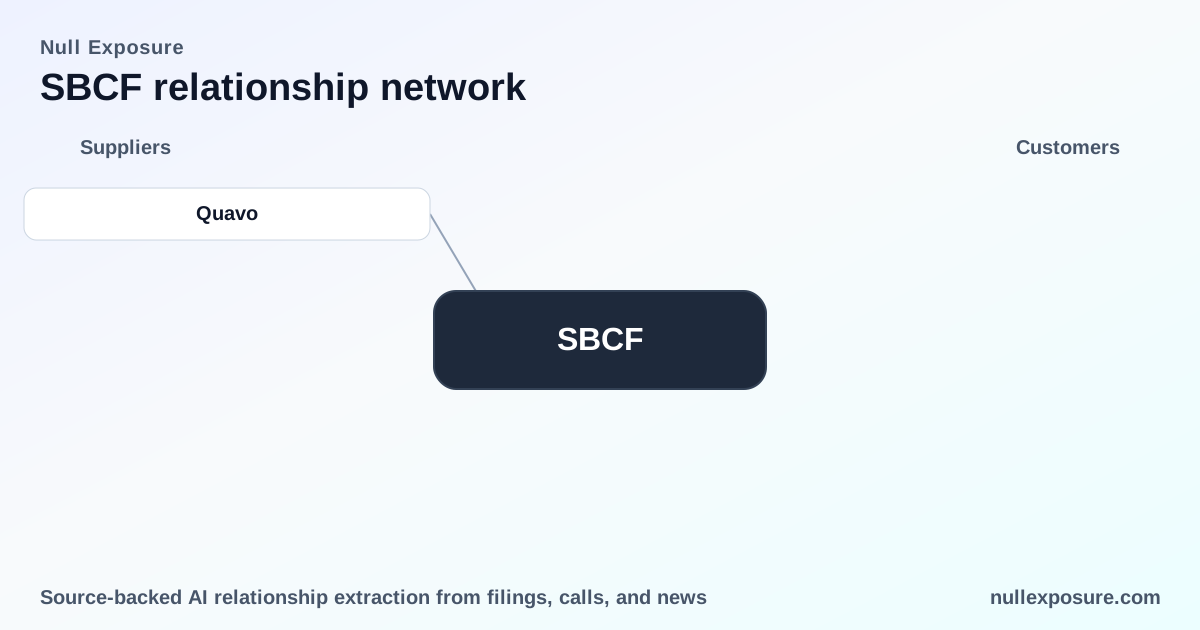
Seacoast’s partnership announcement with Quavo described as a move to improve operations and fraud protection. MarketScreener covered the announcement referencing a Dec. 09 notice that Seacoast had partnered with Quavo to enhance operational workflows and anti-fraud capabilities, positioning Quavo as a strategic operations and fraud-protection partner for the bank. Source: MarketScreener article reporting the Dec. 09 notice (first seen Mar 10, 2026): https://www.marketscreener.com/news/earnings-flash-sbcf-seacoast-banking-corporation-of-florida-reports-q4-revenue-203-3m-vs-factse-ce7e5bdfdc80fe2d
-
A separate MarketScreener mention tied to the same relationship reiterated the partnership when reporting Seacoast’s dividend decision, noting that the bank partnered with Quavo to improve operations and fraud protection in coverage dated Nov. 06. This duplicate news mention indicates ongoing market discussion of the Quavo engagement across corporate communications. Source: MarketScreener article referencing the Nov. 06 mention (first seen Mar 10, 2026): https://www.marketscreener.com/news/seacoast-banking-of-florida-keeps-quarterly-dividend-at-0-19-a-share-payable-march-31-to-holders-o-ce7e58d3dc81f02c
Interpreting the relationship set Both items point to the same supplier relationship: Quavo engaged to strengthen operations and fraud protection. For investors and operators, this is a supplier that sits at the intersection of operations and risk controls — a class of vendor whose performance affects margin (through efficiency gains) and loss exposure (through fraud reduction). The coverage indicates active vendor adoption rather than pilot-stage exploration, which suggests the relationship is operationally relevant to Seacoast.
Company-level constraints and what they reveal about vendor posture The public constraint excerpts indicate Seacoast uses a managed security service provider to supplement 24/7 coverage and works with leading cybersecurity firms to leverage third-party technology and expertise. This is a company-level signal, not tied by the excerpt to Quavo specifically. From that signal, derive these operational characteristics:
-
Contracting posture: Seacoast follows a formal outsourcing model for security and monitoring, engaging third parties to provide continuous coverage rather than in-house 24/7 staffing alone. This implies contract terms focused on SLAs, incident response obligations, and regulatory compliance provisions.
-
Concentration: Outsourcing security indicates moderate vendor concentration risk—the bank uses external MSSPs and cybersecurity partners to reduce staffing overhead, but reliance on a small number of specialized providers elevates vendor risk if those suppliers fail to meet controls.
-
Criticality: High. Security and fraud detection are mission-critical for a bank; vendor compromise or service interruption translates directly to financial loss and regulatory exposure.
-
Maturity: Seacoast’s use of managed services and multiple cybersecurity partners signals an established, mature vendor strategy rather than ad hoc engagement, suggesting formalized vendor management and procurement processes.
Implications for investors and operators The Quavo relationship and the MSSP disclosure together form two complementary signals: Seacoast invests in vendor-driven operational resilience and fraud controls. Investors should weigh these facts against the bank’s financials:
-
Operational upside: Improved operations and fraud protection can reduce loss rates and processing costs, supporting margins (current operating margin TTM: 43.8%) and protecting net interest and fee income.
-
Vendor risk: Outsourced security and operations increase counterparty risk. Given Seacoast’s high institutional ownership, any material vendor failure would attract swift analyst and regulatory scrutiny; governance and vendor oversight are therefore material to credit and equity valuations.
-
Cost dynamics: Third-party services increase OPEX but can be accretive if they lower fraud losses and processing headcount; the trade-off requires monitoring contract terms, implementation timelines, and measured benefits.
If you want a granular view of supplier contracts, counterparty concentration, and downstream dependencies, explore supplier intelligence on Null Exposure.
Practical next steps for portfolio managers and operational leaders
-
For investors: request or review vendor-risk disclosures and the bank’s third-party risk management framework in investor calls and SEC filings; prioritize questions on SLA penalties, termination rights, and incident history.
-
For operators: verify integration and testing plans for Quavo-enabled workflows, ensure vendor monitoring is embedded in SOC/IT governance, and validate incident response coordination between Seacoast and its MSSP partners.
-
For risk teams: map the overlap between fraud-detection vendors and core transaction processors to detect single points of failure and concentration.
Final takeaway and where to dig deeper Seacoast’s public supplier signals show a deliberate move to outsource specialized security and fraud-protection functions, with Quavo cited in market coverage as a partner for operational and fraud improvements. This supplier posture supports efficiency and risk reduction while concentrating critical controls outside the bank—an arrangement that requires tight contractual discipline and vigilant oversight. For bespoke supplier due diligence or to benchmark Seacoast’s vendor strategy against peers, visit Null Exposure for a focused supplier-risk toolkit and comparative intelligence.