Solo Brands (SBDS) — supplier relationships that drive reach and risk
Solo Brands operates a direct-to-consumer and retail platform selling outdoor and lifestyle products and monetizes primarily through product sales across DTC channels, large retail placements, and high-visibility marketing partnerships that drive conversion and margin capture. The company leverages branded marketing campaigns and third‑party retail distribution to scale demand while outsourcing manufacturing to external partners. Investors evaluating SBDS supplier exposure should focus on the marketing-to-retail pipeline and the concentrated manufacturing footprint that underpins product availability and cost.
For a broader supplier intelligence view, visit https://nullexposure.com/.
How Solo turns marketing into revenue
Solo Brands’ commercial model is straightforward: it invests in branded creative and broad-reach media to generate demand, then fulfills those orders through a mix of direct channels and retail partners. Marketing partnerships (talent, agencies, and platform placements) extend reach and lower customer acquisition costs, while third‑party manufacturers deliver product at scale without the company owning heavy capital equipment. That operating posture delivers rapid go-to-market capability but also creates concentration risk at the supply layer and a dependency on external marketing partners to sustain volume.
The campaign driving the latest partner map
In March 2026 Solo launched a multi-channel campaign — branded “Blunt Marketing” — that pairs celebrity talent with an integrated media plan. The initiative illustrates the company’s approach: deploy bold creative to drive awareness and funnel sales through digital, social and large retail platforms. According to the campaign release, Solo’s integrated plan runs across video, digital, social, influencer, audio, search, performance and retail channels — the largest such campaign the brand has executed. For more on supplier relationships and exposure monitoring, see https://nullexposure.com/.
Relationships you need to know right now
Below are the partnerships surfaced in the company’s recent campaign disclosure; each entry includes a concise plain‑English summary and the source.
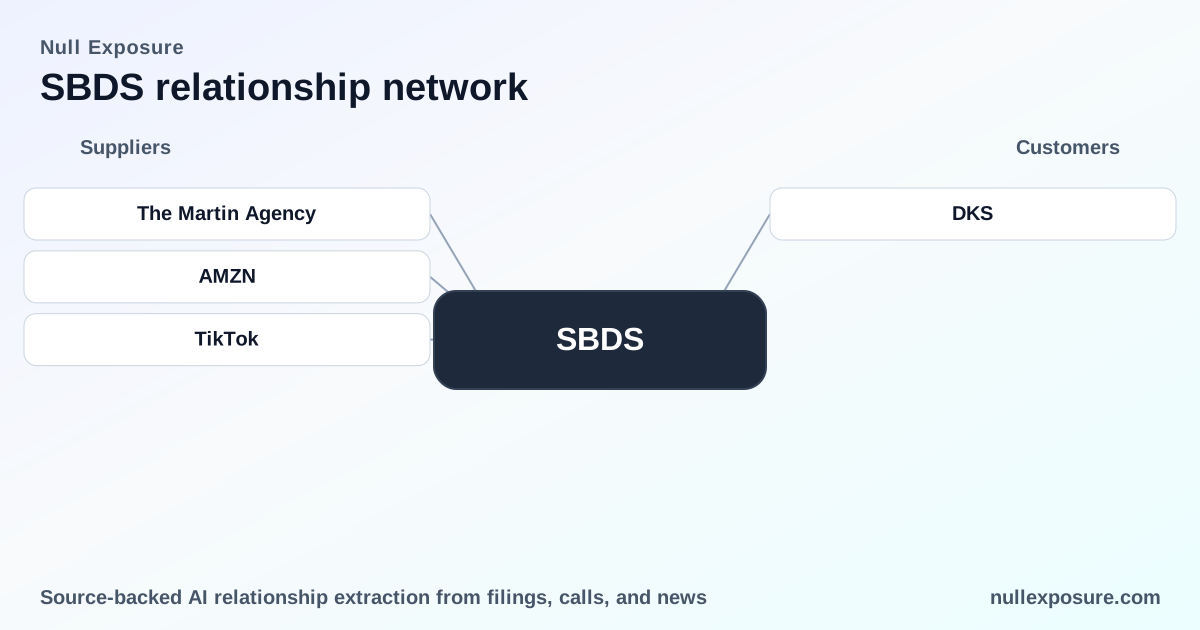
The Martin Agency
Solo engaged The Martin Agency to execute the creative concept titled “Blunt Marketing,” using long-form celebrity content to position Solo Stove products in a direct-to-consumer sales context. According to a PR Newswire release (March 2026), The Martin Agency led creative production featuring Snoop Dogg and Warren G as part of the campaign launch.
Amazon
Amazon is a distribution and media partner in the campaign, providing retail placements and programmatic retail advertising as part of Solo’s largest integrated marketing effort to date. The PR Newswire release (March 2026) lists Amazon among high-visibility channels supporting the full-funnel campaign.
TikTok
TikTok is a strategic social and influencer channel in the integrated media plan, used to amplify short-form creative and influencer activations tied to the campaign. The PR Newswire release (March 2026) identifies TikTok as a core platform for the social and influencer legs of the rollout.
What the relationships reveal about operating priorities
These partnerships reinforce two clear operating priorities for Solo Brands: 1) invest disproportionately in brand-led demand generation, and 2) rely on third-party distribution and manufacturing to deliver product at scale. That split accelerates topline growth when campaigns succeed, but it also concentrates operational risk in a small number of supplier and platform relationships that are critical to conversion and fulfillment.
Supplier constraints and their investment implications
Company disclosures and excerpts show two dominant supplier constraints as company-level characteristics:
- Geography: Solo sources and procures inventory primarily out of China, with some products from Mexico, and maintains manufacturing partners across the U.S., India, Vietnam, Cambodia, and Mexico. The business discloses a heavy concentration with two manufacturers in China, which creates geopolitical and logistical exposure that investors must price into scenario analyses.
- Relationship role: The company’s products are manufactured by third-party manufacturers outside the U.S., establishing a contracting posture where Solo is dependent on external production capacity rather than owning manufacturing assets. This posture increases vendor concentration risk and reduces internal control over lead times and quality.
Taken together, these signals mean: manufacturing is critical, concentrated, and externally contracted, while marketing and retail distribution are diversified across large-scale partners. Investors should consider how these characteristics affect resilience to tariffs, shipping disruptions, and sudden changes in demand triggered by creative campaigns.
Risk factors that matter to procurement and capital planning
- Concentration Risk: Majority of manufacturing concentrated with two Chinese partners increases systemic vulnerability to trade restrictions, factory outages, or input-cost inflation.
- Operational Leverage to Marketing: Large integrated campaigns (like the March 2026 “Blunt Marketing” launch) can materially move sales but also raise marketing spend volatility; failure to convert can leave excess inventory or elevated CAC.
- Platform Dependence: Visibility and retail placements on major platforms (Amazon, TikTok-driven social demand) are powerful growth multipliers, but algorithm or policy shifts at those platforms can materially disrupt traffic and conversions.
Practical takeaways for investors and operators
- Monitor supplier concentration metrics and shipping lead times from China and Mexico; any sign of lengthening lead times or rising MOQ requirements signals margin pressure.
- Track campaign ROI closely: creative partnerships and agency spend (e.g., The Martin Agency) are high impact; investors should demand cadence on conversion metrics and retail sell-through tied to each campaign.
- Stress-test platform exposure: model scenarios where Amazon or TikTok visibility is reduced and quantify incremental CAC needed to replace that demand via paid channels.
For additional supplier intelligence and ongoing tracking of Solo Brands’ partner exposure, visit https://nullexposure.com/.
Final investment view and next steps
Solo Brands runs a lean, asset‑light manufacturing model supported by high-octane marketing partnerships. That combination supports rapid scaling but concentrates execution risk in a handful of external manufacturers and major media/retail platforms. For investors, the immediate questions are whether Solo can sustain sell-through rates at scale and whether supplier concentration can be diversified before a macro or geopolitical shock.
If you are building a monitoring plan or evaluating a position size, prioritize near-term indicators: factory lead times, inventory aging, platform conversion trends, and campaign-level ROI. For an integrated supplier risk overview and continuous monitoring, explore vendor coverage at https://nullexposure.com/.