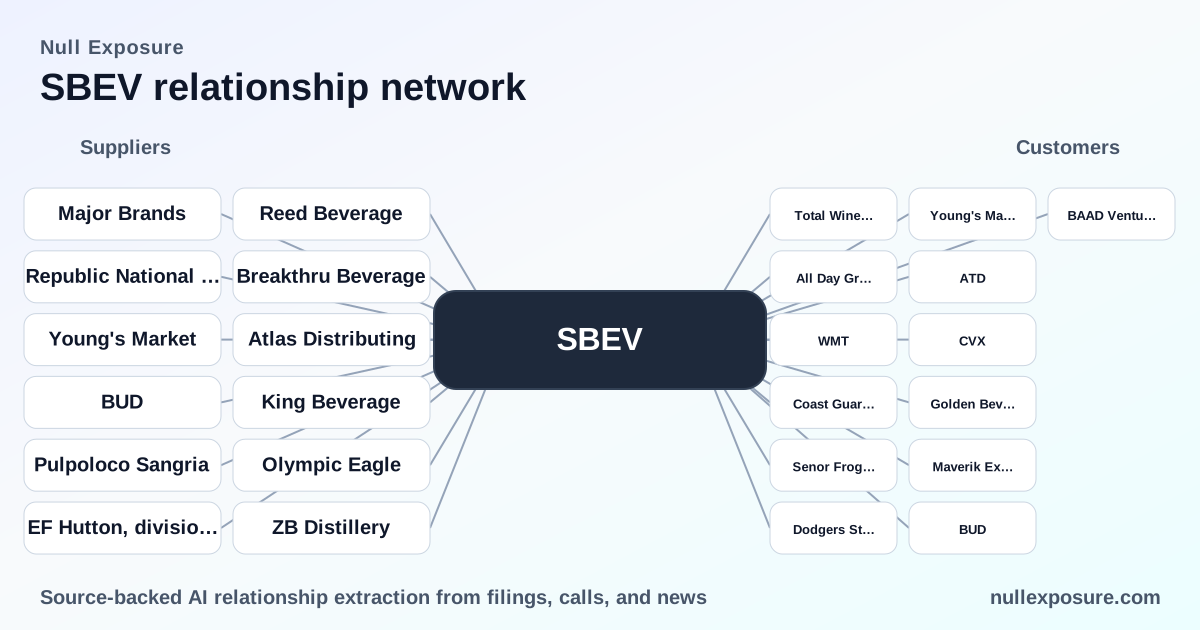
Splash Beverage Group (SBEV): A supplier map and what it means for investors
Splash Beverage Group operates as a small-cap beverage consolidator that acquires brands, outsources manufacturing, and monetizes through third-party distribution agreements, retail placements, and licensing royalties. The company drives revenue by placing owned and acquired spirits and single-serve wine products into national and regional wholesaler networks (including listings in big-box retail), while retaining margin through brand rights and selective in-house production for legacy assets. For investors evaluating supplier risk and upside, the story is distribution coverage and contractual flexibility: broad market access via distributors, offset by outsourced manufacturing and royalty obligations that compress operating leverage. Learn more about supplier risk and coverage at https://nullexposure.com/.
The commercial relationships you need to know
Below I list each partner mentioned in public materials, with a concise plain-English description and the source for due diligence.
-
Reed Beverage — Management cited Reed Beverage in the 2024 Q3 earnings call as the new distributor providing full coverage across West Texas (Amarillo, Lubbock, El Paso), expanding Splash’s regional reach. Source: Splash 2024Q3 earnings call (first reported March 2026).
-
Breakthru Beverage — The company reported Breakthru Beverage acting as the broker through which the Pennsylvania Liquor Control Board authorized Splash’s tequila brand Chispo, indicating channel access in Pennsylvania. Source: Splash 2024Q3 earnings call (2024Q3).
-
Atlas Distributing — Splash expanded its northeast footprint with Atlas Distributing to increase coverage in Massachusetts, improving sell‑through potential in that state. Source: Splash 2024Q3 earnings call (2024Q3).
-
King Beverage — Management noted King Beverage helped deliver full state coverage in Washington for Copa DI Vino and Pulpoloco during a Pacific Northwest expansion, strengthening on‑premise and retail presence. Source: Splash 2024Q3 earnings call (2024Q3).
-
Olympic Eagle — Alongside King Beverage, Olympic Eagle was named as a Washington AB wholesaler that helped achieve statewide distribution for key brands, demonstrating multi‑partner coverage strategy. Source: Splash 2024Q3 earnings call (2024Q3).
-
ZB Distillery — Public releases for FY2026 state the Chispo Tequila product is produced in Jalisco, Mexico in partnership with ZB Distillery, signaling an outsourced distillation relationship for the tequila line. Source: NewMediaWire / EQS corporate news releases (FY2026).
-
Major Brands — A FY2020 corporate release confirms Major Brands was granted distribution rights for Sam’s Club placements for Splash’s SALT tequila SKU, showing national retail channel penetration through major wholesalers. Source: Newsfile press release (FY2020).
-
Republic National Distributing Company (RNDC) — RNDC was one of three major distributors awarded Sam’s Club distribution rights for SALT tequila, giving Splash access to a broad warehouse/club retail channel. Source: Newsfile press release (FY2020).
-
Young’s Market — Young’s Market joined RNDC and Major Brands in carrying SALT tequila into Sam’s Club, reinforcing a multi-distributor strategy for big‑box retail listings. Source: Newsfile press release (FY2020).
-
Anheuser‑Busch Network (Anheuser‑Busch) — The company highlighted incremental distribution within Anheuser‑Busch channels and access to ~13,000 retail locations after the Copa DI Vino acquisition, underlining a critical national outlet for single‑serve wine. Source: Newsfile / GlobeNewswire coverage of the Copa DI Vino acquisition (FY2021) and market commentary (FY2025).
-
Pulpoloco Sangria — Splash’s acquisition and exclusive U.S. import rights for Pulpoloco gave the company control of manufacturing and U.S. distribution for the brand and international expansion opportunities, moving it from distributor-only to owner/operator status. Source: CSP Daily News coverage of the Pulpoloco deal (FY2022).
-
EF Hutton, division of Benchmark Investments, LLC — EF Hutton acted as the sole book‑running manager for Splash’s $15.0 million public offering and U.S. listing transaction, a capital markets relationship that financed growth and distribution initiatives. Source: GlobeNewswire press release (FY2021).
-
Anheuser‑Busch (market commentary) — Independent reporting and analyst commentary in FY2025 noted Splash leverages Anheuser‑Busch distribution channels to push its spirits and wine SKUs, illustrating reliance on established wholesaler infrastructure for scale. Source: market coverage / analyst commentary (FY2025).
What the relationships reveal about Splash’s operating model
-
Distribution-first commercial go-to-market. Splash consistently secures regional and national wholesalers (RNDC, Major Brands, Young’s Market, Anheuser‑Busch channels, regional partners like Reed, Atlas, King Beverage and Olympic Eagle) to achieve rapid geographic coverage without investing heavily in its own logistics. That model accelerates shelf presence but transfers execution risk to partners.
-
Outsourced manufacturing with selective in-house capacity. Public filings note manufacturing is generally outsourced to co‑packers and distillers, while Copa DI Vino production can be performed in Splash’s Oregon facility, creating mixed control over COGS and quality for certain brands. This dual approach reduces capital intensity but leaves gross margin sensitive to third‑party pricing and availability.
-
Contracting posture favors flexibility, not long-term guarantees. Company disclosures describe co‑pack agreements as terminable on request with no minimum production obligations, signaling flexibility that allows Splash to pivot SKUs but also exposes the company to supply interruptions and spot pricing risk if co‑pack partners reprioritize capacity.
-
Licensing creates recurring obligations and leverage on IP. Filings document non‑exclusive, royalty‑bearing license arrangements (for example, a license tied to Copa assets from 1/4 Vin SARL) and historical licensing obligations to brand owners such as ABG TapouT, LLC, which included a 6% royalty on net sales and minimum monthly payments (~$55,000 in 2023 and 2024). These contractual obligations are material to margins until amortized or renegotiated.
-
Concentration and maturity signals. Splash’s market capitalization and trailing profitability metrics indicate a small, early-stage consolidator: negative EBITDA and thin revenue base suggest operating leverage is immature, so distributor placements and a few national retail wins are the primary drivers of near-term value realization.
(If you want a consolidated supplier-risk score and exposure mapping, visit https://nullexposure.com/.)
Key investment implications and risks
-
Upside: Rapid distributor rollouts and national retail placements can generate low‑cost revenue growth because Splash outsources logistics and leverages partners’ shelf space. National network access through RNDC and Anheuser‑Busch channels is a high‑value distribution asset.
-
Downside: Outsourced, terminable manufacturing contracts and royalty‑bearing licenses create supply and margin vulnerability; the TapouT royalty example illustrates fixed minimum cash outflows that compress operating cash flow when top-line is small. Concentrated reliance on distributor relationships amplifies execution risk if a partner reprioritizes SKUs.
What investors should watch next
- Track roll‑outs and velocity from RNDC, Major Brands and Anheuser‑Busch channels for unit sell‑through and retailer reorders.
- Monitor contract developments: any shift from terminable co‑packing to multi‑year manufacturing agreements will improve predictability and margins.
- Watch for licensing renegotiations or expirations—eliminating minimum royalties would be an immediate margin catalyst.
For an investor‑grade supplier risk profile and ongoing monitoring of Splash Beverage’s distributor coverage, see https://nullexposure.com/.
Bottom line: Splash’s model delivers fast access to retail via established wholesalers and low capex, but it remains operationally vulnerable to third‑party manufacturing and legacy licensing cash flows until scale and contract tenure reduce those fixed costs.