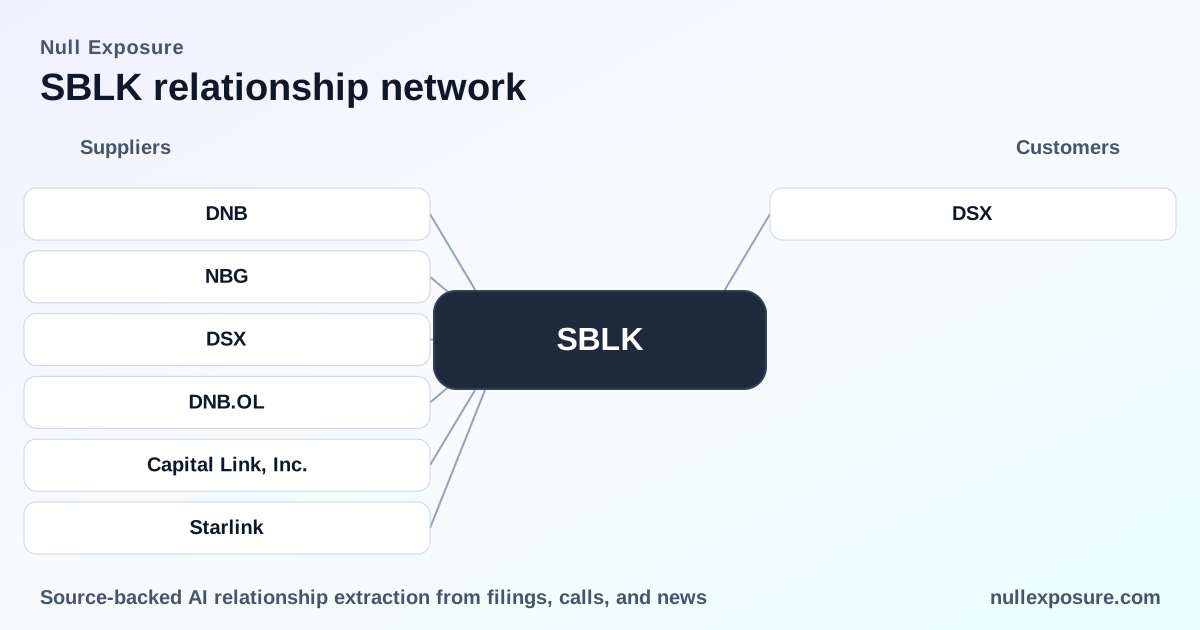
Star Bulk Carriers (SBLK): How its supplier and financing relationships shape growth and risk
Star Bulk Carriers operates as a global drybulk shipping owner-operator that monetizes through charter revenues, fleet deployment and selective vessel acquisitions financed with a mix of cash and secured credit. The company drives cash flow from time and voyage charters while targeting fleet growth to capture higher freight rates and asset appreciation; financing partners and transaction counterparties therefore play a direct role in execution and capital structure. For a deeper view into Star Bulk’s commercial and financing counterparties visit https://nullexposure.com/.
Quick take: what the relationship map tells investors
Star Bulk runs an asset-heavy operating model that depends on external lenders and transactional counterparties to execute fleet expansion. The company’s counterparties provide both committed financing and acquisition channels; these relationships are operationally critical because they directly affect leverage, liquidity and fleet scale. Company financials—$1.042B revenue TTM, $320M EBITDA, EV/EBITDA ~10.7—support active use of debt for acquisitions while keeping a dividend policy in place, which makes supplier and lender posture more than peripheral detail for investors.
Visit https://nullexposure.com/ for a consolidated view of counterparties and filings.
How to read these supplier entries — company-level operating characteristics
- Contracting posture: Star Bulk uses committed lending facilities and conditional sale-and-purchase agreements to execute growth, indicating a preference for secured, documented financing and staged acquisitions rather than opportunistic cash-only buys.
- Concentration and counterparty mix: Counterparties combine traditional banks, an industry peer for vessel acquisition and investor-relations/communications partners, producing moderate concentration but high functional concentration around financing and fleet sourcing.
- Criticality: Lenders and sellers are mission-critical—financing facilities and vessel purchase agreements directly determine capacity and EBITDA generation.
- Maturity and institutionalization: Relationships are with established banking institutions, listed shipping peers and professional IR advisers, reflecting a mature, institutional supplier ecosystem rather than ad-hoc partners.
Who Star Bulk is doing business with right now
DNB Bank ASA
Star Bulk has a committed loan facility of up to $100.0 million with DNB Bank ASA, established in December 2025 as part of its financing program. This is a conventional shipowner bank facility that strengthens short-term financing capacity. (Source: company release reported on Yahoo Finance, March 2026 — https://sg.finance.yahoo.com/news/star-bulk-carriers-corp-reports-210500694.html)
National Bank of Greece S.A. (NBG)
In February 2026 Star Bulk executed a committed term sheet with NBG for a loan facility up to $80.0 million, expanding its pool of secured, institutionally provided credit. This provides additional committed liquidity to support fleet operations or acquisitions. (Source: company press release on GlobeNewswire, Feb 25, 2026 — https://www.globenewswire.com/news-release/2026/02/25/3245012/0/en/Star-Bulk-Carriers-Corp-Reports-Net-Profit-Of-65-2-Million-For-The-Fourth-Quarter-Of-2025-And-Declares-Quarterly-Dividend-Of-0-37-Per-Share.html)
Diana Shipping Inc. (DSX)
Star Bulk entered into a conditional Sale and Purchase Agreement to acquire sixteen vessels from Diana Shipping, a transaction priced at approximately $470.5 million in cash and conditional on Diana’s separate acquisition of Genco Shipping. This is a strategic fleet-scaling transaction that depends on third-party deal outcomes. (Source: corporate announcement on GlobeNewswire, March 6, 2026; additional reporting from Intellectia and Cyprus Shipping News, March 2026 — https://www.globenewswire.com/news-release/2026/03/06/3251093/0/en/Star-Bulk-to-Acquire-16-Vessels-from-Diana-Shipping-Inc-Conditional-Upon-the-Success-of-Its-Offer-to-Acquire-Genco-Shipping-Trading-Ltd.html and https://cyprusshippingnews.com/2026/03/09/diana-shipping-increases-offer-to-acquire-genco-shipping-trading-in-partnership-with-star-bulk-carriers/)
Capital Link, Inc.
Capital Link serves as Star Bulk’s investor-relations and financial media contact, providing market communication and IR distribution. That relationship supports market access and investor dialogue rather than operational supply. (Source: company filings and IR contact listings on GlobeNewswire press releases, Jan–Feb 2026 — https://www.globenewswire.com/news-release/2026/01/30/3229584/0/en/Star-Bulk-Announces-Date-for-the-Release-of-Fourth-Quarter-Ended-December-31-2025-Results-Conference-Call-and-Webcast.html)
Starlink (technology provider)
Star Bulk has implemented Starlink connectivity across its fleet and installed onboard firewalls, signaling a move to modernize onboard communications and cybersecurity for operations and crewing. This is a technology supplier relationship that affects operations, safety and reporting cadence. (Source: Q4 2025 earnings call transcript covered by InsiderMonkey, Jan/Feb 2026 — https://www.insidermonkey.com/blog/star-bulk-carriers-corp-nasdaqsblk-q4-2025-earnings-call-transcript-1705123/)
Place these relationship entries in context and see consolidated partner intelligence at https://nullexposure.com/.
Operational and financial implications investors should track
- Growth funded through secured facilities and conditional SPAs accelerates revenue potential but increases dependency on successful financing drawdowns and third-party M&A outcomes. The DNB and NBG facilities increase committed liquidity; the Diana SPA is conditional and therefore introduces execution risk until closed.
- Leverage and liquidity sensitivity are primary risk vectors. Star Bulk’s headline metrics—EV/EBITDA ~10.7, Price/Book ~1.03 and a forward P/E of ~6—indicate market expectation of near-term earnings improvement, which relies on fleet utilization and successful integration of acquired vessels.
- Counterparty risk is moderate: banks and listed shipping peers are standard counterparties in shipping finance but transaction conditionality (third-party acquisitions) creates unique execution dependencies.
- Operational resilience improves with standardized IR and connectivity partners, which support investor transparency and operational monitoring but do not substitute for capital stability.
Key investor watch-items: consummation of the Diana transaction, drawdowns and covenant terms under the new bank facilities, and fleet utilization trends that convert tonnage into charter revenue. For an updated counterparty and supplier snapshot, go to https://nullexposure.com/.
Data and constraint note
The available record contains no extracted supplier-level constraints as formal constraints in the feed; the operating characteristics described above are company-level signals derived from disclosed financing and transaction activity. That absence of explicit constraints does not change the fact that committed facilities and conditional purchase agreements govern execution timelines and risk allocation.
Bottom line for investors
Star Bulk’s current supplier map shows targeted use of bank financing, an industry peer for bulk vessel procurement and institutional IR/tech partners, which together accelerate fleet growth while concentrating execution risk in financing and M&A outcomes. Investors should monitor closing conditions on the Diana Shipping SPA, loan drawdowns, and charter-rate-driven EBITDA conversion. For continual tracking of Star Bulk’s counterparties and supplier relationships, visit https://nullexposure.com/.
Bold, timely monitoring of those three levers—transaction close, financing performance, and fleet utilization—will determine whether Star Bulk converts announced activity into durable shareholder value.