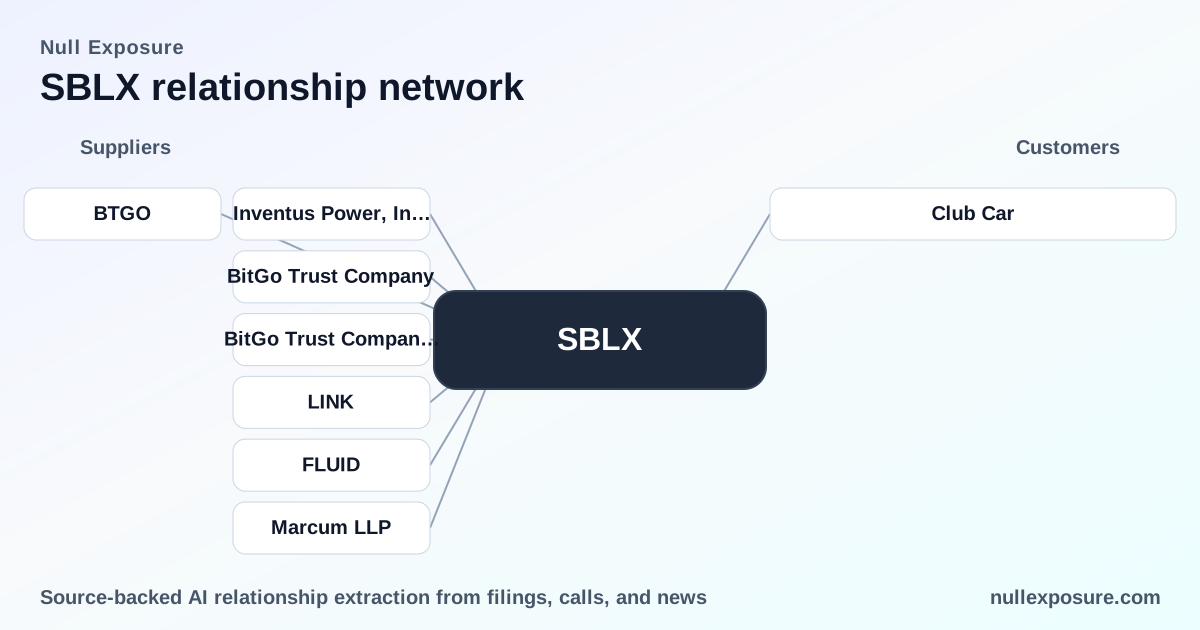
StableX (SBLX) supplier map: custody pivot, battery disputes, and manufacturing churn
StableX Technologies designs and sells electric vehicles for closed-campus mobility, urban/local delivery and government fleets, and captures revenue through vehicle and parts sales plus aftermarket services; over the last 18 months the company has shifted capital allocation into a digital-asset treasury strategy while running a lean outsourced manufacturing and supplier network. This note breaks down the supplier and service-provider relationships disclosed in public filings and news coverage, highlights operational constraints that shape procurement risk, and flags the clearest implications for investors and operator counterparties. For a deeper supplier-intelligence view visit https://nullexposure.com/.
Why suppliers matter for StableX: manufacturing, batteries and a new treasury profile
StableX operates without full-time employees and relies heavily on third-party manufacturers, battery suppliers, and service providers for product assembly, parts, and operational functions. That operating posture concentrates execution risk: long-term manufacturing agreements can lock the company into capacity and quality dependencies, while short purchase agreements concentrate spend and increase procurement volatility. At the same time, StableX is reallocating capital into crypto assets and custodial relationships, transforming treasury-counterparty risk into a front‑line supplier topic for investors.
A practical consequence: operational continuity and balance sheet durability are now joint functions of traditional OEM supply chains and digital‑asset custody partners. Learn more about supplier risk tools at https://nullexposure.com/.
The full supplier list investors should track
Below are every relationship found in the public results for SBLX, each with a one- to two‑sentence investor summary and a concise source reference.
Inventus Power, Inc.
Inventus Power filed suit in February 2024 alleging StableX failed to pay invoices for battery packs and related equipment; this is active supplier litigation that directly implicates battery procurement and working capital management. According to StableX’s FY2024 10‑K, Inventus initiated the complaint in the Circuit Court of DuPage County, Illinois (FY2024 10‑K disclosure).
BitGo Trust Company, Inc. / BitGo
StableX has entered a strategic custody and facilitation relationship with BitGo to secure up to $100 million of crypto assets, with BitGo providing regulated cold storage and its trading affiliates assisting OTC acquisitions and liquidity. Multiple press reports and a company announcement in FY2025 described BitGo as StableX’s institutional custodian for the crypto treasury and as a facilitator for planned token purchases (press release and news coverage, FY2025).
Chainlink (LINK)
StableX completed a token acquisition of Chainlink (LINK) as its second strategic purchase in the company’s token-buying program, signaling active asset diversification within the stablecoin/crypto interoperability sector. The purchase was reported in a FY2025 media release that detailed the company’s token buys (Globe and Mail/Newswire coverage, FY2025).
FLUID
FLUID was disclosed as StableX’s initial token investment and is cited as part of the company’s strategy to build a diversified portfolio of assets that underpin its stablecoin strategy. The investment in FLUID was referenced alongside the Chainlink purchase in FY2025 press coverage (Globe and Mail/Newswire coverage, FY2025).
Marcum LLP
Marcum LLP is named as the company’s auditor in public market disclosures and market‑data pages, a governance and reporting relationship that underpins financial statement credibility. Market reporting in FY2025 lists Marcum LLP in StableX’s disclosures (market-data reporting, FY2025).
Constraints and what they reveal about operating risk
Public constraint excerpts yield practical signals about StableX’s supplier posture and procurement economics:
-
Contract mix — long and short terms co-exist. StableX has evidence of long-term manufacturing arrangements with automatic renewals (an MLA with an initial three‑year term that renews for successive two‑year terms) alongside shorter purchase agreements that run through discrete periods (e.g., battery purchases through 2025 valued at roughly $1.21 million). These contract types imply both multi-year supply dependencies and notable near-term spend buckets that drive working-capital timing.
-
Manufacturing and supplier role concentration. Excerpts name manufacturing partners and supply agreements that designate counterparties as component manufacturers and assemblers; this signals a reliance on external production capacity and exposes StableX to supplier performance risk and termination exposure.
-
Terminations and churn are material. The company has terminated relationships and settled supplier obligations (for example, the Athena supply agreement was terminated with a roughly $289k settlement and a separate MLA was not renewed and terminated per contract terms). Terminated supplier contracts point to execution disruption and potential re‑sourcing costs.
-
Outsourced operating model. StableX conducts business through a network of independent contractors and third‑party service providers rather than traditional headcount, which lowers fixed payroll but raises vendor management and continuity risk.
-
Spend concentration bands. Public excerpts show discrete spend bands: single-supplier purchase commitments in the $1m–$10m range and settled amounts in the $100k–$1m range. Those bands indicate material but not enormous supplier exposures—large enough to affect near-term cash flow, small relative to enterprise-scale OEMs.
-
Geographic sourcing footprint signal. There are indications of APAC manufacturing nodes referenced in public supplier narratives; the company’s supply chain has connections to international EV manufacturing hubs, which implies geopolitical and logistics tail risk.
Those constraints combine to create an operating profile that is outsourced, supplier‑dependent, and exposed to both procurement legal disputes and treasury‑counterparty risk.
Investment implications and risk checklist
- Legal exposure in the supply chain is active. The Inventus complaint is a near-term legal liability that affects cash flows and supplier trust; investors must monitor court filings and reserve adequacy.
- Manufacturing churn increases re‑sourcing and quality risk. Terminated MLAs and supply agreements mean replacement sourcing could be costly or lead to production delays—material for a capital‑light EV OEM.
- Crypto treasury introduces a new counterparty and liquidity vector. BitGo custody reduces custody risk but concentrates treasury counterparty exposure to the regulated custodian and its trading affiliates; token holdings (LINK, FLUID) create market‑liquidity sensitivity and regulatory complexity.
- Audit and governance signals matter. External auditor engagement should be reviewed for continuity, scope changes, and any audit opinions that affect reporting reliability.
If you want a supplier-risk deep dive or to monitor ongoing legal and custody developments in real time, start here: https://nullexposure.com/.
Bottom line — what investors and operators should do next
StableX combines traditional EV supplier risk (batteries and manufacturing) with an emerging digital‑asset treasury strategy. That duality raises both operational and market‑risk vectors: procurement disputes and supplier terminations threaten product delivery, while concentrated crypto positions require active treasury governance and custody diligence.
Recommended actions:
- Review the Inventus litigation docket and assess potential working‑capital impacts.
- Request detail on replacement manufacturing capacity and contingency sourcing given terminated MLAs.
- Validate custody contracts with BitGo, verify OTC execution arrangements, and stress test token liquidity under adverse market scenarios.
For tailored supplier intelligence and continuous monitoring tools, visit https://nullexposure.com/ and get a targeted briefing on StableX counterparties and contract exposures.