Sabine Royalty Trust (SBR): Supplier relationships that move the cash line
Sabine Royalty Trust monetizes long-lived oil and gas overriding royalty interests by collecting production revenues from third-party operators and distributing them monthly to unitholders. The trust does not operate wells; it relies on a trustee to administer cash flows and on legacy contractual royalty conveyances that were established in 1982, producing predictable, commodity-linked distributions that investors buy for yield and duration exposure.
If you evaluate supplier or counterparty risk for income-producing energy trusts, consider the operational role of the trustee and the upstream origin of the royalties. Learn more at https://nullexposure.com/.
How the business actually runs and where the fees live
Sabine is an administrative trust rather than an operating company. The Trust has no employees; administrative functions are performed by the Trustee, and material general and administrative fees are disclosed in filings — Trustee’s fee of $478,878 and an escrow agent fee of $1,436,631 are representative line items. Those contractual service relationships are core to the cash-distribution mechanism: the Trustee collects operator receipts, manages timing (including occasional revenue deferrals), and declares monthly distributions.
From a supplier-risk perspective, that structure implies four practical characteristics:
- Contracting posture: Predominantly service contracts (trustee, escrow, professional advisers) rather than procurement of goods. Contracts are stable but service-intensive.
- Concentration: A small set of service relationships perform material administration and cash-handling functions, so operational concentration is high.
- Criticality: Trustee services are mission-critical — interruptions or disputes would directly impair distributions.
- Maturity: The trust has long-established legal roots (originated in 1982) and established monthly payout mechanics; supplier relationships are therefore mature and recurring.
For a direct look at the trust’s public profile and what that means for counterparties, visit https://nullexposure.com/.
The supplier and origin relationships investors should know
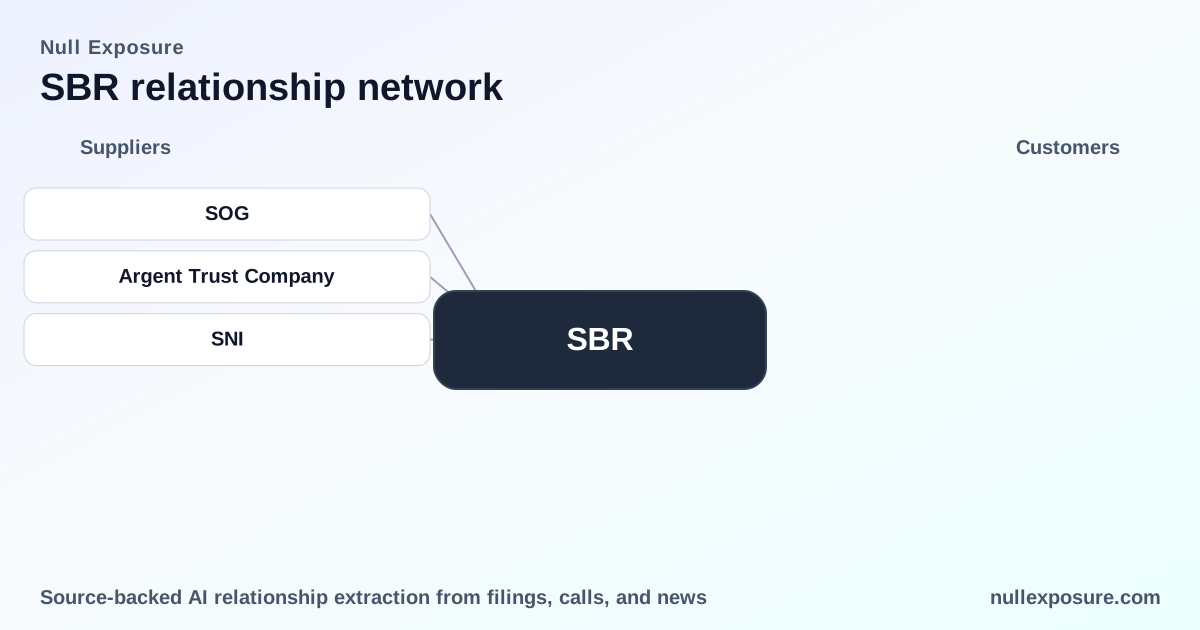
Argent Trust Company — the Trustee and transaction-level cash agent
Argent Trust Company functions as Trustee and the public face for monthly distribution declarations and production reporting. Argent has been declaring monthly cash distributions across Q4 2025 and Q1 2026 — for example, a December 29, 2025 distribution of $0.196670 per unit tied to preliminary production figures, a January 29, 2026 distribution of $0.321550 per unit that included a disclosure of revenue timing adjustments, and February 2026 distributions in the ~$0.283 per unit range alongside reported declines in monthly production volumes. These statements and monthly notices are carried in investor commentary and news recaps. Sources: simplywall.st coverage of Argent Trust Company notices (December 2025–February 2026) and SahmCapital articles summarizing monthly production and declared distributions in early 2026.
Sabine Oil & Gas Corporation — the upstream origin of royalty interests
Sabine Royalty Trust was established through a transaction with Sabine Oil & Gas Corporation in 1982, when Sabine transferred overriding royalty interests in a portfolio of wells and acreage into the Trust. That historical conveyance defines the underlying cash flows — operator receipts on those royalty interests — and remains the legal basis for the Trust’s revenue stream. MarketBeat’s reporting and filing summaries recount the 1982 transaction and use it as the origin story for the trust’s asset base. Sources: MarketBeat instant alerts and filing summaries referencing the establishment and transferred royalty interests.
Note on the news flow: market coverage through early 2026 centers on monthly production volatility and consequent distribution changes announced by Argent Trust, and on occasional market filings and investor trading activity referenced in MarketBeat. Sources include MarketBeat instant alerts (February–March 2026) and analyst/news write-ups on simplywall.st and SahmCapital.
What those relationships mean for investors and operators
- Operational dependence is concentrated. The Trustee is not optional — Argent Trust Company’s role is required to administer cash receipts, hold reserves, and declare distributions; any operational disruption would be immediately visible in cash timing and payout notices.
- Fee profile is meaningful but not outsized. Company disclosures list Trustee and escrow fees in the mid-six-figure to low-seven-figure band, which is consistent with the constraint signals showing spend bands between $100k–$1m and $1m–$10m for administrative fees.
- Revenue timing is a real variable. Public notices show that the Trustee can and will defer revenue recognition across reporting periods (for example, certain January 2024 revenues moved into February reporting), which directly affects monthly payout quantum and introduces short-term distribution volatility.
- Geographic and governance anchors exist. The Trust’s principal office is in Dallas, Texas, which frames jurisdiction and service-provider selection for administrative and legal functions.
Key watch list for the next 12 months:
- Trustee performance and any contract amendments that change fee or reserve policies.
- Monthly production trends from the underlying wells and any accelerating declines or operational curtailment by operators.
- Cash-reserve actions by the Trustee that can reduce near-term distributions to cover contingent liabilities.
Quick, actionable takeaways
- Trustee concentration is the primary supplier risk; Argent Trust Company executes the mechanics that convert operator receipts into investor cash. (See monthly notices published in early 2026 via simplywall.st and SahmCapital.)
- Underlying asset origin is legacy and fixed; Sabine Oil & Gas Corporation’s 1982 conveyance remains the contractual foundation for cash flows (MarketBeat filing summaries).
- Fees are visible and material; filings show Trustee and escrow fees in the mid-six-figure to low-seven-figure range, which matter to net distributable cash.
For a deeper supplier-risk diligence workflow and to compare SBR’s supplier posture across income trusts, start here: https://nullexposure.com/.
Final investor note and next steps
Sabine Royalty Trust is a distribution-first vehicle that depends on a narrow set of service relationships and a decades-old royalty conveyance. Investors and operators should prioritize trustee contract reviews, monitor monthly production notices for timing shifts, and treat administrative concentration as a governance and operational risk. For direct access to curated supplier intelligence and comparative trust analytics, visit https://nullexposure.com/ and review supplier profiles and contract-level signals.