SABESP (SBS) — supplier relationships, strategic moves, and what investors should price in
Companhia de Saneamento Básico do Estado de São Paulo (SABESP) operates as a regulated water and sewage utility serving residential, commercial, industrial and government customers in São Paulo state. The company monetizes through regulated tariffs, concession contracts and targeted acquisitions that expand its service footprint and asset base; earnings are driven by volumetric sales, tariff adjustments and efficiency gains. For investors, SABESP combines regulated cash flows with episodic strategic deals that can materially change capital structure and operational scope. Learn more about supplier and partner relationships at https://nullexposure.com/.
Why these relationships matter for valuation and risk
SABESP is a classic regulated-utility investment: stable revenues, visible margins, and sensitivity to regulation and political decisions. The supplier and partner map over the last reporting window shows two classes of interactions that move valuation: operational-improvement partnerships (technology and consulting) and transformational M&A (control of Emae). These relationships change the risk profile from purely regulatory execution to integration and capital-structure execution.
A mid-cycle example: SABESP engaged a consultancy (IFC) to analyze share-capital restructuring while simultaneously executing a large acquisition (Emae), and separately brought in an AI partner for operational forecasting—each relationship has different time horizons and return profiles. For a closer look at counterparty details and implications, visit https://nullexposure.com/.
The counterparties you need on your radar
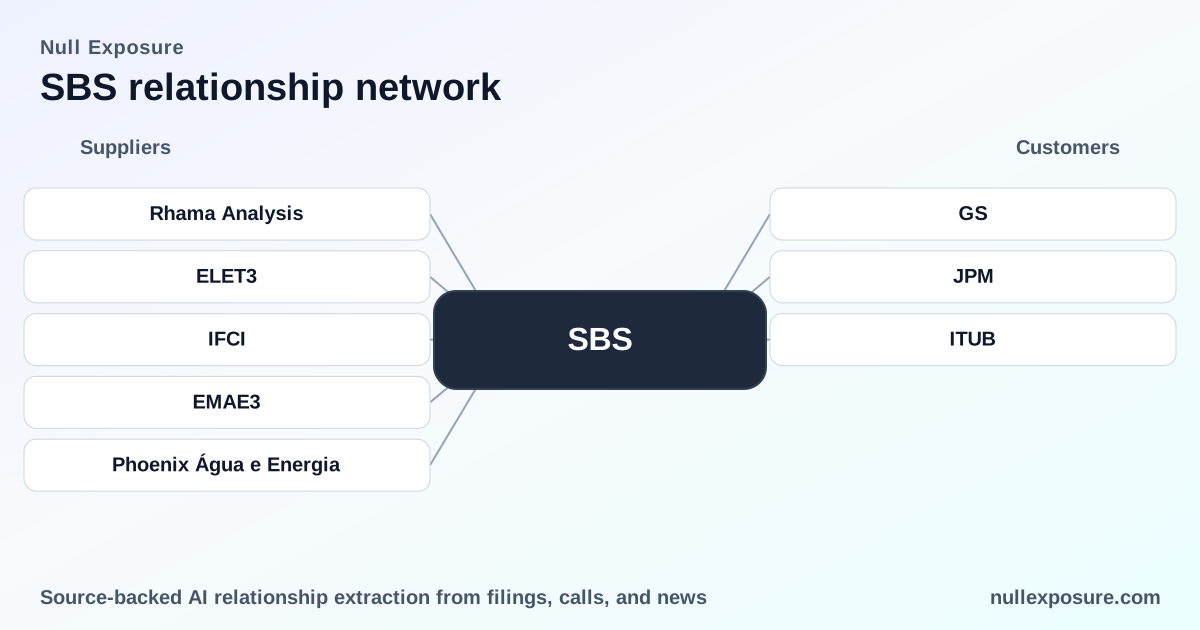
Below I summarize every relationship surfaced in the public record for the supplier scope, with concise sourcing and the practical takeaway for investors.
Rhama Analysis — AI for climate-aware supply planning
SABESP engaged Rhama Analysis to implement an artificial-intelligence system to monitor climate and plan water supply; Rhama was credited for predictive work during the May 2024 floods in Rio Grande do Sul. This is an operational-improvement engagement aimed at reducing supply interruptions and improving allocation decisions. Source: CNN Brasil report covering the initiative (FY2025).
Eletrobras — vendor/transaction counterparty in the Emae deal
Eletrobras sold 66.8% of the preferred shares of Emae as part of the transaction that led to SABESP acquiring control of Emae; the reported price was R$32.07 per preferred share. This transaction positions Eletrobras as a counterparty in a major strategic acquisition that alters SABESP’s asset exposure. Source: Gazeta do Povo coverage of the Emae acquisition announcement (FY2025).
IFC (International Finance Corporation) — capital-structure advisory
SABESP hired the IFC to provide consulting services to the State, specifically to analyze alternatives for restructuring SABESP’s share capital, as noted in a material-fact disclosure reported in FY2026. This engagement signals proactive attention to capital structure and governance optimization ahead of or after transformational deals. Source: PR Newswire/Finviz summary of the material fact (FY2026).
Empresa Metropolitana de Águas e Energia (Emae) — acquisition target and operational expansion
SABESP announced the purchase of control of the Empresa Metropolitana de Águas e Energia (Emae), acquiring 74.9% of the ordinary shares and 66.8% of the preferred shares through negotiated transactions. That acquisition represents a material expansion in SABESP’s operational footprint and creates integration and regulatory oversight tasks that will affect near-term capex and cash-flow timing. Source: Gazeta do Povo reporting on the acquisition (FY2025).
Phoenix Água e Energia — selling shareholder in the Emae transaction
Phoenix Água e Energia sold 74.9% of Emae’s ordinary shares to SABESP at R$59.33 per share as part of the same transaction, making Phoenix a principal seller and counterparty in the deal. The presence of a strategic seller changes the negotiation dynamics and the immediate ownership profile SABESP must integrate. Source: Gazeta do Povo article detailing transaction participants (FY2025).
Operating-model characteristics and company-level signals
Although there were no explicit constraint excerpts in the record, the public relationship set provides clear company-level signals investors should incorporate into modeling:
- Contracting posture: SABESP works as a regulated monopoly with long-term concession obligations; it supplements core delivery through targeted external advisory (IFC) and specialized tech partners (Rhama), indicating a preference for third-party expertise for one-off transformations rather than wholesale internal capability buildouts.
- Concentration and geography: Business is concentrated in São Paulo state and adjacent metropolitan infrastructure; acquisitions like Emae increase geographic and business-line concentration risk but also create scale-based efficiency opportunities.
- Criticality: Water and sewage services are essential municipal services; supplier and partner disruptions have outsized public and regulatory consequences, increasing political and reputational sensitivity around counterparties.
- Maturity and financial posture: SABESP shows mature-utility financial characteristics — visible EBITDA and dividend profile — yet the engagement with IFC for capital-structure analysis signals proactive management of balance-sheet flexibility following transformational transactions.
Investment implications and near-term risk factors
- Acquisition integration is the primary execution risk. The Emae purchase materially alters SABESP’s asset base and requires operational, regulatory and financial integration; investors should expect elevated capex, one-off transaction costs, and possible regulatory scrutiny in the next 12–24 months. This is the single most consequential relationship for valuation over the medium term.
- Capital-structure work is active. Hiring the IFC to evaluate share-capital restructuring is a strong corporate-governance signal that SABESP and its controlling shareholders are managing dilution, minority protections and potential recapitalization pathways; this impacts leverage assumptions and dividend forecasting.
- Operational upside from AI is real but incremental. The Rhama Analysis engagement is a credible operational lever to reduce non-revenue water losses and improve outage planning; benefits will compound slowly and support margins rather than instantly transform cash flow.
- Counterparty and political dynamics matter. The involvement of former holders like Phoenix and state-linked sellers such as Eletrobras indicates transactions are intertwined with broader public-sector asset reshuffling—investors must model potential political influence on regulatory outcomes and tariff adjustments.
What investors should do next
- Revisit your valuation under two scenarios: (1) successful Emae integration with modest synergies and optimized capital structure via IFC counsel; (2) integration delays, higher capex and regulatory friction. Stress-test free cash flow against tariff reauthorization timelines.
- Monitor material-fact updates and regulatory filings for explicit capital-structure proposals or tariff decisions; these will be the clearest readouts of IFC work and deal-related liabilities.
- Track operational KPIs tied to the Rhama engagement—distribution losses and outage frequency—to quantify the efficiency upside.
For a deeper counterparty and risk-screen review, visit https://nullexposure.com/ and see how these relationships map to other utilities and supplier exposures.
SABESP’s profile is a blend of regulated earnings stability and transformational event risk; the Emae acquisition and IFC engagement are immediate value drivers, while AI partnerships provide steady operational upside. For investors and operators evaluating exposure to SABESP, the next 12 months will clarify whether these relationships accelerate returns or introduce execution drag. Final due diligence should prioritize regulatory filings and integration milestones—stay updated at https://nullexposure.com/.