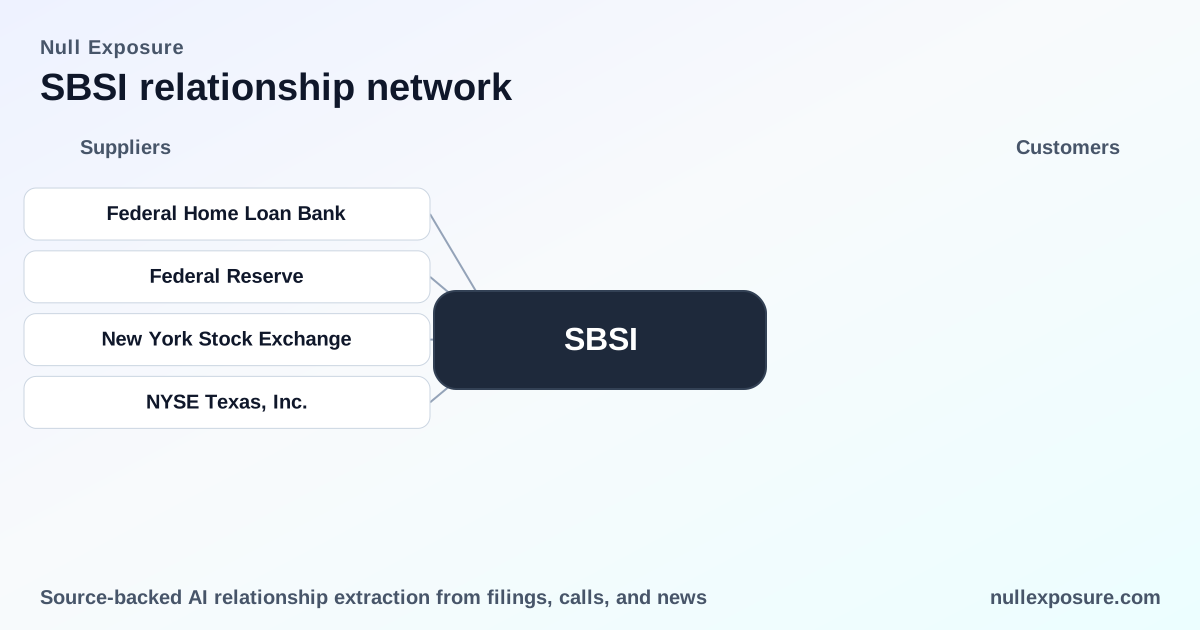
Southside Bancshares (SBSI): Supplier relationships that shape liquidity and market access
Southside Bancshares operates as the bank holding company for Southside Bank, generating revenue through traditional net interest income, fee and noninterest income (including merchant services), and securities activities. The company monetizes by originating and servicing loans, collecting deposit margins, and extracting ancillary fees from payments and merchant processing; its balance-sheet posture is supported by contingent liquidity lines from system counterparties and by public market listings that underpin share liquidity. For investors assessing counterparty exposure, the supplier map is compact and concentrated around liquidity providers and exchange venues—each relationship carries operational and market-access implications that feed directly into funding resilience and investor liquidity. Explore deeper coverage and signal analytics at https://nullexposure.com/.
Quick snapshot that matters to counterparties and investors
Southside reports $234M in trailing revenue, a market capitalization near $909M, and profit margins near 29.6%, reflecting a small regional bank with strong operating leverage and conservative capital dynamics. The company discloses contingent liquidity of $2.78 billion as of December 31, 2025, which is explicitly composed of bank-system funding lines and exchange access that constrain and enable growth (company press materials, FY2026). These supplier relationships underpin both day-to-day funding and the stock’s tradability for institutional holders.
How the company contracts and where risk concentrates
Southside’s disclosures show a contracting posture oriented toward established banking counterparties rather than bespoke vendors. Two company-level signals stand out: the firm uses external service providers for merchant processing and security assessment, indicating operational dependency on third-party payments and controls vendors; and its financial statements reveal large investing and purchasing flows consistent with a spend footprint above typical mid-tier thresholds. Both signals imply a need for robust vendor governance and contingency planning across treasury and payments functions. Learn more about supplier signals at https://nullexposure.com/.
- Contracting posture: Relationship with system liquidity providers (FHLB, Federal Reserve) follows standard secured and collateralized frameworks typical of regional banks.
- Concentration: Supplier set is narrowly concentrated around liquidity counterparties and exchange venues—high criticality, limited number of counterparties.
- Criticality: Funding lines and exchange listings are mission-critical: disruptions would immediately affect funding costs, loan growth, and stock liquidity.
- Maturity: These are mature, institutional relationships (central bank facilities, FHLB advances, national exchanges), not ad-hoc vendor contracts.
The supplier map — each relationship, plain-English, with sources
Federal Home Loan Bank — primary secured liquidity partner
Southside identifies FHLB advances as a key component of its $2.78 billion contingent liquidity, indicating regular access to secured, collateralized borrowings to manage balance-sheet swings and liquidity stress. (Company fourth-quarter and FY2025 results press release, Jan 29, 2026 — GlobeNewswire: https://www.globenewswire.com/news-release/2026/01/29/3228323/8642/en/Southside-Bancshares-Inc-Announces-Financial-Results-for-the-Fourth-Quarter-and-Year-Ended-December-31-2025.html)
Federal Reserve — discount window as backstop liquidity
The firm counts the Federal Reserve Discount Window among its contingent liquidity sources, which provides an institutional backstop for short-term funding and supports confidence in the bank’s liquidity management framework. (Company fourth-quarter and FY2025 results press release, Jan 29, 2026 — GlobeNewswire: https://www.globenewswire.com/news-release/2026/01/29/3228323/8642/en/Southside-Bancshares-Inc-Announces-Financial-Results-for-the-Fourth-Quarter-and-Year-Ended-December-31-2025.html)
New York Stock Exchange — primary listing and market access
Southside confirmed that it will maintain a primary listing on the New York Stock Exchange under the ticker SBSI, a structural element that preserves deep market access for institutional holders and underpins share liquidity and governance standards. (Company dual-listing announcement, Nov 24, 2025 — GlobeNewswire: https://www.globenewswire.com/news-release/2025/11/24/3193750/0/en/Southside-Bancshares-Inc-Announces-Dual-Listing-on-NYSE-Texas.html)
NYSE Texas, Inc. — secondary electronic listing in Texas
The company added a dual listing on NYSE Texas, Inc., providing a fully electronic regional trading venue and additional execution venues for regional investors while leaving the NYSE as the primary exchange. (Company dual-listing announcement, Nov 24, 2025 — GlobeNewswire: https://www.globenewswire.com/news-release/2025/11/24/3193750/0/en/Southside-Bancshares-Inc-Announces-Dual-Listing-on-NYSE-Texas.html)
What these relationships imply for investors
- Funding resilience is structural. The explicit inclusion of FHLB advances and the Fed discount window in disclosed contingent liquidity confirms that Southside maintains formalized, collateralized funding access sufficient to absorb short-term pressures. That profile reduces tail liquidity risk relative to banks lacking such arrangements.
- Market liquidity is codified. A primary NYSE listing with a secondary NYSE Texas venue improves tradability for institutional flows and reduces single-venue execution risk, supporting valuation stability for shareholders.
- Operational dependency on service providers requires governance. Company disclosures identify merchant-services revenue and the use of external vendors for security controls and testing; that creates an operational dependency that must be monitored through vendor risk programs rather than considered purely financial counterparties.
Constraints and company-level signals to watch
Southside’s reporting surfaces two company-level constraints that shape supplier risk and procurement behavior:
- Service-provider reliance: The firm’s noninterest income includes merchant services processed by third-party vendors, and management explicitly references the use of external service providers for security testing and controls—this is a structural operational dependency that increases the value of vendor oversight.
- Large invest/purchase flows: Investing activities show material securities purchases in the financials, consistent with a spend band above mid-tier thresholds and indicating sizeable counterparty exposure in securities settlement and custody operations.
Both signals indicate high criticality suppliers and justify active monitoring by investors and boards focused on operational resilience.
Investment takeaways and next steps
Southside’s supplier relationships are concentrated, measurable, and standard for a regional bank: secured liquidity from FHLB and the Fed, plus dual exchange listings that protect market access. The most actionable investor questions are operational: how robust is vendor governance for merchant processing, and how does treasury execution manage counterparty concentration in securities purchases?
If you want a focused supplier-risk briefing or continuous signal monitoring on SBSI, visit https://nullexposure.com/ for tailored reports and alerts. For ongoing coverage of supplier exposures across regional banks, register for updates at https://nullexposure.com/.