SBXD (SilverBox Corp IV): Supplier relationships and what they mean for investors
SilverBox Corp IV is a SPAC (special purpose acquisition company) that monetizes by completing a business combination and collecting sponsor and advisory fees around IPO and deal closing activity. Its balance sheet shows cash held in trust and contractually defined service arrangements for sponsor support, financial advisory, transfer agency and legal counsel; the company’s supplier posture is therefore service-heavy, short-term, and concentrated around a small set of professional advisers and custodial counterparties. For a fast read on counterparties and exposure mapping, visit the Null Exposure homepage: https://nullexposure.com/.
A compact map of SBXD’s supplier relationships (what the public record identifies)
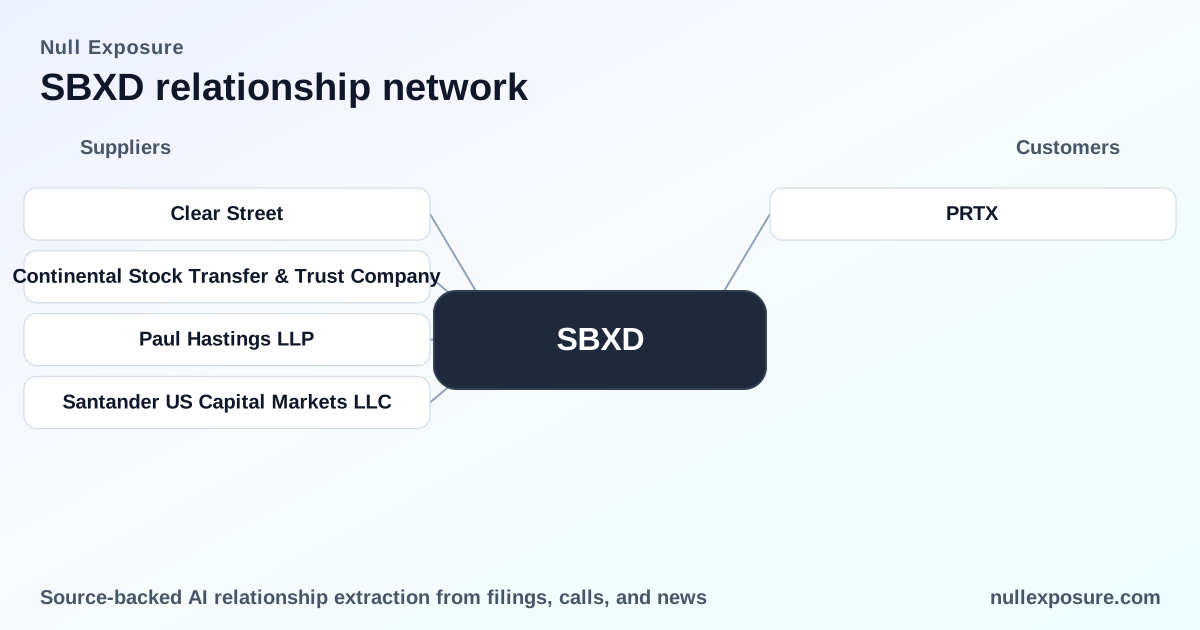
The record captured in news coverage and filings identifies four named suppliers involved in SBXD’s SPAC lifecycle: Clear Street, Continental Stock Transfer & Trust Company, Paul Hastings LLP, and Santander US Capital Markets LLC. Each plays a discrete role that is common to SPACs — placement/advisory, trustee/transfer-agent, legal counsel, and capital markets advising respectively — and their combined profile shapes how the company runs and how counterparty risk accumulates.
Clear Street
Clear Street is serving as SilverBox’s financial advisor and placement agent in connection with its transaction activity. MarketScreener’s coverage of Parataxis Holdings’ non‑binding LOI to acquire SilverBox (reported March 10, 2026) lists Clear Street in the advisory and placement role. (MarketScreener, March 10, 2026)
Continental Stock Transfer & Trust Company
Continental acted as transfer agent and is the trustee holding the SPAC trust account that contains the proceeds from the IPO and related offerings; filings disclose roughly $201 million placed in that trust account. That custody role makes Continental a systemically critical counterparty for investor protections and redemption mechanics. (MarketScreener coverage; company filings FY2025)
Paul Hastings LLP
Paul Hastings LLP is listed as SilverBox’s legal advisor with a named individual (Lucas M. Rachuba) serving on the matter, a conventional arrangement for SPAC deal work and transaction documentation. MarketScreener’s March 2026 report records Paul Hastings’ legal advisory role. (MarketScreener, March 10, 2026)
Santander US Capital Markets LLC
Santander is serving as lead capital markets advisor on the transaction, a role that supports deal execution and capital markets strategy during the combination process. This placement is described in the same March 2026 news coverage. (MarketScreener, March 10, 2026)
How SBXD’s supplier contracts and cash posture change the risk profile
Company filings and public disclosures paint a consistent operating model: short-term service contracts, high intermediation, and concentrated custody of cash. That has four practical consequences for investors and operators.
-
Contracting posture: SBXD operates with short-term and subscription-style arrangements. The filings disclose monthly sponsor payments ($15,000 per month for administrative and shared personnel support) and transaction-linked advisory fees (for example, a two-component fee structure for SilverBox Securities tied to IPO close and business combination close). These are contractually finite and tied to SPAC lifecycle milestones (company filings, FY2025).
-
Concentration and criticality: A material cash pool (approximately $201 million) sits in a trust account administered by Continental Stock Transfer & Trust Company, which is explicitly named in filings as the trustee. That makes Continental a single point of custody risk: custody failures or operational issues there would directly affect redemption flows and trust accounting (company filings, FY2025).
-
Counterparty mix and counterparty size: The filing language shows trust funds are invested in very short‑term U.S. government obligations and held at a U.S.‑chartered bank with consolidated assets north of $100 billion. Liquidity is conservatively managed on paper, but the operational chain still routes through large custodians and capital markets advisers that are central to execution (company filings, FY2025).
-
Spend maturity and bands: Spend signals are mixed — very large custodied assets at the top end (~$201M trust) coexist with moderate service fees: sponsor support is in the $100k range if extended to full SPAC life ($360k cap in some scenarios), and advisor fees include a $170k payment at IPO plus a $2.03M contingent payment at business combination close. Those numbers create a profile of high asset concentration and modest ongoing vendor spend (company filings, FY2025).
If you want a structured supplier risk brief for portfolio due diligence, Null Exposure offers tailored mapping and scoring: https://nullexposure.com/.
Relationship maturity and operational implications
The supplier roster is typical and mission-critical for a SPAC in active deal mode: financial advisors (Clear Street, Santander), legal counsel (Paul Hastings), and transfer/trust services (Continental). These relationships are active, short-dated, and highly transactional, which drives two investor-relevant observations:
-
Operational dependency is acute but temporally bounded. The service providers are crucial while the SPAC pursues a business combination, but their contracts generally terminate on deal close or liquidation.
-
Counterparty credit and operational resilience matter more than long-term vendor lock. Because custody and advisor failures impair deal execution and investor redemptions, investors must evaluate the counterparties’ operational controls and financial strength rather than long-term contractual economics alone.
Practical takeaways for investors and operators
-
Custody concentration is the principal single-vendor risk: Continental’s trustee role is explicitly documented; that custody relationship underpins the SPAC’s investor protections and redemption mechanism. Review trustee confirmations and reconciliation practices in due diligence.
-
Short-term contracts reduce strategic vendor risk but increase execution risk: Vendors can be replaced, but the window during deal execution is narrow; ensure contingency advisers and back-up trustee provisions are understood.
-
Cash safety is structured conservatively, but operational links remain: Investments restricted to short‑term treasuries and deposits at a very large bank are risk-minimizing on paper, but administrative and execution dependencies remain with the named service providers.
If you’re evaluating counterparties or building an operational playbook for SPAC counterparties, start a supplier risk assessment at Null Exposure: https://nullexposure.com/.
Recommended next steps for an investor due-diligence plan
- Obtain trustee confirmations and recent audit statements for the trust account; validate investment policies for the trust.
- Request contracts or terms of engagement for Clear Street, Santander, and Paul Hastings to confirm termination and replacement mechanics.
- Verify vendor insurance, cyber controls, and operational resiliency given the SPAC’s outsourced model for critical services.
Conclusion — succinct investor verdict
SilverBox Corp IV operates a classic SPAC supplier footprint: conservative cash placement and short-term, high-importance service arrangements. The single largest operational exposure is the custodian/trust relationship with Continental Stock Transfer & Trust Company, and the remainder of the supplier mix represents standard transaction execution risk. Investors should focus diligence on custody mechanics, advisory contract triggers, and contingency plans around execution windows.
For a concise supplier-risk brief or to commission a tailored exposure map for SPAC counterparties, visit the Null Exposure homepage: https://nullexposure.com/.