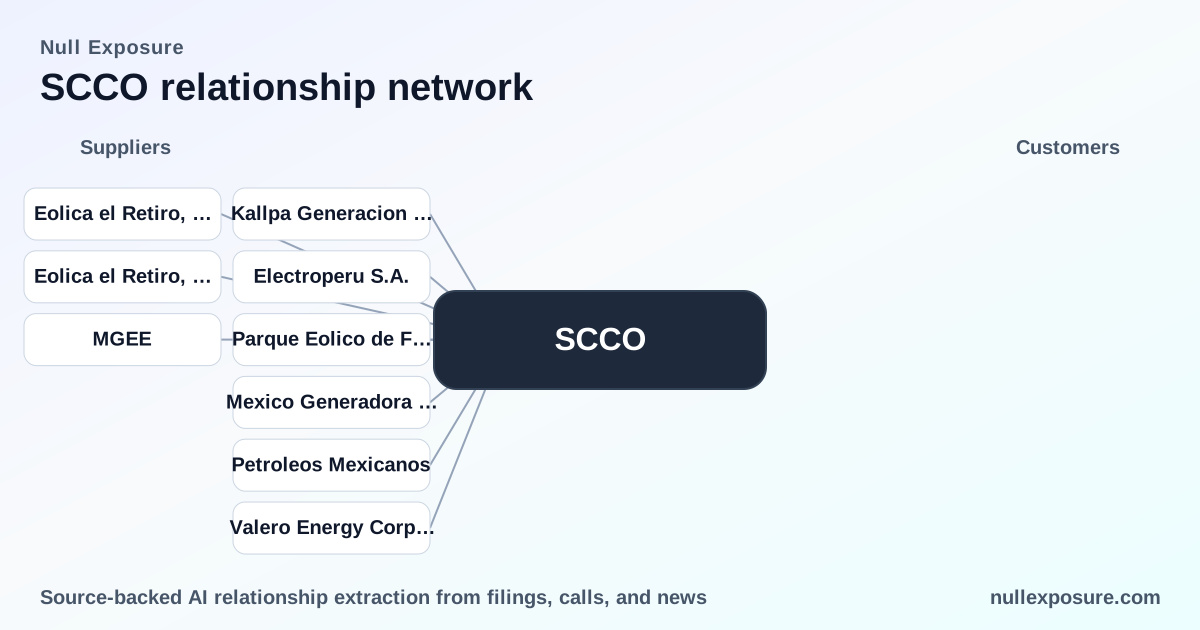
Southern Copper (SCCO) — how its supplier footprint underwrites production and risk
Southern Copper extracts, smelts and refines copper across Peru and Mexico and monetizes through long-life mine output sold into global metals markets and value-accretive refining. The company’s operating economics depend heavily on contracted energy and fuel supply for smelting and concentrator operations, plus capital investment that keeps mines and smelters running, which converts commodity production into durable free cash flow. For investors evaluating counterparty and operational risk, the supplier map below is the primary lens into cost stability and continuity of production. For a consolidated view of supplier exposure and contract profiles, visit https://nullexposure.com/.
How Southern Copper’s suppliers actually move the needle
Southern Copper is not a spot-buyer of critical inputs: power and fuel are secured under multi-year power purchase agreements and long-term fuel arrangements, while capital spend and exploration commitments drive sourcing needs across jurisdictions. Company disclosures describe large recurring commitments for energy and for capital investment, which positions suppliers as strategic partners rather than transactional vendors.
Key company-level signals:
- Long-term contracting posture is embedded in the business: SCCO discloses multi-year PPAs and decade-plus supply windows for energy.
- Supplier criticality is high: electricity and fuel are essential to smelting and milling and are listed among the most significant contractual obligations.
- Scale of spend is material to supplier negotiating leverage: SCCO disclosed over $1.0 billion of capital investments in 2024 and a $1.598 billion program approved for 2025, underlining that energy and fuel suppliers support a high-spend operator.
- Provider role: many counter‑parties are service providers rather than commodity traders, so operational performance from suppliers directly affects production cadence.
Below I list every supplier relationship disclosed in the company’s 2024 Form 10‑K and summarize the commercial facts investors need to know.
Supplier roster and what each relationship means for operations
Kallpa Generacion S.A.
Southern Copper holds two PPAs with Kallpa: a 120 MW agreement that supplied Peruvian operations beginning April 17, 2017 and running through April 30, 2027, plus an additional PPA for up to 80 MW that started May 1, 2017 and runs to October 31, 2029. These contracts provide a fixed bulk of generation capacity for Peruvian sites, locking in supply through multi‑year terms. According to Southern Copper’s 2024 Form 10‑K, Kallpa’s capacity is contracted specifically for Peruvian operations (FY2024 filing).
Electroperu S.A.
SCCO entered a 120 MW power purchase agreement with the state-owned Electroperu that started on April 17, 2017 and runs for twenty years, securing long-term grid-scale energy to Peruvian operations. The company’s 2024 Form 10‑K records Electroperu as a long-term energy counterparty supplying power to Peruvian operations (FY2024 filing).
Parque Eolico de Fenicias, S. de R.L. de C.V.
A 2020 PPA with Parque Eolico de Fenicias (an indirect Grupo Mexico subsidiary) commits 611,400 MWh per year for 20 years to certain Mexican operations, and SCCO began receiving energy from the Fenicias wind park in mid‑2024. This renewable supply represents both a volume and ESG signal and is cited in the company’s 2024 Form 10‑K as an active supplier to IMMSA and other Mexican units (FY2024 filing).
Mexico Generadora de Energia S. de R. L. (MGE)
SCCO purchases most of its electricity in Mexico from Mexico Generadora de Energia S. de R. L., a Grupo Mexico subsidiary that operates two plants designed to serve La Caridad and Buenavista units. The 2024 Form 10‑K explicitly calls out MGE as the primary electricity source for those Mexican operations (FY2024 filing).
Petroleos Mexicanos (PEMEX)
Since 2018, SCCO has purchased fuel in Mexico from state producer Petroleos Mexicanos as well as from private suppliers, making PEMEX a routine fuel counterparty for mobile and thermal needs at Mexican sites. The 2024 Form 10‑K confirms fuel purchases from PEMEX beginning in 2018 (FY2024 filing).
Valero Energy Corporation (Valero Peru)
In Peru, the company obtains fuel primarily from Valero Peru, a local subsidiary of Valero Energy Corporation, to supply fuel needs for Peruvian operations and logistics. Southern Copper’s 2024 Form 10‑K identifies Valero Peru as a principal fuel supplier in Peru (FY2024 filing).
Eolica el Retiro, S.A.P.I de C.V.
SCCO has a PPA with Eolica el Retiro, a windfarm energy producer that is an indirect Grupo Mexico subsidiary; the 2013 agreement supplies power to some Mexican operations. The 2024 Form 10‑K references this arrangement as part of the company’s Mexican renewable supply mix (FY2024 filing).
Eolica el Retiro, S.A.P.I. de C.V. (duplicate entry in filing)
The company’s filing repeats the Eolica el Retiro reference, reiterating that the windfarm PPA dates from 2013 and supplies power to Mexican operations; the duplicate mention in the 2024 Form 10‑K reinforces the ongoing contractual linkage (FY2024 filing).
MGE (ticker inferred: MGEE)
Separately referenced as “MGE” in the filing—with an inferred symbol of MGEE—SCCO signed an agreement in 2012 with this Grupo Mexico affiliate to supply power to Mexican operations through 2032, underlining long-dated energy commitments in Mexico. The 2014–2012 PPA timelines are detailed in the 2024 Form 10‑K (FY2024 filing).
(Each of the above summaries is drawn from Southern Copper Corporation’s 2024 Form 10‑K disclosure.)
Mid‑article note — if you want integrated supplier risk analytics and contract timelines, you can start from our homepage: https://nullexposure.com/.
Investment implications: concentration, contract maturity and counterparty mix
Southern Copper’s supplier picture has three investment-grade implications:
- Counterparty concentration with Grupo Mexico affiliates is material. Multiple Mexican power contracts tie SCCO’s electricity supply to Grupo Mexico subsidiaries (MGE, Parque Eolico de Fenicias, Eolica el Retiro), creating correlated operational risk across Mexican operations if a supplier experiences performance issues.
- Long-term PPAs lock-in supply and price exposure. Electroperu’s 20‑year PPA and several multi‑decade Mexican agreements reduce spot-energy volatility but create counterparty duration risk around contract renewal and credit. The Electroperu agreement is an explicit 20‑year contract starting April 17, 2017 (company 10‑K).
- Renewables penetration is increasing but remains integrated with legacy suppliers. The Fenicias wind PPA supplies large annual MWh volumes since SCCO began receiving energy in 2024; this is a structural change in fuel mix and an operational credit variable for Grupo Mexico as operator (company 10‑K).
Company disclosures also identify supplier commitments as part of the company’s most significant contractual obligations and show that capital investment is substantial — $1,027.3 million invested in 2024 and a $1.598 billion program approved for 2025 — underscoring why energy and fuel suppliers fall into high spend bands and strategic sourcing considerations (company 10‑K evidence).
What investors should monitor next
- Track contract expiries and renewal provisions for Kallpa (2027/2029 tranches), MGE (through 2032), and Electroperu (20‑year window). Those dates determine re‑pricing risk and replacement cost.
- Watch operational performance and delivery from Grupo Mexico affiliates because multiple Mexican PPAs concentrate supplier risk.
- Follow capital program execution (the company disclosed large 2024/2025 capex) since any acceleration or delay changes future energy and fuel demand.
For a deeper, searchable look at supplier contracts and a timeline of expiries, start with our supplier analytics hub: https://nullexposure.com/.
Bottom line for investors
Southern Copper’s production economics are tightly coupled to a small set of large, long-dated energy and fuel agreements. That structure reduces short-term volatility in input costs but concentrates counterparty and renewal risk—especially in Mexico where Grupo Mexico affiliates are dominant suppliers. Investors should value SCCO with the dual lens of commodity exposure and contractual certainty: secured energy underpins production but introduces long‑tenor counterparties whose credit and operational health matter materially to free cash flow.
To explore supplier-level disclosures, contract durations, and counterparty concentration more visually, visit https://nullexposure.com/.