Southern California Edison 5.45% Trust Preference Securities (SCE-P-K): What investors and counterparties need to know
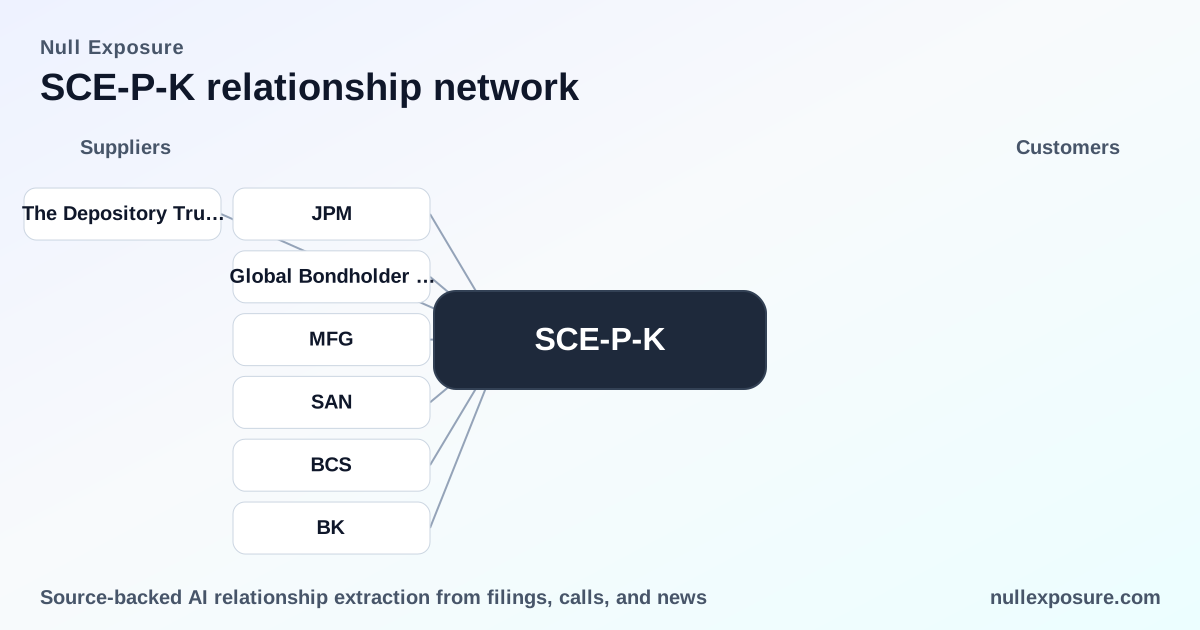
Southern California Edison’s 5.45% Fixed-to-Floating Rate Trust Preference Securities (SCE‑P‑K) are a structured preferred instrument issued by SCE Trust V and supported by Edison International’s corporate framework. The security monetizes for holders as a predictable coupon until conversion to a floating rate, while the issuer executes periodic liability management — most recently a cash tender and a full redemption — to reshape its capital stack and interest-rate profile. For investors and operational counterparties, the credit is best evaluated through the lens of capital structure priority, redemption optionality, and the set of dealer, trustee and agent relationships that execute liquidity events. Interested in the primary filings and market signals? Visit https://nullexposure.com/ for the full supplier intelligence feed.
How the security operates in plain terms
SCE‑P‑K is a trust-issued preferred security: investors receive a fixed coupon that converts to floating under the trust indenture, and the issuing company (through the trust) retains the right to pursue tender offers and redemptions as part of balance-sheet management. The economics for holders are driven by coupon carry until the floating reset and by the issuer’s propensity to call or tender the securities when refinancing conditions are favorable. Tender agent and trustee mechanics determine execution quality and settlement timelines when the company chooses to retire these securities.
Deal execution: recent liability management events that matter
In late 2025 SCE executed a tender offer to purchase outstanding trust preference securities, followed by a formal redemption in early 2026. These actions shift cash flow and optionality for holders and concentrate operational execution risk in a small set of counterparties that handled dealer management, tender processing and trustee functions. Active liability management reduces interest-rate exposure for the issuer and creates one-off liquidity events for holders — the terms and operational readiness of dealers, tender agents and the trustee determine whether those events are orderly. If you track counterparty capacity or settlement risk, these are the names to watch.
For a deeper supplier view and to monitor counterparties on similar capital actions, go to https://nullexposure.com/.
Supplier relationships and what each party did
J.P. Morgan Securities LLC
J.P. Morgan served as one of the dealer managers for SCE’s December 20, 2025 cash tender offer to purchase outstanding 5.45% trust preference securities, providing primary distribution and execution support for the Offer. A BizWire press release distributed via markets.financialcontent.com (Dec. 20, 2025) lists J.P. Morgan among the dealer managers for the transaction.
Barclays Capital Inc.
Barclays Capital acted as a dealer manager on the same December 20, 2025 tender offer, sharing underwriting and market-making responsibilities to facilitate the purchase of outstanding trust securities. The role is documented in the BizWire transaction notice posted on markets.financialcontent.com (Dec. 20, 2025).
Mizuho Securities USA LLC
Mizuho Securities USA was named as a dealer manager for the December 2025 tender offer, participating in the syndicate that managed the offer and market execution. The participation is described in the BizWire announcement available on markets.financialcontent.com (Dec. 20, 2025).
Santander US Capital Markets LLC
Santander US Capital Markets joined the dealer-manager syndicate for the tender offer, providing distribution and advisory services for SCE’s liability management program announced on December 20, 2025. The transaction press release on markets.financialcontent.com lists Santander among the dealers.
Global Bondholder Services Corporation
Global Bondholder Services Corporation served as the tender agent and information agent for the tender offer, handling delivery confirmations and investor communications for holders who elected to tender their trust securities. The agent role and contact instructions are included in the BizWire press release distributed via markets.financialcontent.com (Dec. 20, 2025).
The Bank of New York Mellon Corporate Trust
The Bank of New York Mellon Corporate Trust acted as the trustee responsible for surrender and redemption mechanics when the Trust Preference Securities were redeemed; redemption instructions and the trustee address were published in SCE’s redemption notice. The trustee instructions appear in a February 10, 2026 press release on markets.financialcontent.com regarding the redemption of SCE Trust V securities.
The Depository Trust Company
Trust Preference Securities held through The Depository Trust Company (DTC) were to be redeemed according to DTC procedures, making DTC the central settlement vehicle for the redemption event described in the issuer’s February 10, 2026 notice. The redemption procedures for DTC-held securities are referenced in the Feb. 10, 2026 press release on markets.financialcontent.com.
What these relationships signal about operating posture and risk
-
Contracting posture and execution concentration: SCE deployed a small, top-tier dealer syndicate and a well-known tender agent/trustee for its liability management, which signals a preference for established market counterparties and centralized execution. This reduces execution execution risk relative to a dispersed or ad-hoc syndicate.
-
Counterparty criticality: The tender agent and trustee are operationally critical during a tender or redemption; any failure in tender processing, transfer or trustee settlement would directly impact holder payout timing and reconciliation.
-
Maturity and formality: Use of major dealers, Global Bondholder Services and BNY Mellon indicates a mature, standardized process for security retirement — predictable for institutional holders but still subject to settlement windows and DTC procedures.
-
Concentration risk: The same small group of counterparties handled distribution, information and settlement; while efficient, this creates single-point dependency in liquidity events and elevates operational counterparty exposure during market stress.
These are company-level signals derived from the structure and execution of the tender and redemption — they describe how SCE conducts liability management rather than specifics about any one contractual provision.
Investment implications and what operators should prioritize
-
Yield vs. call risk: Fixed coupon carry is attractive only so long as SCE does not exercise call or tender options; recent activity shows the issuer is willing to actively manage these securities when market conditions allow. That makes duration and event risk a primary valuation input.
-
Settlement and counterparty resilience: For treasury and operations teams, prioritize counterparty testing and confirm BNY Mellon/Global Bondholder Services instructions in advance of any corporate action; these entities controlled the mechanics in the December 2025 tender and the February 2026 redemption (markets.financialcontent.com releases).
-
Liquidity planning: Holders should model both scheduled floating-rate conversion and issuer-initiated cash retirement scenarios; tender offers and redemptions materially change cash flows and can force reinvestment at different yields.
If you want continuous monitoring of these counterparties and future corporate actions, check our supplier intelligence hub at https://nullexposure.com/.
Bottom line
SCE‑P‑K is a structured preferred backed by an issuer that executes active liability management through a compact, high-quality counterparty network. The primary risk to investors is event-driven: tender and redemption activity can truncate expected cash flows and push reinvestment decisions; operationally, trustee and tender-agent performance is decisive during such events. For portfolio managers and operational teams, the path to de‑risk is clear: incorporate issuer optionality into valuation, confirm settlement chains ahead of actions, and monitor the dealer/trustee roster for changes.
Stay informed on future issuer actions and counterparty movements at https://nullexposure.com/.