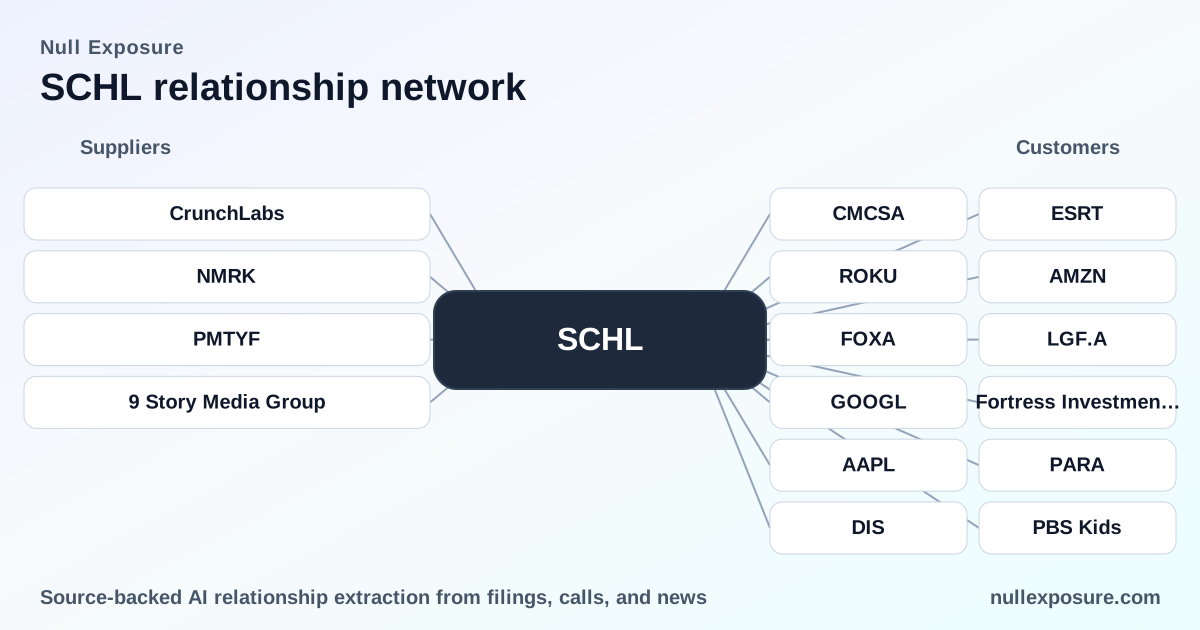
Scholastic (SCHL) — how supplier relationships shape cash flow and strategic optionality
Thesis: Scholastic monetizes a diversified content and education franchise by combining book publishing and distribution with licensing, entertainment tie‑ins, and targeted M&A to capture intellectual property upside. The company funds growth and working capital through a mix of operating cash flow, targeted acquisitions (notably content studios), and balance‑sheet moves such as sale‑leasebacks, while contracting multi‑year supplier and licensing arrangements to secure input costs and content pipelines. Investors should view Scholastic’s supplier network as a mixture of strategic licensors, manufacturing partners and capital advisers that both stabilize margins and concentrate operational risk.
Explore Scholastic supplier signals and relationship intelligence at https://nullexposure.com/
How Scholastic contracts and where risks concentrate
Scholastic’s operating model reflects a purposeful tradeoff between stability and concentration. Company filings and disclosures signal a preference for long‑dated, volume‑guaranteed agreements that lock in pricing and supply — an approach that reduces short‑term margin volatility but increases counterparty and contract performance risk. The firm also outsources critical processes and increasingly uses subscription software, which shifts execution risk to third parties and elevates dependency on external IT and services providers.
Key company-level signals:
- Long-term contracting posture: The company discloses multi‑year agreements and a U.S. credit facility with defined maturities, indicating a tendency toward extended contractual commitments and structured financing (evidence includes U.S. credit agreement terms and multi‑year guarantees).
- SaaS and subscription reliance: Scholastic is engaging third parties for SaaS, which streamlines operations but increases dependency on vendors for business‑critical IT.
- Manufacturer relationships: Paper and print inputs are purchased directly from mills and third parties, making raw‑material supply a critical operational dependency.
- Licensor role and royalty advances: Scholastic routinely incurs royalty advances to secure author and licensor commitments, reflecting the centrality of IP procurement to revenue generation.
- Active, material spend: Recent M&A and financing activity (e.g., a nine‑figure acquisition and sale‑leaseback) point to capital allocation at the $100M+ scale, so supplier and adviser choices have meaningful P&L and balance‑sheet effects.
These signals imply a company with mature supplier relationships that are strategically critical, concentrated in a few categories (content licensors, paper/manufacturing, and specialized service providers).
Who Scholastic is working with — relationship roll call and what it means
CrunchLabs — publishing partnership for global rights
Scholastic negotiated a publishing partnership with CrunchLabs and YouTuber Mark Rober to publish worldwide rights in all languages, reflecting Scholastic’s use of brand partnerships and licensors to extend reach into consumer franchises and educational entertainment. This was announced in Scholastic’s press release in March 2026 (FY2026). Source: Scholastic newsroom press release (March 2026) — http://www.scholastic.com/newsroom/all-news/press-release/crunchlabs-and-mark-rober-partner-with-scholastic-to-publish-boo...
Newmark — real estate adviser on a sale‑leaseback of HQ
Newmark advised Scholastic on a $386 million sale‑leaseback of its New York City headquarters, a transaction that materially adjusted the company’s real‑estate capital structure and liquidity profile. Multiple news reports covering FY2025–FY2026 referenced the $386M sale‑leaseback and Newmark’s advisory role (Finviz news, March 2026). Source: Finviz coverage of Newmark advisory (FY2025–FY2026) — https://finviz.com/news/267184/scholastic-appoints-jeffrey-mathews-as-president-of-scholastic-education-adding-to-current-role-as-chief-growth-officer
Playmates Toys — commercial tie‑in for franchise merchandising
Scholastic is coordinating a global tie‑in publishing program with Playmates Toys for a franchise launch slated for fall 2026, demonstrating the company’s strategy of synchronizing publishing and toy merchandising to amplify content monetization. This relationship was referenced during Scholastic’s Q2 2026 earnings call transcript and commentary (InsiderMonkey, FY2025/Q2 2026). Source: Q2 2026 earnings/transcript coverage (InsiderMonkey) — https://www.insidermonkey.com/blog/scholastic-corporation-nasdaqschl-q2-2026-earnings-call-transcript-1662791/
9 Story Media Group — strategic acquisition to scale content production
Scholastic acquired Canada’s 9 Story Media Group to expand its children’s media production capabilities and vertically integrate content creation with publishing and distribution; 9 Story’s CEO noted a decades‑long relationship with Scholastic. The acquisition was reported in March 2024 and referenced in the company’s FY2024 commentary. Source: Publishing Perspectives (March 2024) — https://publishingperspectives.com/2024/03/scholastic-is-acquiring-canadas-9-story-media-group/
What these relationships reveal about operating leverage and vulnerability
Taken together, Scholastic’s relationships form a strategic web that amplifies IP monetization but concentrates execution risk. Key implications for investors:
- Revenue mix leverage: Partnerships with CrunchLabs, Playmates, and 9 Story show Scholastic’s strategy to convert publishing IP into media and merchandising revenue, increasing lifetime value per title.
- Capital and liquidity management: The Newmark‑advised sale‑leaseback is a clear example of using real‑estate monetization to fund liquidity needs and M&A activity; such moves improve near‑term cash flow but create long‑term lease obligations.
- Operational dependency: Heavy reliance on external manufacturers, licensors, and SaaS providers means counterparty performance and supply‑chain disruptions are material to margins and fulfilment.
- Maturity and scale: Long‑term contracts and nine‑figure acquisitions indicate a mature supplier posture—Scholastic is optimizing for scale and predictability rather than short‑term flexibility.
Explore more supplier intelligence and contract risk analytics at https://nullexposure.com/
Investment takeaways and recommended actions
- Positive: Scholastic demonstrates a coherent content monetization strategy, pairing publishing with entertainment and merchandising partnerships to drive multi-channel revenue growth.
- Watch‑list risks: Monitor execution risk tied to paper supply, SaaS providers, and the performance of acquired production assets; also watch lease obligations arising from sale‑leasebacks for their impact on leverage ratios.
- Catalysts: Successful franchise launches (e.g., fall 2026 tie‑ins) and effective integration of 9 Story content production would materially de‑risk revenue concentration and lift margins.
For deal teams and investors assessing supplier exposure, run targeted diligence on counterparties in three buckets: licensors/content partners, manufacturing/paper suppliers, and IT/service vendors. For more detailed supplier mapping and contract‑level signals, visit https://nullexposure.com/
Bottom line: Scholastic’s supplier network is intentionally structured to maximize IP extraction and stabilize production, but it concentrates execution risk in a limited set of high‑impact relationships. Active monitoring of these counterparties, contract terms, and the company’s use of balance‑sheet tools will determine whether Scholastic’s strategy converts content scale into durable shareholder value.