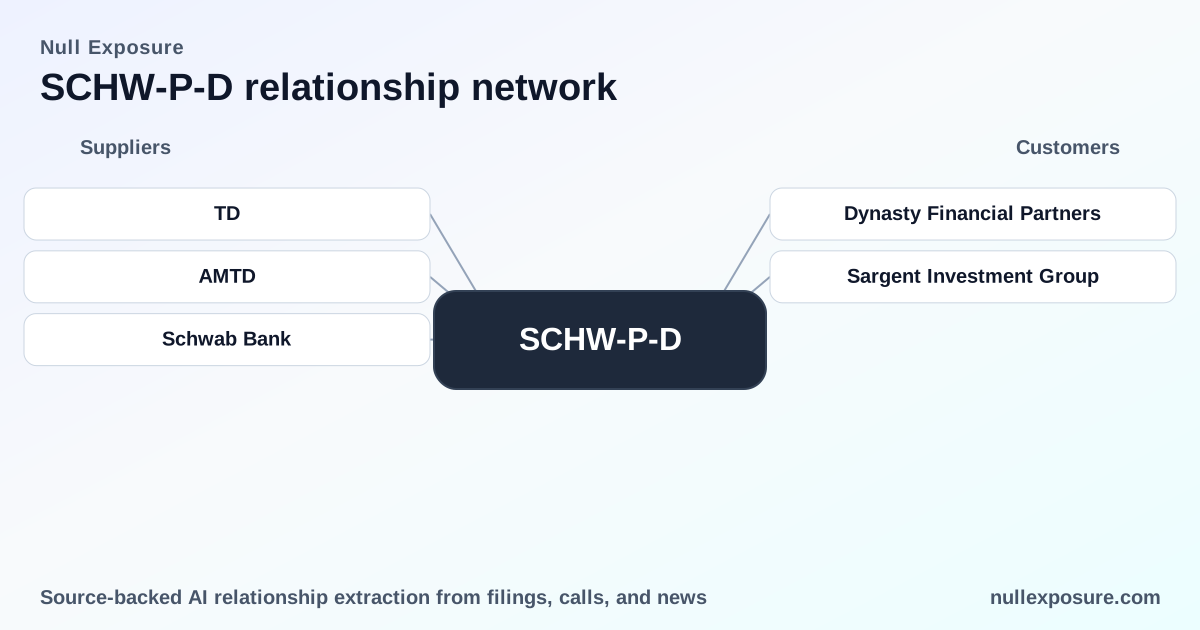
SCHW-P-D supplier relationships: what investors and operators need to know
The Charles Schwab Corporation operates a vertically integrated financial services platform that monetizes through brokerage commissions, asset management and advisory fees, banking interest spread, and custody services; the SCHW-P-D instrument represents a series of depositary preferred shares that trade on the NYSE and capture a slice of Schwab’s capital structure. For investors and operational partners, these supplier-level signals illuminate how Schwab’s strategic acquisitions and internal banking capabilities shape counterparty exposure, capital flows, and execution risk. If you want a consolidated view of supplier influences on financial instruments like SCHW-P-D, start here: https://nullexposure.com/
How Schwab’s commercial model translates into supplier importance
The Charles Schwab Corporation is a full-service financial platform that combines retail brokerage, wealth management, and bank products—a structure that drives multiple fee streams and creates cross-product dependencies. Schwab monetizes through:
- Transaction and advisory fees from brokerage and advising,
- Net interest margin and deposit products via Schwab Bank,
- Custody and service fees from institutional clients and advisors.
The preferred depositary shares (SCHW-P-D) trade in the public markets and are sensitive to Schwab’s capital allocation choices, M&A activity, and institutional ownership patterns; the instrument’s 52-week trading band (approximately $24.25–$25.63) reflects relatively narrow volatility for this series. Operators evaluating supplier relationships should prioritize counterparties that influence client flows, custody operations, and capital holders.
Key supplier relationships and what they mean for SCHW-P-D holders
Below are the supplier relationships identified in the collected coverage, each summarized in plain language with its source.
Toronto‑Dominion Bank (TD)
Toronto‑Dominion sold its remaining stake in Charles Schwab stock, executing a final sale at $79.25 per share on February 12, 2025, which represents institutional de‑risking of direct equity exposure to Schwab. According to a Finviz news roundup referencing that February 12, 2025 sale, TD completed its exit to concentrate on its core banking strategy (https://finviz.com/news/17608/charles-schwab-stock-trading-up-in-a-down-market).
TD Ameritrade
Schwab absorbed the TD Ameritrade retail brokerage business—including the ThinkorSwim trading platform—transferring those retail trading assets out of TD Bank so TD could refocus on commercial and retail banking. The same Finviz summary documents Schwab’s acquisition and integration of TD Ameritrade’s retail operations in FY2025, a transaction that reshaped distribution and platform cost structures (https://finviz.com/news/17608/charles-schwab-stock-trading-up-in-a-down-market).
Schwab Bank
Schwab Advisor Services leverages Schwab Bank to underwrite loans that facilitate succession financing for advisory firms, enabling junior partners to buy stakes from retiring senior partners and locking more advisory assets into Schwab’s custody and servicing ecosystem. InvestmentNews covered this initiative historically in 2012, describing how Schwab uses bank lending to cement advisor relationships and grow custody volumes (https://www.investmentnews.com/practice-management/schwab-dips-toes-into-succession-financing-waters/45324).
What these relationships signal for operators and investors
These three relationships together reveal how Schwab balances external capital rotation with internal platform expansion:
- Concentration and counterparty movement. Institutional exits such as TD’s sale are liquidity events that influence public equity holders and show that large bank counterparties rebalance away from equity exposure when strategic priorities shift.
- Acquisition-driven platform scale. The TD Ameritrade integration is a structural driver of client flow and trading volumes, increasing Schwab’s platform scale and operational workload while lowering distribution risk for the owner of SCHW‑P‑D.
- Internal banking as a strategic lever. Schwab Bank’s role in succession financing is a deliberate tool to lock advisory assets into Schwab’s custody and services, boosting long-term fee visibility and client stickiness.
These are company-level operating-model signals: contracting posture is centralized and scale-focused, vendor and counterparty concentration is diversified by internalizing key functions, criticality of Schwab Bank to the platform is high, and maturity of the business model is advanced—Schwab executes deliberate integration of banking and custody to deepen client relationships.
If you want a consolidated supplier risk feed tied into capital instruments like SCHW‑P‑D, explore further at https://nullexposure.com/
Risk implications tied to these relationships
- Market liquidity and ownership rotation: Large institutional sales can put pressure on Schwab’s equity and influence preferred share sentiment if perceived as signaling strategic re‑allocation by sophisticated holders. The TD sale is evidence of this dynamic.
- Integration and operational risk: Absorbing a retail brokerage operation at TD Ameritrade scale increases systems, compliance, and settlement complexity; sustained integration cost or execution issues would flow into market perception of Schwab’s capital resilience.
- Regulatory and credit dependencies: Using Schwab Bank to finance advisor succession increases credit exposure to small-business lending dynamics and ties forward fee recognition to bank performance.
These are the material considerations that affect both corporate counterparties and investors in capital instruments like SCHW‑P‑D. Active monitoring of bank-led financing programs, institutional ownership trends, and integration milestones is essential.
How to act on these signals
- For investors: track institutional ownership patterns and integration milestones tied to TD Ameritrade assets to gauge trading volume and margin trajectory; also monitor Schwab Bank lending metrics as a forward indicator of advisor retention.
- For operators and suppliers: prioritize resilience in custody, settlement, and banking interfaces, and plan for elevated transaction volumes during integration phases.
- For governance teams: ensure stress-testing scenarios include large institutional sales and bank-lending shocks given Schwab’s cross-product exposures.
Final takeaway: Schwab’s supplier landscape is shaped by strategic acquisitions and an internal banking layer that increases fee predictability while concentrating operational criticality. These dynamics are central to valuation and risk assessment for SCHW‑P‑D holders.
For a consolidated supplier-impact view across capital instruments, start your analysis at https://nullexposure.com/ and contact our team for tailored exposure reports.